Zhang Yuehuan, Qin Yanping, Ma Lai, Zhou Zihua, Xiao Shu, Ma Haitao, Pan Ying, Li Jun, Yu Ziniu
Key Laboratory of Tropical Marine Bio-resources and Ecology, South China Sea Institute of Oceanology, Chinese Academy of Sciences, Guangzhou, China.
Guangdong Provincial Key Laboratory of Applied Marine Biology, Guangzhou, China.
Front Physiol. 2019 May 15;10:524. doi: 10.3389/fphys.2019.00524. eCollection 2019.
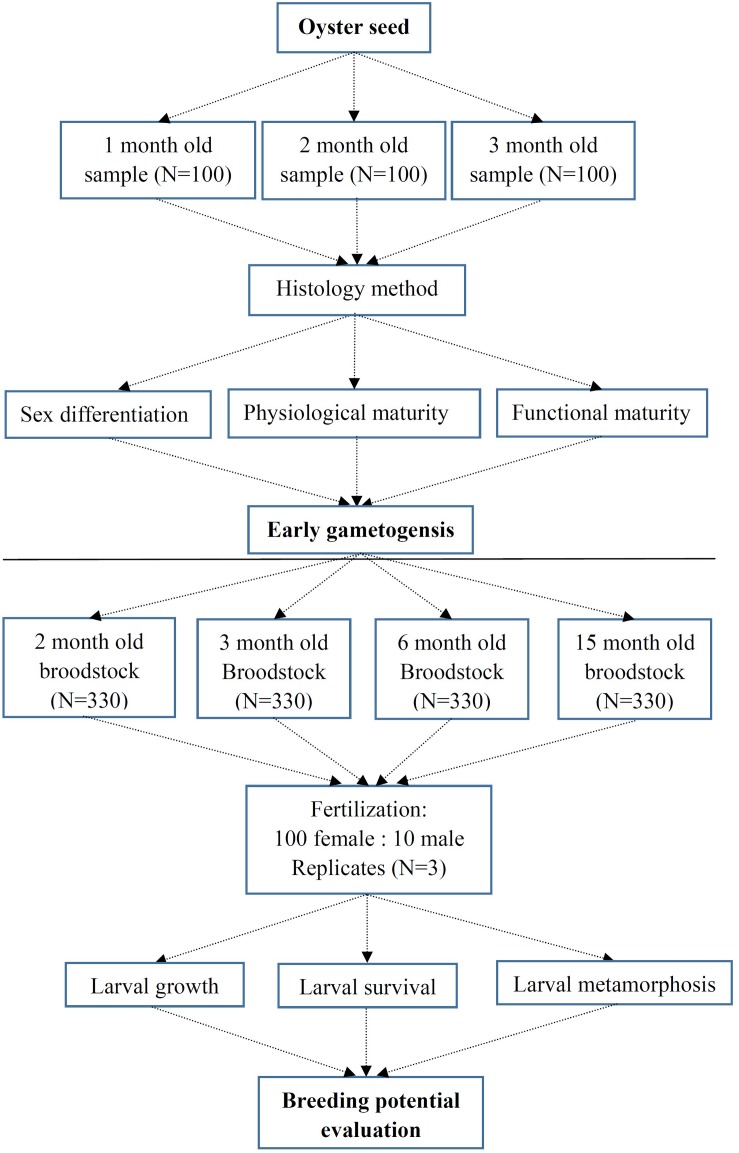
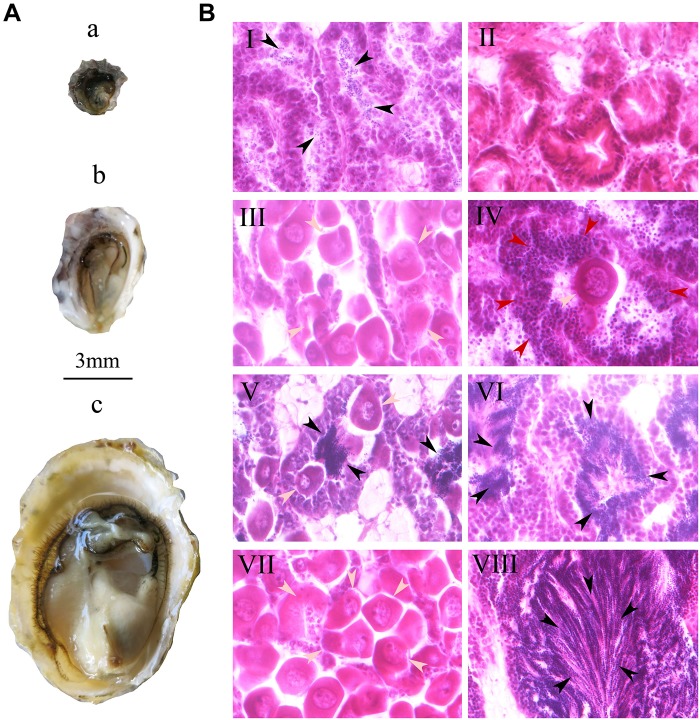
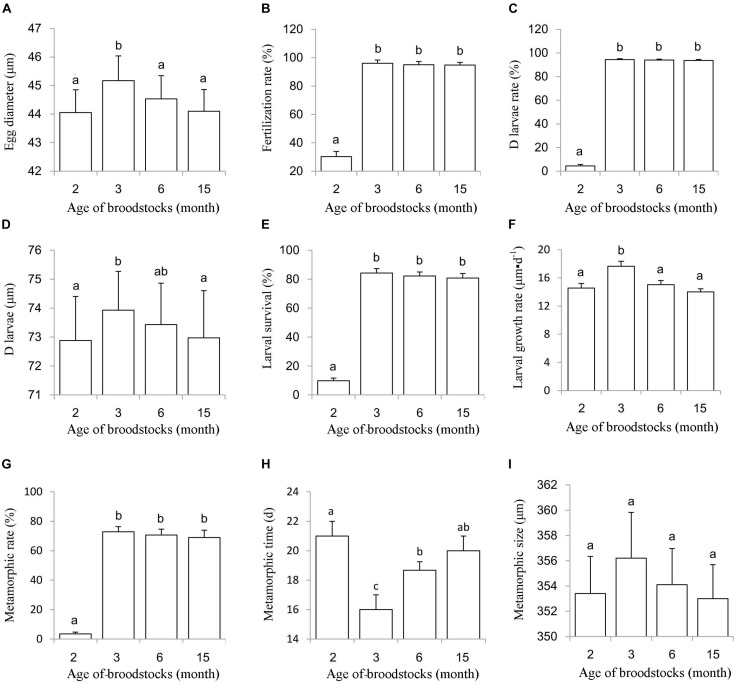
The Kumamoto oyster, , is native to Southeast Asia, including China, Japan and Korea, and is an important traditional wild fishery resource. Although this oyster's early gametogenesis was reported in Mexico, no related research was found on the breeding potential using early forming gametes. We re-examined the gametogenesis of during early life history in southern China and further divided it into three phases: sex differentiation (1 month old, shell height 2-3 mm), physiological maturity (2 months old, shell height 3-5 mm) and functional maturity (3 months old, shell height 9-12 mm). The breeding potential was evaluated using four sets of gametes from parent oysters of different ages (2, 3, 6, and 15 months old). The physiologically mature gametes were not suitable for artificial hatchery due to the low production of eggs, and yielding a high deformity rate of D larvae (95.47 ± 1.25%) and heavy larval morality (90.23 ± 1.84%) post-fertilization. However, progeny from functionally mature gametes grew significantly faster than those of other age groups, with no significant differences in fertilization, hatching level or survival of progeny among them. This study clearly demonstrates that the first batch of functionally mature gametes can develop normally and produce viable progeny, suggesting that artificial hatchery of is completely feasible using parent oysters from 3 months old and onward. Furthermore, this hatchery method can effectively shorten the breeding cycle and accelerate the breeding process.
熊本牡蛎原产于东南亚,包括中国、日本和韩国,是一种重要的传统野生渔业资源。尽管在墨西哥报道过这种牡蛎的早期配子发生情况,但未发现有关利用早期形成的配子进行繁殖潜力的相关研究。我们重新研究了中国南方熊本牡蛎早期生活史中的配子发生情况,并将其进一步分为三个阶段:性别分化(1月龄,壳高2 - 3毫米)、生理成熟(2月龄,壳高3 - 5毫米)和功能成熟(3月龄,壳高9 - 12毫米)。利用来自不同年龄(2、3、6和15月龄)亲贝的四组配子评估了繁殖潜力。生理成熟的配子由于产卵量低,不适合人工育苗,受精后D型幼虫畸形率高(95.47 ± 1.25%),幼虫死亡率高(90.23 ± 1.84%)。然而,功能成熟配子产生的后代生长速度明显快于其他年龄组,它们在受精、孵化水平或后代存活率方面没有显著差异。这项研究清楚地表明,第一批功能成熟的配子能够正常发育并产生有活力的后代,这表明使用3月龄及以上的亲贝进行熊本牡蛎的人工育苗是完全可行的。此外,这种育苗方法可以有效缩短繁殖周期,加快育种进程。