Hogarth Lee, Hardy Lorna, Bakou Alexandra, Mahlberg Justin, Weidemann Gabrielle, Cashel Sharon, Moustafa Ahmed A
School of Psychology, University of Exeter, Exeter, United Kingdom.
School of Social Sciences and Psychology, Western Sydney University, Sydney, NSW, Australia.
Front Psychiatry. 2019 May 15;10:274. doi: 10.3389/fpsyt.2019.00274. eCollection 2019.
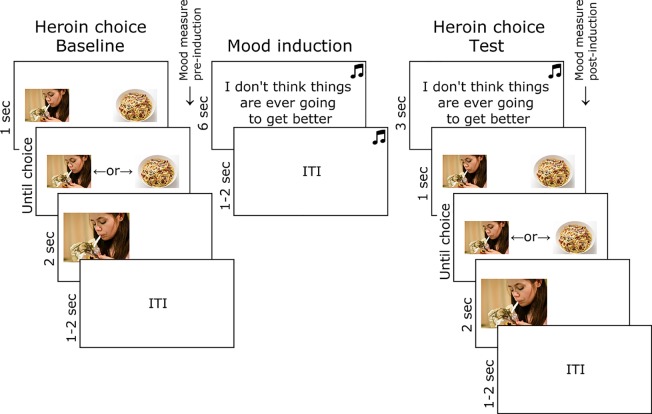
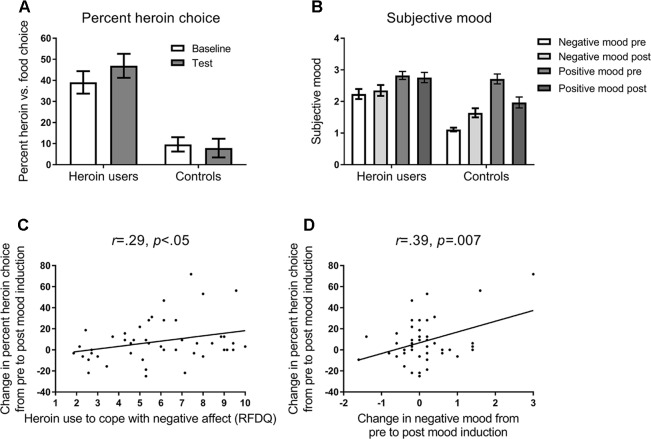
Acute growth in negative affect is thought to play a major role in triggering relapse in opiate-dependent individuals. Consistent with this view, three lab studies have demonstrated that negative mood induction increases opiate craving in opiate-dependent individuals. The current study sought to confirm these effects with a behavioral measure of heroin seeking, and test whether the effect is associated with self-reported opiate use to cope with negative affect and subjective reactivity to mood induction. Participants were heroin-dependent individuals engaged with treatment services (n = 47) and control participants (n = 25). Heroin users completed a questionnaire assessing reasons for using heroin: negative affect, social pressure, and cued craving. Baseline heroin choice was measured by preference to enlarge heroin versus food thumbnail pictures in two-alternative forced-choice trials. Negative mood was then induced by depressive statements and music before heroin choice was tested again. Subjective reactivity was indexed by negative and positive mood reported at the pre-induction to post-test timepoints. Heroin users chose heroin images more frequently than controls overall ( = .001) and showed a negative mood-induced increase in heroin choice compared to control participants (interaction < .05). Mood-induced heroin choice was associated with self-reported heroin use to cope with negative affect ( < .05), but not social pressure ( = .39) or cued craving ( = .52), and with subjective mood reactivity ( = .007). These data suggest that acute negative mood is a trigger for heroin seeking in heroin-dependent individuals, and this effect is pronounced in those who report using heroin to cope with negative affect, and those who show greater subjective reactivity to negative triggers. Interventions should seek to target negative coping motives to build resilience to affective triggers for relapse.
消极情绪的急性增长被认为在引发阿片类药物依赖个体的复吸中起主要作用。与此观点一致的是,三项实验室研究表明,消极情绪诱导会增加阿片类药物依赖个体对阿片类药物的渴望。本研究旨在通过一种寻求海洛因的行为测量方法来证实这些影响,并测试这种影响是否与自我报告的使用阿片类药物来应对消极情绪以及对情绪诱导的主观反应性有关。参与者为接受治疗服务的海洛因依赖个体(n = 47)和对照参与者(n = 25)。海洛因使用者完成了一份评估使用海洛因原因的问卷:消极情绪、社会压力和提示性渴望。在双选强制选择试验中,通过对放大的海洛因与食物缩略图的偏好来测量基线海洛因选择。然后在再次测试海洛因选择之前,通过抑郁陈述和音乐诱导消极情绪。主观反应性通过在诱导前到测试后时间点报告 的消极和积极情绪来衡量。总体而言,海洛因使用者比对照组更频繁地选择海洛因图像(p = .001),并且与对照参与者相比,消极情绪诱导使海洛因选择增加(交互作用p < .05)。情绪诱导的海洛因选择与自我报告的使用海洛因来应对消极情绪有关(p < .05),但与社会压力(p = .39)或提示性渴望(p = .52)无关,并且与主观情绪反应性有关(p = .007)。这些数据表明,急性消极情绪是海洛因依赖个体寻求海洛因的触发因素,并且这种影响在那些报告使用海洛因来应对消极情绪的个体以及对消极触发因素表现出更大主观反应性的个体中更为明显。干预措施应旨在针对消极的应对动机,以增强对复吸情感触发因素的恢复力。