Hartmann Raimo, Singh Praveen K, Pearce Philip, Mok Rachel, Song Boya, Díaz-Pascual Francisco, Dunkel Jörn, Drescher Knut
Max Planck Institute for Terrestrial Microbiology, 35043 Marburg, DE.
Department of Physics, Philipps-Universität Marburg, 35032 Marburg, DE.
Nat Phys. 2019 Apr 26;15(3):251-256. doi: 10.1038/s41567-018-0356-9. Epub 2018 Nov 26.
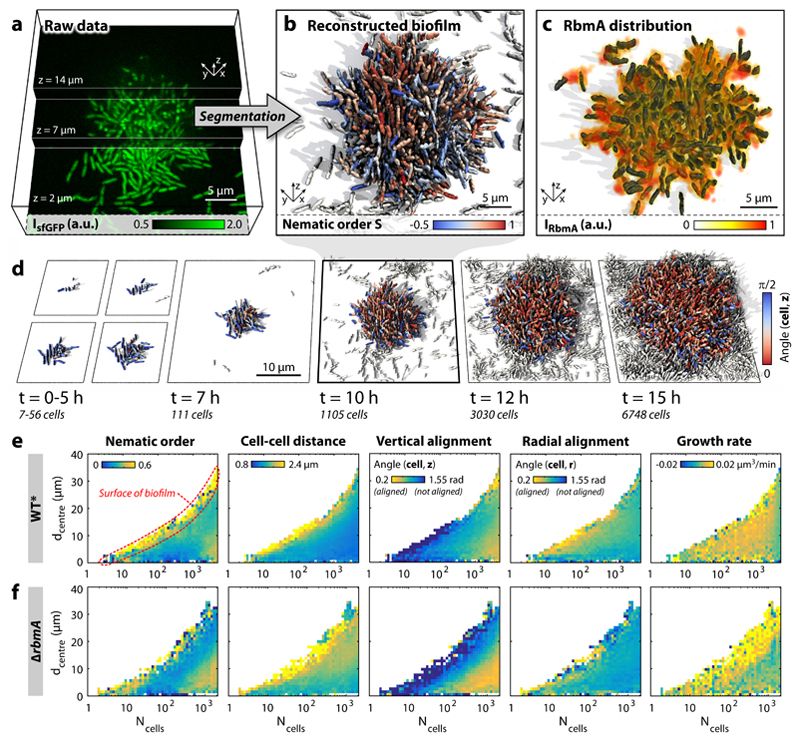
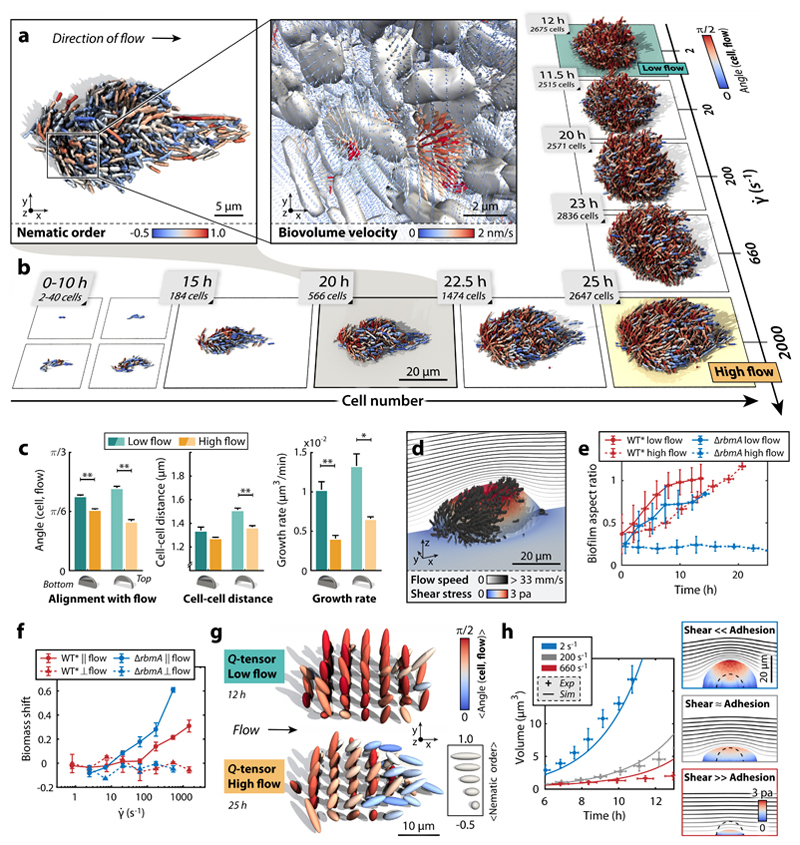
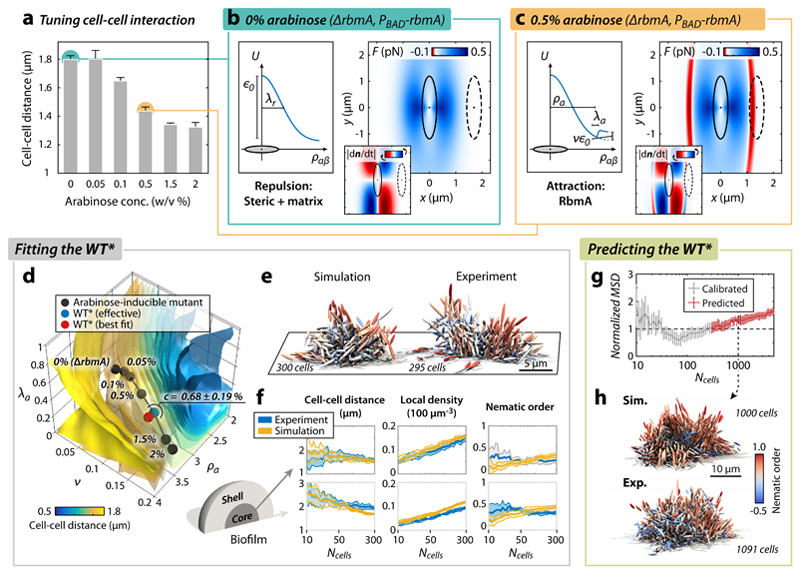
Surface-attached bacterial biofilms are self-replicating active liquid crystals and the dominant form of bacterial life on earth (1-4). In conventional liquid crystals and solid-state materials, the interaction potentials between the molecules that comprise the system determine the material properties. However, for growth-active biofilms it is unclear whether potential-based descriptions can account for the experimentally observed morphologies, and which potentials would be relevant. Here, we overcame previous limitations of single-cell imaging techniques (5,6) to reconstruct and track all individual cells inside growing three-dimensional (3D) biofilms with up to 10,000 individuals. Based on these data, we identify, constrain, and provide a microscopic basis for an effective cell-cell interaction potential, which captures and predicts the growth dynamics, emergent architecture, and local liquid crystalline order of biofilms. Furthermore, we show how external fluid flows control the microscopic structure and 3D morphology of biofilms. Our analysis implies that local cellular order and global biofilm architecture in these active bacterial communities can arise from mechanical cell-cell interactions, which cells can modulate by regulating the production of particular matrix components. These results establish an experimentally validated foundation for improved continuum theories of active matter and thereby contribute to solving the important problem of controlling biofilm growth.
附着在表面的细菌生物膜是自我复制的活性液晶,也是地球上细菌生命的主要形式(1 - 4)。在传统的液晶和固态材料中,构成系统的分子之间的相互作用势决定了材料的性质。然而,对于生长活跃的生物膜,基于势的描述是否能够解释实验观察到的形态,以及哪些势是相关的,目前尚不清楚。在这里,我们克服了单细胞成像技术以前的局限性(5,6),以重建和追踪生长中的三维(3D)生物膜内多达10000个的所有单个细胞。基于这些数据,我们识别、约束并为有效的细胞间相互作用势提供了微观基础,该势能够捕捉并预测生物膜的生长动力学、涌现结构和局部液晶秩序。此外,我们展示了外部流体流动如何控制生物膜的微观结构和三维形态。我们的分析表明,这些活跃细菌群落中的局部细胞秩序和整体生物膜结构可能源于细胞间的机械相互作用,细胞可以通过调节特定基质成分的产生来调节这种相互作用。这些结果为改进活性物质的连续介质理论建立了经过实验验证的基础,从而有助于解决控制生物膜生长这一重要问题。