Javier Sarah J, Belgrave Faye Z
Department of Psychology, Virginia Commonwealth University, Richmond, VA.
Asian Am J Psychol. 2019 Jun;10(2):141-153. doi: 10.1037/aap0000133. Epub 2018 Dec 27.
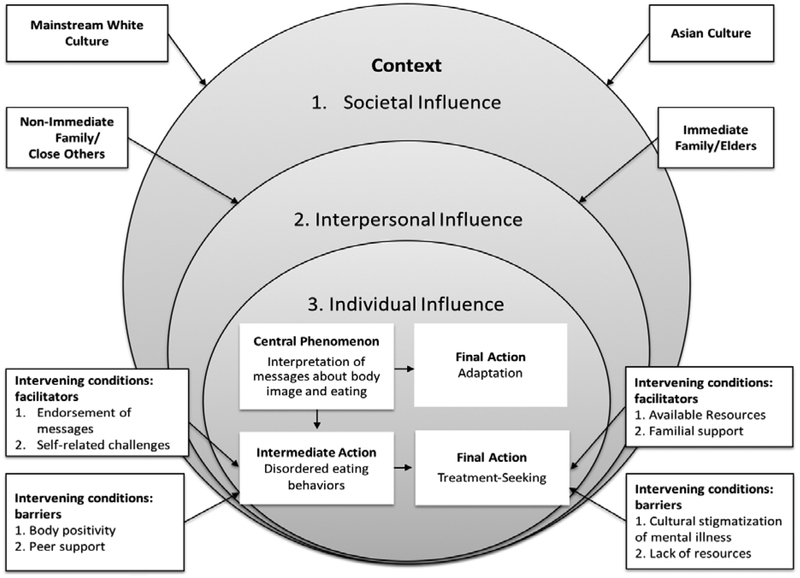
The purpose of the current study was to examine the relationships between body image, eating disorders, and treatment-seeking motivations among Asian American women in emerging adulthood (ages 18-24). Twenty-six Asian American women participated in qualitative focus groups of 4 to 6 individuals each from December 2015 to February 2016. Constructivist grounded theory was used to analyze focus group data. The resulting theoretical model, the "Asian American Body Image Evolutionary Model," maintains that a central phenomenon of perceptions and interpretation of messages about body image and eating, is rooted in three influencing factors: (1) Societal influence of mainstream White culture and Asian culture; (2) interpersonal influences of immediate family and close others; and (3) individual influence. An individual's perceptions and subsequent interpretation of messages may lead to disordered eating and decisions around treatment-seeking. The model developed can be utilized by practitioners or clinicians to help obtain a better understanding of the societal, interpersonal, and intrapersonal forces that may shape conceptualizations about body image and eating behaviors among Asian American women. In addition, findings from this study can be incorporated into prevention programs and interventions that focus on mental health among this population.
本研究的目的是探讨成年早期(18至24岁)亚裔美国女性的身体意象、饮食失调和寻求治疗动机之间的关系。2015年12月至2016年2月,26名亚裔美国女性参加了每组4至6人的定性焦点小组。采用建构主义扎根理论分析焦点小组数据。由此产生的理论模型“亚裔美国人体象演变模型”认为,对身体意象和饮食信息的认知与解读这一核心现象,源于三个影响因素:(1)主流白人文化和亚洲文化的社会影响;(2)直系亲属和亲密他人的人际影响;(3)个人影响。个人对信息的认知及随后的解读可能导致饮食失调以及寻求治疗的决定。所开发的模型可供从业者或临床医生使用,以帮助更好地理解可能塑造亚裔美国女性身体意象和饮食行为概念化的社会、人际和个人力量。此外,本研究的结果可纳入针对该人群心理健康的预防计划和干预措施中。