Department of Orthopedic Surgery, Samsung Medical Center, Sungkyunkwan University School of Medicine, Seoul, Korea.
Clin Orthop Surg. 2019 Jun;11(2):226-232. doi: 10.4055/cios.2019.11.2.226. Epub 2019 May 9.
Results of limb lengthening in patients with achondroplasia were previously reported in many studies. However, the reports of comparison among the three long bones (femur, tibia, and humerus) are rare, especially for the results of crossed lengthening (lengthening of one femur and contralateral tibia followed by that of the opposite side) for the lower limbs. The purpose of this study was to report the surgical results of a series of limb lengthening in achondroplastic or hypochondroplasia patients at our institution.
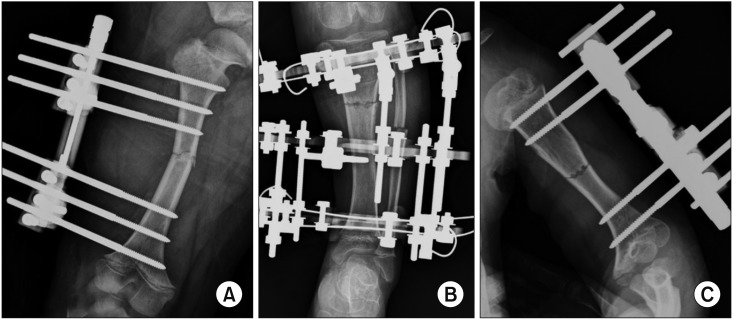
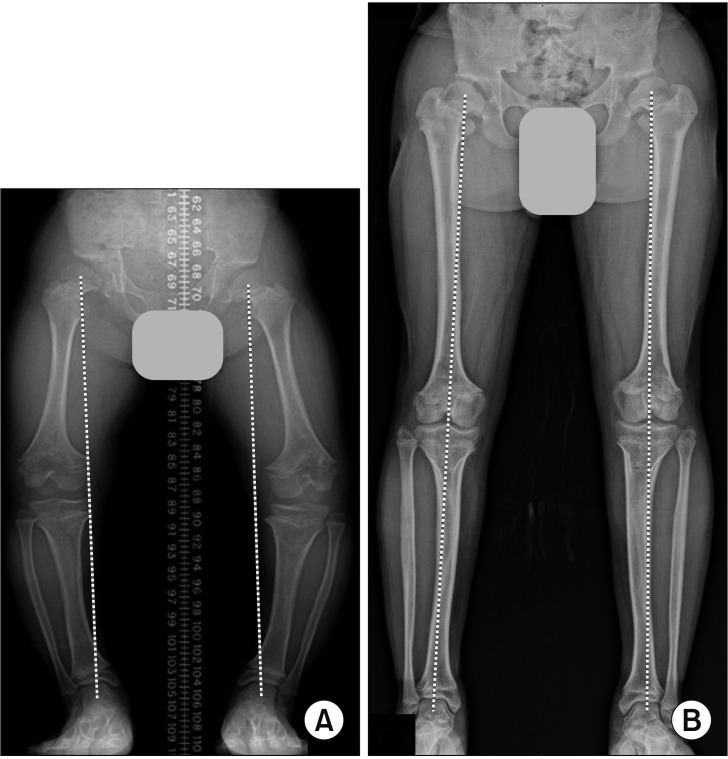
Fifteen patients (14 with achondroplasia and 1 with hypochondroplasia) underwent lower limb lengthening of the femur (n = 32) and tibia (n = 28), and 12 of them underwent crossed lengthening. Humeral lengthening was performed in 14 patients (n = 28). The mean age at the first operation was 11.7 years, and the mean follow-up duration was 66.7 months. The healing index, consolidation period index (duration of consolidation period/gained length), and other radiographic indices were analyzed. Limb length discrepancy and hip-knee-ankle alignment in lower limbs, and the occurrence of difficulties were assessed.
The average gain in length for the femur, tibia, and humerus was 8.3 cm, 8.5 cm, and 7.4 cm, respectively. The mean healing index was 29.6 days/cm for the femur, 29.0 days/cm for the tibia, and 27.2 days/cm for the humerus. The mean consolidation period index was 14.7 days/cm for the humerus, which was significantly lower than that in the lower limb (17.3 days/cm for the femur and 17.8 days/cm for the tibia). Of the 12 who underwent crossed lengthening, five showed limb length discrepancy ≥ 1.0 cm. Among their 24 lower limbs, three showed valgus alignment ≥ 5° and one showed varus alignment ≥ 5°. Thirty-two pin site infections and three fractures were conservatively managed. Three femoral fractures, eight equinus deformities, and four cases with premature consolidation of the fibula were surgically treated. Obstacle and true complication related to humeral lengthening were not observed.
Humeral lengthening was relatively effective and safe. Careful attention will be needed to avoid the occurrence of limb length discrepancy or malalignment in crossed lengthening.
肢端肥大症患者肢体延长的结果先前已在许多研究中报道。然而,关于三根长骨(股骨、胫骨和肱骨)的比较报告很少,尤其是对于下肢的交叉延长(一侧股骨和对侧胫骨的延长,然后是对侧的延长)结果。本研究旨在报告我们机构一系列肢端肥大症或软骨发育不全患者肢体延长手术的结果。
15 名患者(14 名肢端肥大症,1 名软骨发育不全)行股骨(n=32)和胫骨(n=28)下肢延长术,其中 12 名患者行交叉延长术。14 名患者行肱骨延长术(n=28)。第一次手术的平均年龄为 11.7 岁,平均随访时间为 66.7 个月。分析了愈合指数、骨痂形成期指数(骨痂形成期/获得长度)和其他影像学指数。评估下肢肢体长度差异和髋膝踝对线以及出现的困难。
股骨、胫骨和肱骨的平均延长长度分别为 8.3cm、8.5cm 和 7.4cm。股骨的平均愈合指数为 29.6 天/cm,胫骨为 29.0 天/cm,肱骨为 27.2 天/cm。肱骨的平均骨痂形成期指数为 14.7 天/cm,明显低于下肢(股骨为 17.3 天/cm,胫骨为 17.8 天/cm)。在 12 名接受交叉延长术的患者中,有 5 名患者的肢体长度差异≥1.0cm。在他们的 24 条下肢中,有 3 条出现外翻角度≥5°,1 条出现内翻角度≥5°。32 例针道感染和 3 例骨折经保守治疗。3 例股骨骨折、8 例马蹄足畸形和 4 例腓骨过早愈合行手术治疗。未观察到与肱骨延长相关的障碍和真正并发症。
肱骨延长相对有效且安全。在交叉延长术时需要谨慎注意避免出现肢体长度差异或对线不良。