San Diego State University School of Public Health, San Diego, California, United States of America.
Mildmay Uganda, Lweza, Kampala, Uganda.
PLoS One. 2019 Jun 3;14(6):e0216892. doi: 10.1371/journal.pone.0216892. eCollection 2019.
Fisherfolk are a most-at-risk population for HIV being prioritized for the scale up of HIV treatment in Uganda. Heavy alcohol use and potential drug use may be a major barrier to treatment adherence for men in this setting.
This study examines the prevalence of substance use, and its influence on antiretroviral treatment (ART) adherence, among male fisherfolk on ART in Wakiso District, Uganda.
This cross-sectional study included structured questionnaires (N = 300) with men attending HIV clinics near Lake Victoria. Using generalized logistic modeling analyses with a binomial distribution and logit link, we conducted multivariate models to test the association between each alcohol variable (quantity and frequency index, hazardous drinking) and missed pills, adjusting for covariates, and tested for interactions between number of pills prescribed and alcohol variables.
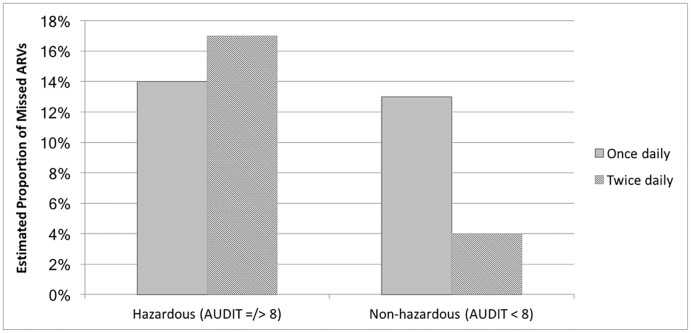
Thirty-one percent of men reported sub-optimal adherence. Half (46.7%) reported drinking, of which 64.8% met criteria for hazardous drinking. Illicit drug use was low (6%). In the multivariate model, men with greater scores on the alcohol frequency and quantity index were more likely to report missed pills compared to those reporting no drinking (AOR: 1.60, 95% CI: 1.29-1.97). Hazardous drinking had a greater effect on missed ARV doses among men taking twice daily regimens compared to once daily (AOR: 4.91, 95% CI: 1.68-14.37).
Our findings highlight the need for targeted alcohol-reduction interventions for male fisherfolk on ART who drink at high quantities to improve ART adherence and to prevent the known negative health effects of alcohol for HIV-infected individuals.
渔民是乌干达艾滋病毒治疗扩大优先考虑的高危人群。在这种情况下,大量饮酒和潜在的吸毒可能是男性治疗依从性的主要障碍。
本研究调查了乌干达瓦基索区接受抗逆转录病毒治疗(ART)的男性渔民的物质使用情况及其对治疗依从性的影响。
本横断面研究包括在维多利亚湖附近的艾滋病毒诊所就诊的男性的结构化问卷(N=300)。使用二项分布和对数链接的广义逻辑建模分析,我们进行了多变量模型来测试每个酒精变量(数量和频率指数、危险饮酒)与漏服药物之间的关联,调整了协变量,并测试了规定药物数量与酒精变量之间的相互作用。
31%的男性报告依从性不理想。一半(46.7%)的人报告饮酒,其中 64.8%的人符合危险饮酒标准。非法药物使用率较低(6%)。在多变量模型中,与不饮酒的男性相比,酒精频率和数量指数得分较高的男性更有可能报告漏服药物(AOR:1.60,95%CI:1.29-1.97)。与每日一次相比,每日两次服用方案的男性危险饮酒对漏服 ARV 剂量的影响更大(AOR:4.91,95%CI:1.68-14.37)。
我们的研究结果强调需要针对高危男性渔民开展有针对性的酒精减少干预措施,以提高他们的治疗依从性,并预防已知的艾滋病毒感染者饮酒的不良健康影响。