Aguiar de Sousa Diana, von Martial Rascha, Abilleira Sònia, Gattringer Thomas, Kobayashi Adam, Gallofré Miquel, Fazekas Franz, Szikora Istvan, Feigin Valery, Caso Valeria, Fischer Urs
Department of Neurology, University of Lisbon, Hospital de Santa Maria, Lisbon, Portugal.
Department of Neurology, University of Bern, Inselspital, Bern, Switzerland.
Eur Stroke J. 2019 Mar;4(1):13-28. doi: 10.1177/2396987318786023. Epub 2018 Jul 20.
Acute stroke unit care, intravenous thrombolysis and endovascular treatment significantly improve the outcome for patients with ischaemic stroke, but data on access and delivery throughout Europe are lacking. We assessed best available data on access and delivery of acute stroke unit care, intravenous thrombolysis and endovascular treatment throughout Europe.
A survey, drafted by stroke professionals (ESO, ESMINT, EAN) and a patient organisation (SAFE), was sent to national stroke societies and experts in 51 European countries (World Health Organization definition) requesting experts to provide national data on stroke unit, intravenous thrombolysis and endovascular treatment rates. We compared both pooled and individual national data per one million inhabitants and per 1000 annual incident ischaemic strokes with highest country rates. Population estimates were based on United Nations data, stroke incidences on the Global Burden of Disease Report.
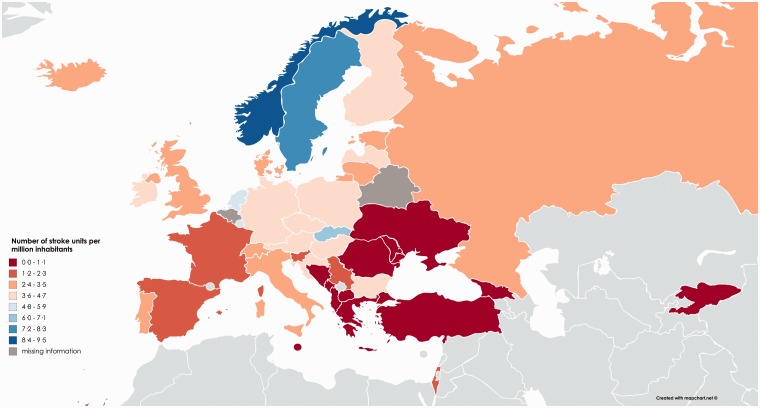
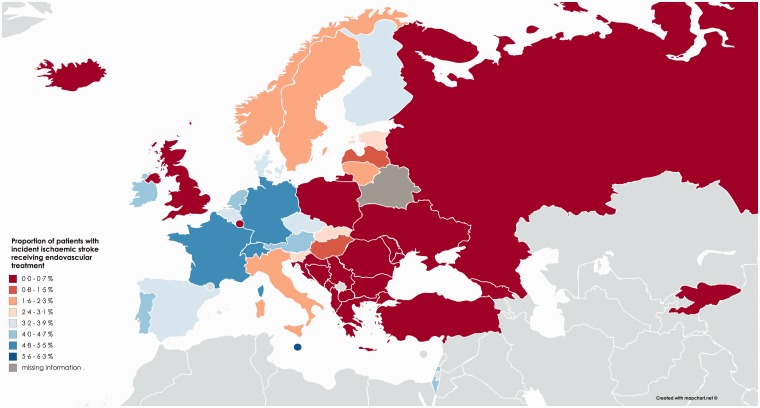
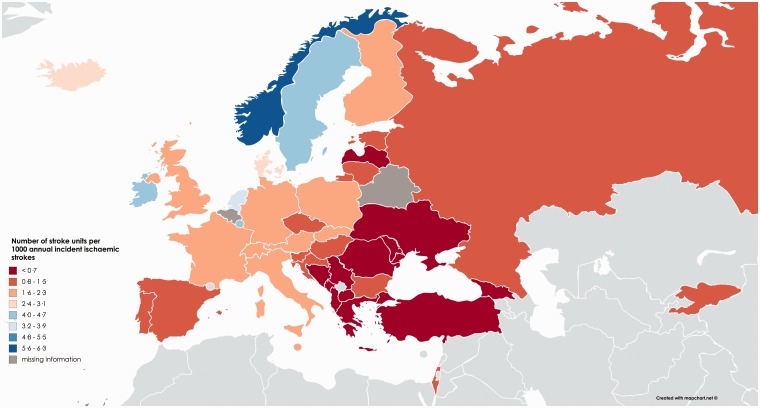
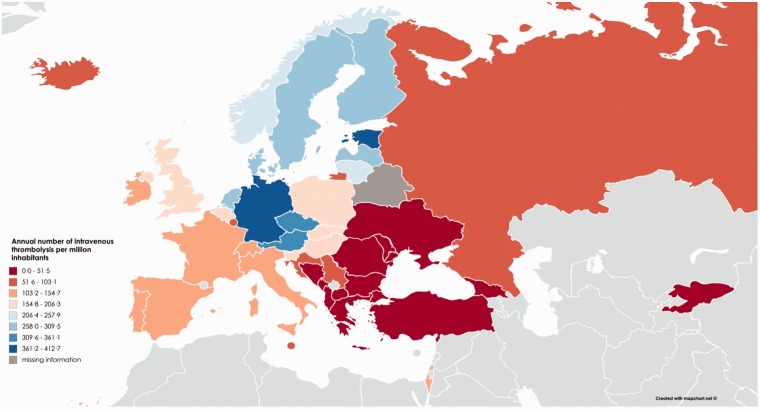
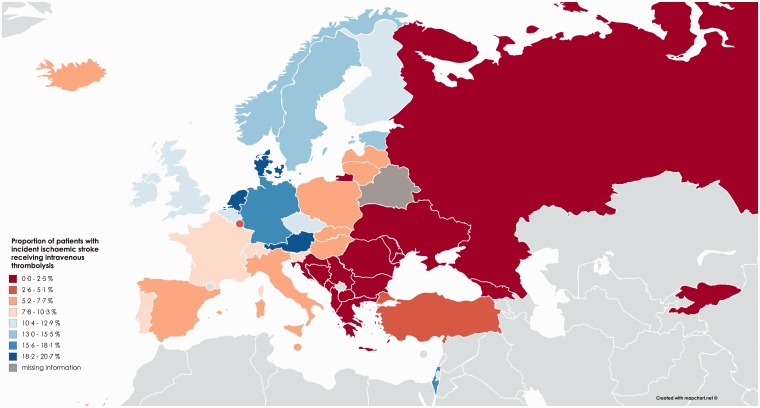
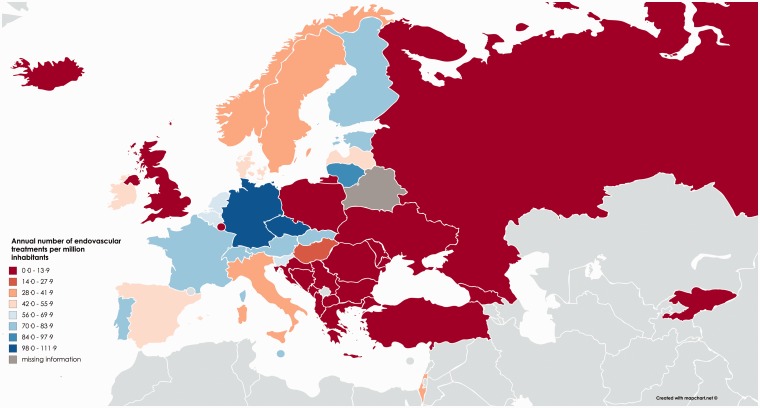
We obtained data from 44 European countries. The estimated mean number of stroke units was 2.9 per million inhabitants (95% CI 2.3-3.6) and 1.5 per 1000 annual incident strokes (95% CI 1.1-1.9), highest country rates were 9.2 and 5.8. Intravenous thrombolysis was provided in 42/44 countries. The estimated mean annual number of intravenous thrombolysis was 142.0 per million inhabitants (95% CI 107.4-176.7) and 72.7 per 1000 annual incident strokes (95% CI 54.2-91.2), highest country rates were 412.2 and 205.5. Endovascular treatment was provided in 40/44 countries. The estimated mean annual number of endovascular treatments was 37.1 per million inhabitants (95% CI 26.7-47.5) and 19.3 per 1000 annual incident strokes (95% CI 13.5-25.1), highest country rates were 111.5 and 55.9. Overall, 7.3% of incident ischaemic stroke patients received intravenous thrombolysis (95% CI 5.4-9.1) and 1.9% received endovascular treatment (95% CI 1.3-2.5), highest country rates were 20.6% and 5.6%.
We observed major inequalities in acute stroke treatment between and within 44 European countries. Our data will assist decision makers implementing tailored stroke care programmes for reducing stroke-related morbidity and mortality in Europe.
急性卒中单元护理、静脉溶栓和血管内治疗显著改善了缺血性卒中患者的预后,但欧洲各地关于治疗机会和治疗实施情况的数据尚不完善。我们评估了欧洲各地急性卒中单元护理、静脉溶栓和血管内治疗的最佳可得数据。
由卒中专业人员(欧洲卒中组织、欧洲介入和急性神经病学学会、欧洲神经病学学会)和一个患者组织(卒中协会)起草的一项调查被发送给51个欧洲国家(世界卫生组织定义)的国家卒中协会和专家,要求专家提供关于卒中单元、静脉溶栓和血管内治疗率的国家数据。我们将每百万居民和每1000例年度缺血性卒中事件的汇总数据及各国数据与发病率最高的国家进行了比较。人口估计基于联合国数据,卒中发病率基于《全球疾病负担报告》。
我们从44个欧洲国家获得了数据。估计平均每百万居民有2.9个卒中单元(95%可信区间2.3 - 3.6),每1000例年度缺血性卒中事件中有1.5个(95%可信区间1.1 - 1.9),发病率最高的国家分别为9.2和5.8。44个国家中有42个提供静脉溶栓治疗。估计平均每年每百万居民接受静脉溶栓治疗的人数为142.0例(95%可信区间107.4 - 176.7),每1000例年度缺血性卒中事件中有72.7例(95%可信区间54.2 - 91.2),发病率最高的国家分别为412.2和205.5。44个国家中有40个提供血管内治疗。估计平均每年每百万居民接受血管内治疗的人数为37.1例(95%可信区间26.7 - 47.5),每1000例年度缺血性卒中事件中有19.3例(95%可信区间13.5 - 25.1),发病率最高的国家分别为111.5和55.9。总体而言,7.3%的缺血性卒中患者接受了静脉溶栓治疗(95%可信区间5.4 - 9.1),1.9%接受了血管内治疗(95%可信区间1.3 - 2.5),发病率最高的国家分别为20.6%和(5.6%)。
我们观察到44个欧洲国家之间以及国家内部在急性卒中治疗方面存在重大不平等。我们的数据将有助于决策者实施针对性的卒中护理计划,以降低欧洲与卒中相关的发病率和死亡率。