Ann Romney Center for Neurologic Diseases, Department of Neurology, Brigham and Women's Hospital and Harvard Medical School, Boston, MA.
Genentech (a member of the Roche Group), South San Francisco, CA.
Ann Neurol. 2019 Aug;86(2):215-224. doi: 10.1002/ana.25513. Epub 2019 Jun 22.
Oligomeric forms of amyloid β protein (oAβ) are believed to be principally responsible for neurotoxicity in Alzheimer disease (AD), but it is not known whether anti-Aβ antibodies are capable of lowering oAβ levels in humans.
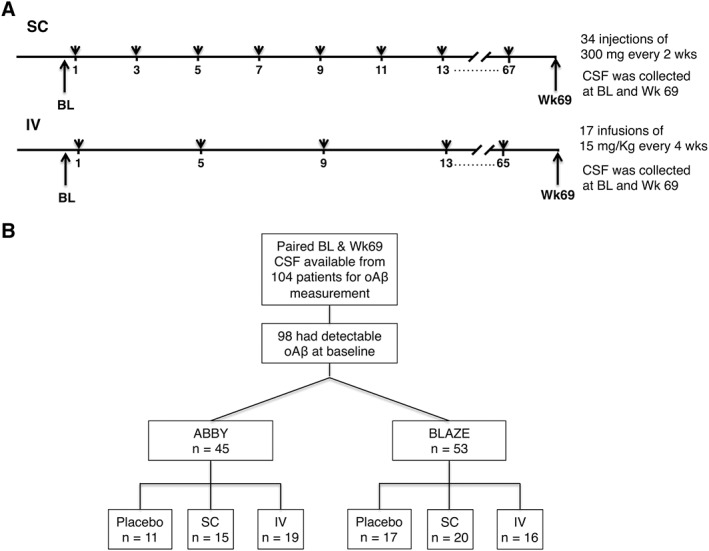
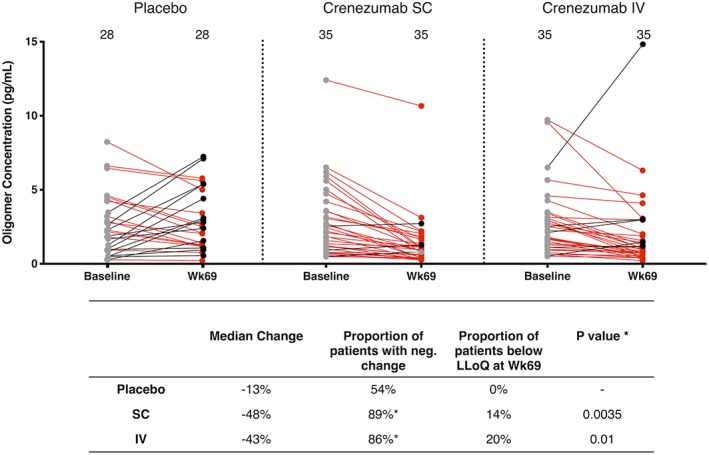
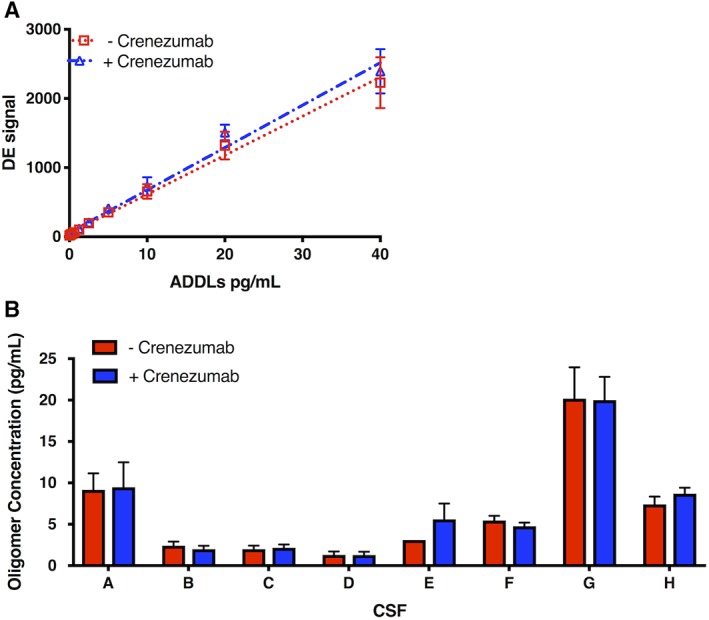
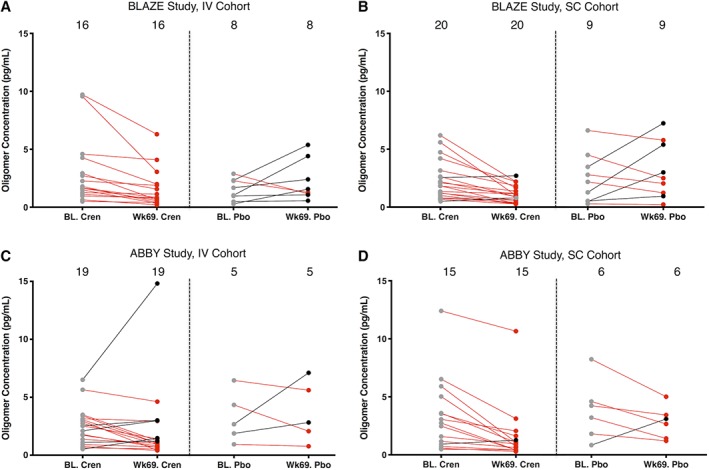
We developed an ultrasensitive immunoassay and used it to measure oAβ in cerebrospinal fluid (CSF) from 104 AD subjects participating in the ABBY and BLAZE phase 2 trials of the anti-Aβ antibody crenezumab. Patients received subcutaneous (SC) crenezumab (300mg) or placebo every 2 weeks, or intravenous (IV) crenezumab (15mg/kg) or placebo every 4 weeks for 68 weeks. Ninety-eight of the 104 patients had measurable baseline oAβ levels, and these were compared to levels at week 69 in placebo (n = 28), SC (n = 35), and IV (n = 35) treated patients.
Among those receiving crenezumab, 89% of SC and 86% of IV patients had lower levels of oAβ at week 69 versus baseline. The difference in the proportion of patients with decreasing levels was significant for both treatment arms: p = 0.0035 for SC and p = 0.01 for IV crenezumab versus placebo. The median percentage change was -48% in the SC arm and -43% in the IV arm. No systematic change was observed in the placebo group, with a median change of -13% and equivalent portions with negative and positive change.
Crenezumab lowered CSF oAβ levels in the large majority of treated patients tested. These results support engagement of the principal pathobiological target in AD and identify CSF oAβ as a novel pharmacodynamic biomarker for use in trials of anti-Aβ agents. ANN NEUROL 2019;86:215-224.
淀粉样 β 蛋白(Aβ)的寡聚体形式被认为主要负责阿尔茨海默病(AD)的神经毒性,但目前尚不清楚抗 Aβ 抗体是否能够降低人类 Aβ水平。
我们开发了一种超灵敏免疫测定法,并用于测量 104 名参加抗 Aβ 抗体 crenezumab 的 ABBY 和 BLAZE 二期临床试验的 AD 患者的脑脊液(CSF)中的 oAβ。患者接受皮下(SC)crenezumab(300mg)或安慰剂,每 2 周一次,或静脉内(IV)crenezumab(15mg/kg)或安慰剂,每 4 周一次,共 68 周。104 名患者中有 98 名可测量基线 oAβ 水平,将这些水平与安慰剂(n=28)、SC(n=35)和 IV(n=35)治疗患者的第 69 周的水平进行比较。
在接受 crenezumab 的患者中,89%的 SC 和 86%的 IV 患者在第 69 周时 oAβ水平较基线下降。与安慰剂相比,两种治疗组的 oAβ水平下降患者比例差异均有统计学意义:SC 臂 p=0.0035,IV 臂 p=0.01。SC 臂的中位数变化百分比为-48%,IV 臂为-43%。安慰剂组没有观察到系统变化,中位数变化为-13%,负变化和正变化的比例相当。
Crenezumab 降低了大多数接受测试的治疗患者的 CSF oAβ 水平。这些结果支持 AD 主要病理生物靶标的结合,并确定 CSF oAβ 作为用于抗 Aβ 药物试验的新型药效动力学生物标志物。