Sivapragasam Smitha, Grove Anne
Department of Biological Sciences, Louisiana State University, Baton Rouge, LA 70803, USA.
Antibiotics (Basel). 2019 Jun 6;8(2):76. doi: 10.3390/antibiotics8020076.
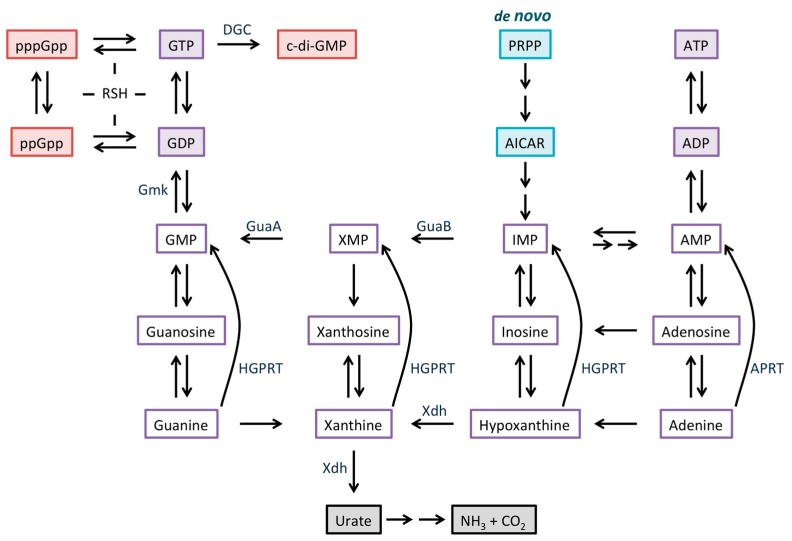
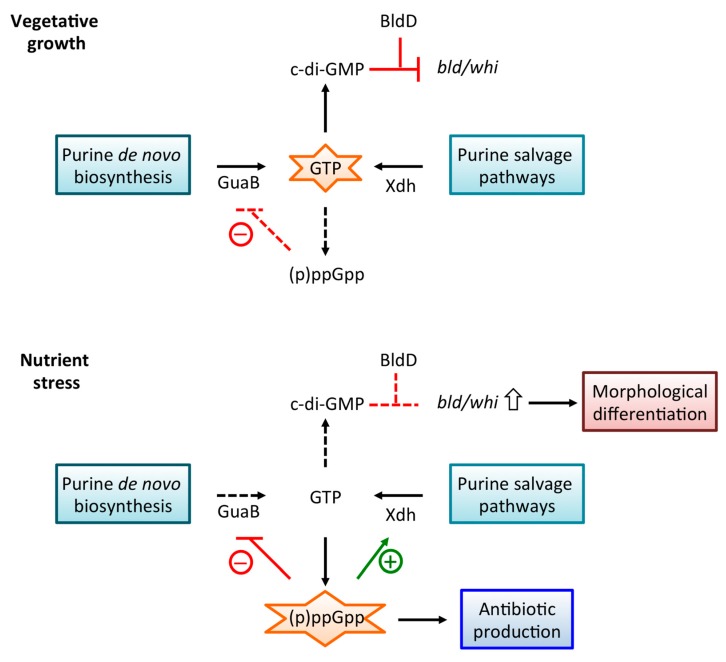
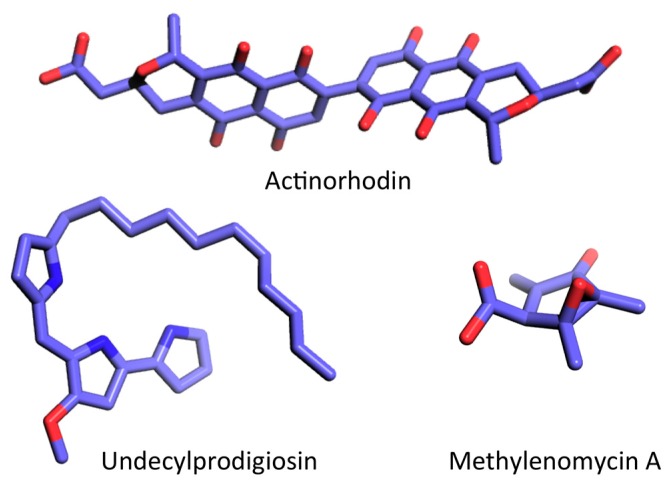
Stress and starvation causes bacterial cells to activate the stringent response. This results in down-regulation of energy-requiring processes related to growth, as well as an upregulation of genes associated with survival and stress responses. Guanosine tetra- and pentaphosphates (collectively referred to as (p)ppGpp) are critical for this process. In Gram-positive bacteria, a main function of (p)ppGpp is to limit cellular levels of GTP, one consequence of which is reduced transcription of genes that require GTP as the initiating nucleotide, such as rRNA genes. In Streptomycetes, the stringent response is also linked to complex morphological differentiation and to production of secondary metabolites, including antibiotics. These processes are also influenced by the second messenger c-di-GMP. Since GTP is a substrate for both (p)ppGpp and c-di-GMP, a finely tuned regulation of cellular GTP levels is required to ensure adequate synthesis of these guanosine derivatives. Here, we discuss mechanisms that operate to control guanosine metabolism and how they impinge on the production of antibiotics in species.
压力和饥饿会导致细菌细胞激活严谨反应。这会导致与生长相关的耗能过程下调,以及与生存和应激反应相关的基因上调。鸟苷四磷酸和五磷酸(统称为(p)ppGpp)对这一过程至关重要。在革兰氏阳性细菌中,(p)ppGpp的一个主要功能是限制细胞内GTP的水平,其结果之一是减少了以GTP作为起始核苷酸的基因(如rRNA基因)的转录。在链霉菌中,严谨反应还与复杂的形态分化以及次级代谢产物(包括抗生素)的产生有关。这些过程也受到第二信使c-di-GMP的影响。由于GTP是(p)ppGpp和c-di-GMP的底物,因此需要对细胞内GTP水平进行精细调节,以确保这些鸟苷衍生物的充分合成。在这里,我们讨论控制鸟苷代谢的机制,以及它们如何影响物种中抗生素的产生。