Paul-Ehrlich-Institut, Vice President´s Research Group 1: Molecular Allergology, 63225 Langen (Hesse), Germany.
Cells. 2019 Jun 6;8(6):546. doi: 10.3390/cells8060546.
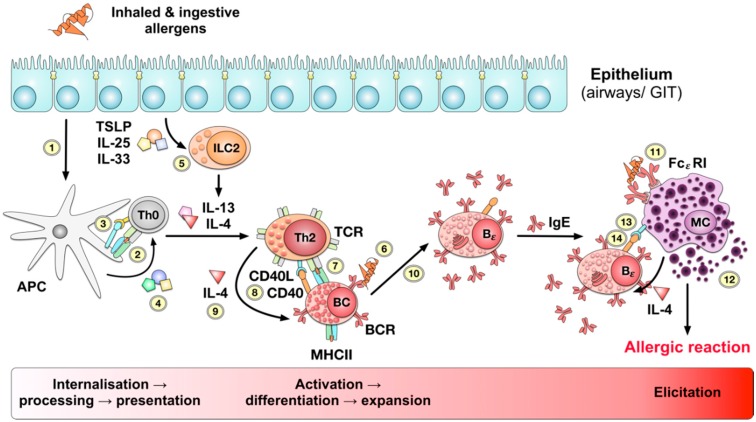
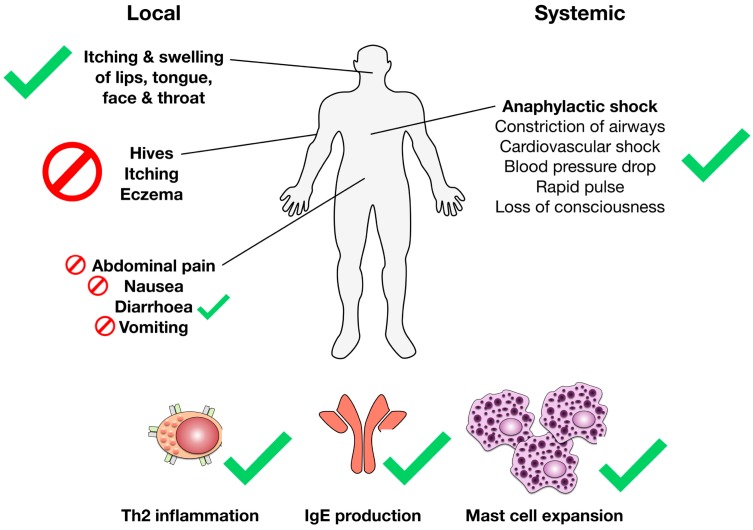
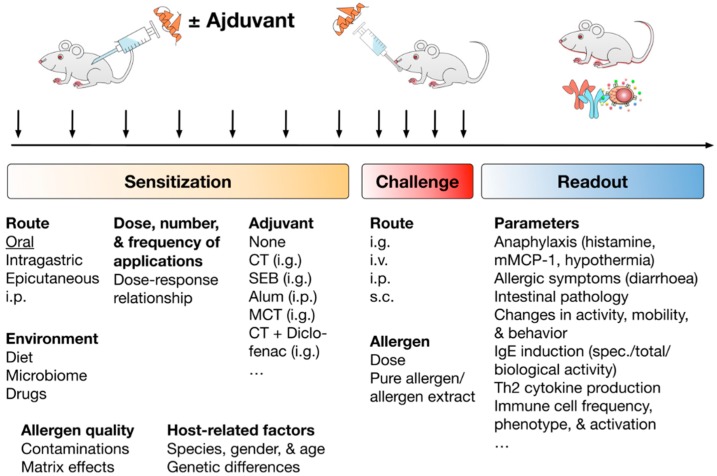
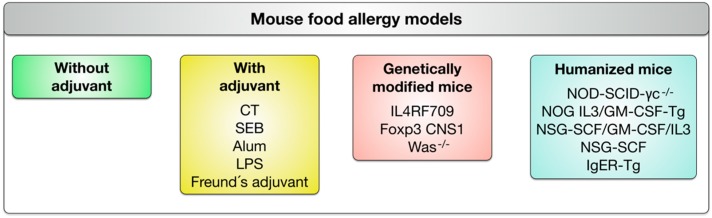
Food allergies are a steadily increasing health and economic problem. Immunologically, food allergic reactions are caused by pathological, allergen-specific Th2 responses resulting in IgE-mediated mast cell degranulation and associated inflammatory reactions. Clinically, food allergies are characterized by local inflammation of the mouth mucosa, the face, the throat, the gastrointestinal tract, are frequently paralleled by skin reactions, and can result in life-threatening anaphylactic reactions. To better understand food allergies and establish novel treatment options, mouse models are indispensable. This review discusses the available mouse food allergy models, dividing them into four categories: (1) adjuvant-free mouse models, (2) mouse models relying on adjuvants to establish allergen-specific Th2 responses, (3) mouse models using genetically-modified mouse strains to allow for easier sensitization, and (4) humanized mouse models in which different immunodeficient mouse strains are reconstituted with human immune or stem cells to investigate humanized immune responses. While most of the available mouse models can reproducibly portray the immunological parameters of food allergy (Th2 immune responses, IgE production and mast cell activation/expansion), so far, the recreation of the clinical parameters has proven more difficult. Therefore, up to now none of the available mouse models can reproduce the complete human pathology.
食物过敏是一个日益严重的健康和经济问题。在免疫学上,食物过敏反应是由病理性、过敏原特异性 Th2 反应引起的,导致 IgE 介导的肥大细胞脱颗粒和相关炎症反应。临床上,食物过敏表现为口腔黏膜、面部、喉咙和胃肠道的局部炎症,常伴有皮肤反应,并可导致危及生命的过敏反应。为了更好地了解食物过敏并建立新的治疗方法,使用小鼠模型是必不可少的。本文讨论了现有的小鼠食物过敏模型,将其分为四类:(1)无佐剂小鼠模型,(2)依赖佐剂建立过敏原特异性 Th2 反应的小鼠模型,(3)使用基因修饰小鼠品系更容易致敏的小鼠模型,(4)人源化小鼠模型,其中不同的免疫缺陷小鼠品系用人类免疫或干细胞重建以研究人源化免疫反应。虽然大多数现有的小鼠模型可以重现食物过敏的免疫学参数(Th2 免疫反应、IgE 产生和肥大细胞激活/扩增),但到目前为止,重现临床参数更为困难。因此,迄今为止,尚无一种现有的小鼠模型能够再现完整的人类病理。