Environmental Health Occupational Health and Food Safety unit, Ministry of Health, Nutrition and Indigenous Medicine, Colombo, Sri Lanka.
Ministry of Health, Nutrition and Indigenous Medicine, Colombo, Sri Lanka.
BMC Nephrol. 2019 Jun 7;20(1):208. doi: 10.1186/s12882-019-1371-5.
Evidence of chronic low levels of exposure to heavy metals in Sri Lanka has emerged in a number of studies carried out in the recent past. The source and magnitude of such exposures have to be understood in order to assess the risk of adverse health effects of this exposure and to propose suitable public health interventions.
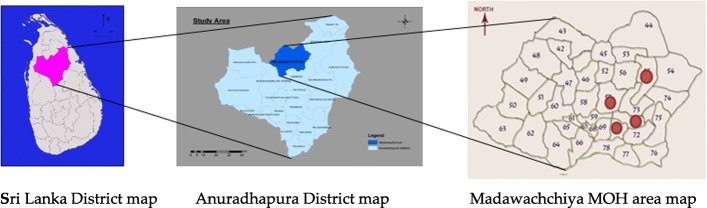
An assessment was carried out to quantify chronic exposure to cadmium, lead and arsenic through food in people living in an area in Sri Lanka, where prevalence of Chronic Kidney Disease of unknown origin (CKDu) is highest. First a dietary survey was carried out in the subjects to estimate the type and quantity of typical food items in order to estimate an average consumption. A model diet was formulated using this dietary consumption data; and this was thereafter used for estimation of chronic dietary exposure of selected contaminants. In parallel, the levels of contaminants of interest in the various identified food items: cadmium, lead and arsenic, were determined.
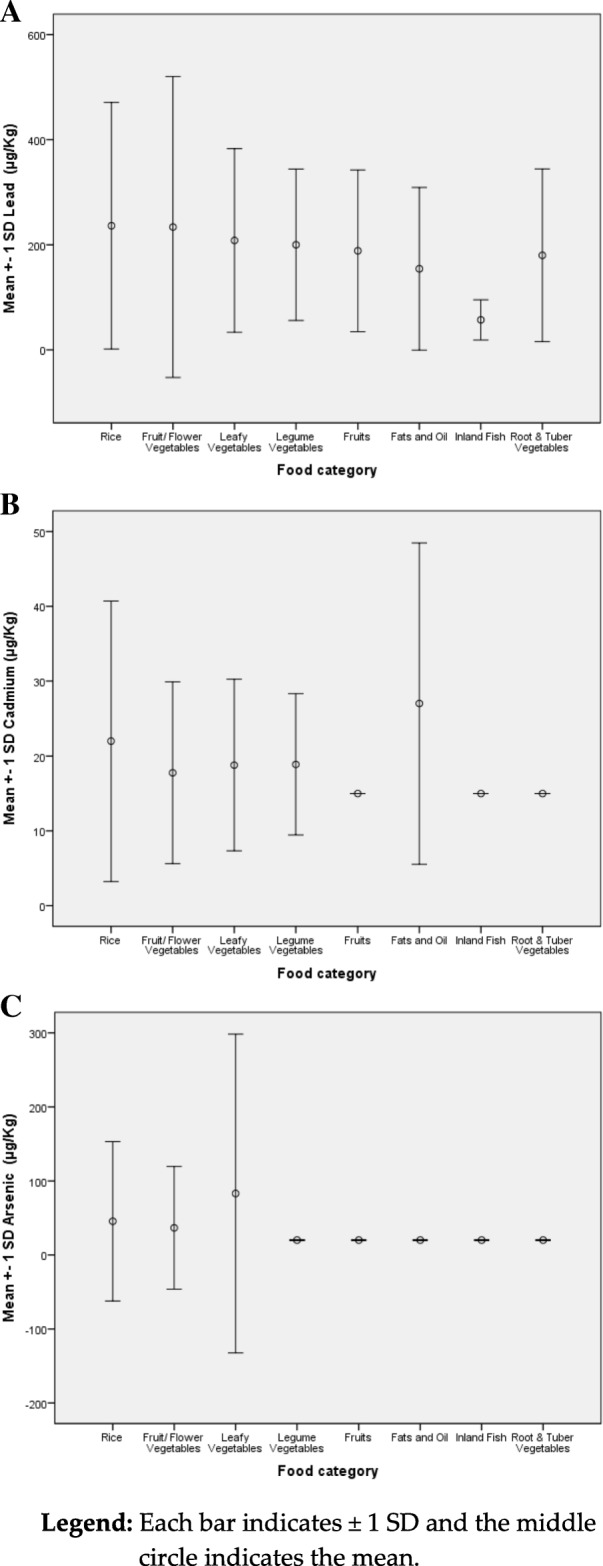
Assuming the major route of intake is food, and based on the quantity and type of food items consumed, a 60 kg man is exposed to average doses of 83.7 μg cadmium, 924.1 μg lead, and 180.3 μg arsenic per week. The impact of chronic lead exposure was affirmed by a mean blood lead level of 3.0 μg/dL, with a maximum level of 8.8 μg/dL being observed in some cases.
Chronic low dose exposure of lead from food appears to be a public health concern in the studied population. Cadmium exposure through food appears to be of concern also. However, arsenic exposure through food appears to be within safe limits. As there are numbers of possible adverse health outcomes that can be associated with such estimated exposures of heavy metals, public health interventions are warranted to limit the described harmful exposures. Advocacy on dietary patterns and agronomic practices to lower the contaminants identified are the two broad strategies suggested.
在最近的一些研究中,斯里兰卡出现了大量证据表明人们慢性低水平暴露于重金属。为了评估这种暴露对健康产生不良影响的风险,并提出适当的公共卫生干预措施,必须了解这种暴露的来源和程度。
在斯里兰卡一个慢性肾病病因不明(CKDu)发病率最高的地区,对人们通过食物摄入镉、铅和砷的慢性暴露情况进行了评估。首先,在研究对象中进行了膳食调查,以估计典型食物的种类和数量,从而估算平均摄入量。利用这些饮食消费数据制定了一种典型饮食模式;此后,利用这种模式来估算选定污染物的慢性饮食暴露量。同时,还确定了各种确定的食物中感兴趣的污染物的含量:镉、铅和砷。
假设主要的摄入途径是食物,基于消耗的食物种类和数量,一名 60 公斤重的男性每周摄入的平均镉剂量为 83.7μg,铅剂量为 924.1μg,砷剂量为 180.3μg。慢性铅暴露的影响通过平均血铅水平 3.0μg/dL 得到证实,在某些情况下,最高水平达到 8.8μg/dL。
研究人群中,食物来源的慢性低剂量铅暴露似乎是一个公共卫生问题。通过食物摄入的镉暴露也令人担忧。然而,通过食物摄入的砷暴露似乎处于安全范围内。由于可能与这些重金属估计暴露相关的许多不良健康后果,因此需要采取公共卫生干预措施来限制所描述的有害暴露。建议采取两种广泛的策略,即倡导饮食模式和农业实践以降低所确定的污染物。