Vargas-Romero Fernanda, González-Barrios Rodrigo, Guerra-Calderas Lissania, Escobedo-Avila Itzel, Cortés-Pérez Daniel, López-Ornelas Adolfo, Rocha Luisa, Soto-Reyes Ernesto, Velasco Iván
Instituto de Fisiología Celular - Neurociencias, Universidad Nacional Autónoma de México, Mexico City, Mexico.
Unidad de Investigación Biomédica en Cáncer, Instituto Nacional de Cancerología-Instituto de Investigaciones Biomédicas, Universidad Nacional Autónoma de México, Mexico City, Mexico.
Front Cell Neurosci. 2019 May 21;13:215. doi: 10.3389/fncel.2019.00215. eCollection 2019.
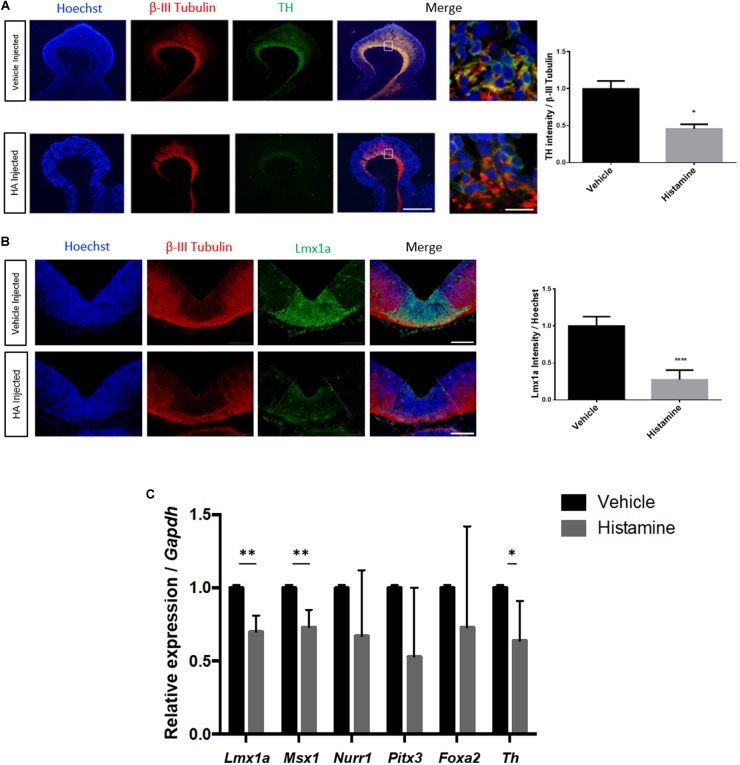
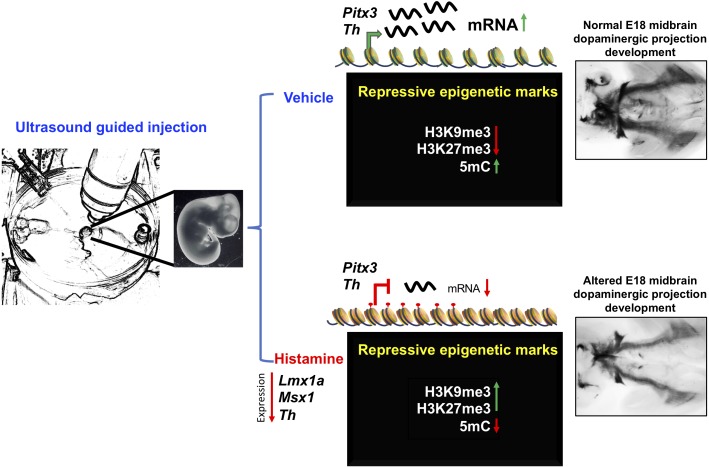
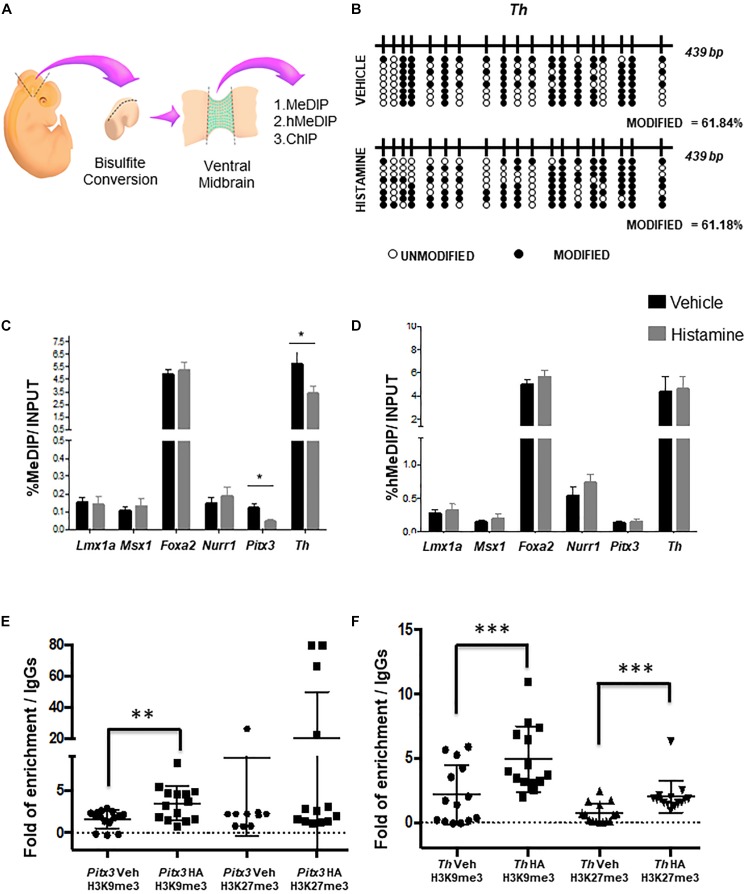
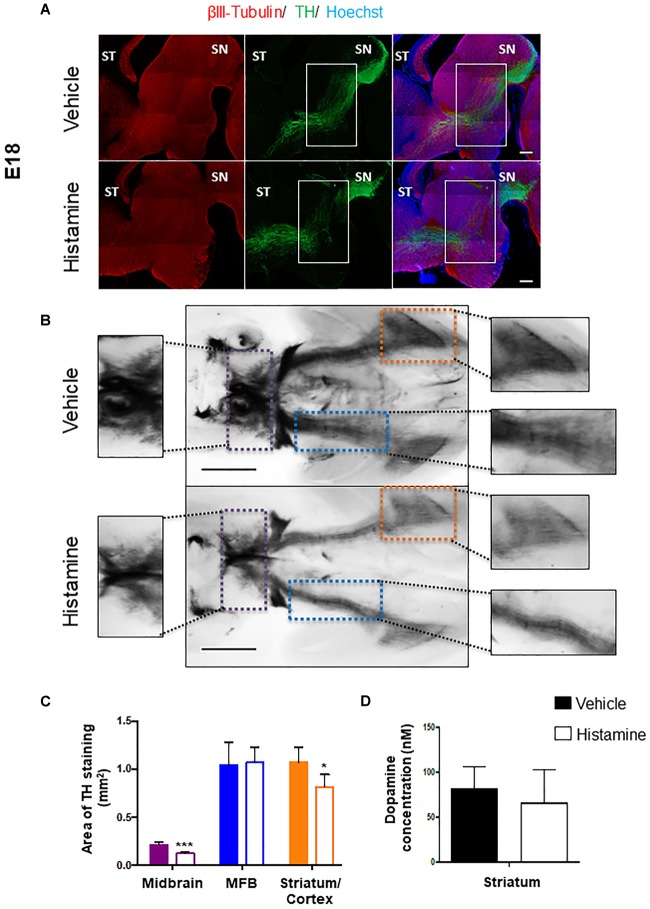
During midbrain development, dopamine neuron differentiation occurs before birth. Epigenetic processes such as DNA methylation and demethylation as well as post-translational modification of histones occur during neurogenesis. Here, we administered histamine (HA) into the brain of E12 embryos and observed significant lower immunoreactivity of Lmx1a+ and Tyrosine Hydroxylase (TH)+ cells, with parallel decreases in the expression of early (, and late () midbrain dopaminergic (mDA) genes. With MeDIP assays we found that HA decreases the percentage of 5-methylcytosine of and , without changes in 5-hydroxymethylcytosine. Additionally, HA treatment caused a significant increase in the repressive epigenetic modifications H3K9me3 in and , and also more H3K27me3 marks in . Furthermore, HA has a long-term effect on the formation of the nigrostriatal and mesolimbic/mesocortical pathways, since it causes a significant decrease in midbrain TH immunoreactivity, as well as alterations in dopaminergic neuronal fibers, and significant lower TH-positive area in the forebrain in whole-mount stainings. These findings suggest that HA diminishes dopaminergic gene transcription by altering several epigenetic components related to DNA and histone modifications, which affects mDA neuron progression during development.
在中脑发育过程中,多巴胺神经元分化在出生前就已发生。诸如DNA甲基化和去甲基化以及组蛋白的翻译后修饰等表观遗传过程在神经发生期间出现。在此,我们将组胺(HA)注入E12胚胎的大脑中,并观察到Lmx1a+和酪氨酸羟化酶(TH)+细胞的免疫反应性显著降低,同时早期(、和晚期()中脑多巴胺能(mDA)基因的表达也相应减少。通过甲基化DNA免疫沉淀(MeDIP)分析,我们发现HA降低了和的5-甲基胞嘧啶百分比,而5-羟甲基胞嘧啶没有变化。此外,HA处理导致和中抑制性表观遗传修饰H3K9me3显著增加,并且中也有更多的H3K27me3标记。此外,HA对黑质纹状体和中脑边缘/中脑皮质通路的形成具有长期影响,因为它导致中脑TH免疫反应性显著降低,以及多巴胺能神经元纤维的改变,并且在全组织染色中前脑的TH阳性区域显著减少。这些发现表明,HA通过改变与DNA和组蛋白修饰相关的几种表观遗传成分来减少多巴胺能基因转录,这会影响发育过程中的mDA神经元进程。