
主动视觉的动态因果建模。
Dynamic Causal Modelling of Active Vision.
机构信息
Wellcome Centre for Human Neuroimaging, Institute of Neurology, University College London, WC1N 3BG, United Kingdom,
Wellcome Centre for Human Neuroimaging, Institute of Neurology, University College London, WC1N 3BG, United Kingdom.
出版信息
J Neurosci. 2019 Aug 7;39(32):6265-6275. doi: 10.1523/JNEUROSCI.2459-18.2019. Epub 2019 Jun 10.
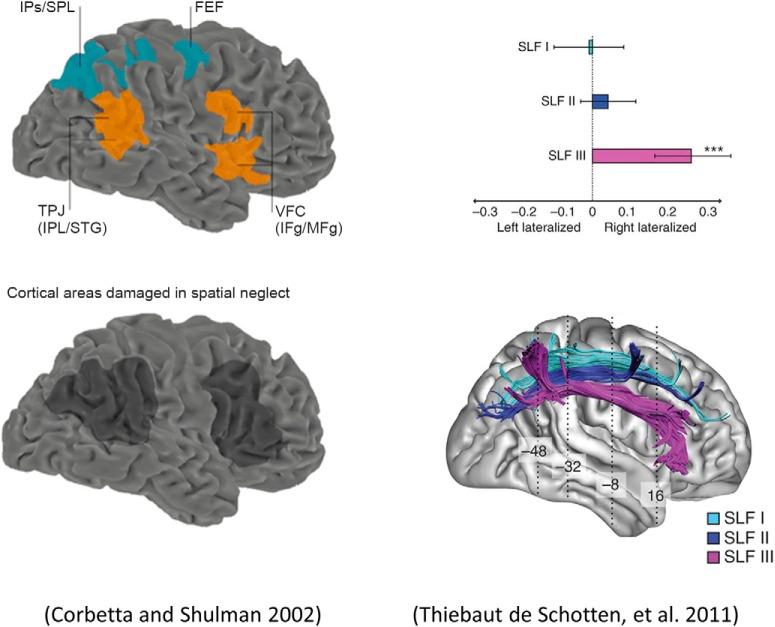
In this paper, we draw from recent theoretical work on active perception, which suggests that the brain makes use of an internal (i.e., generative) model to make inferences about the causes of sensations. This view treats visual sensations as consequent on action (i.e., saccades) and implies that visual percepts must be actively constructed via a sequence of eye movements. Oculomotor control calls on a distributed set of brain sources that includes the dorsal and ventral frontoparietal (attention) networks. We argue that connections from the frontal eye fields to ventral parietal sources represent the mapping from "where", fixation location to information derived from "what" representations in the ventral visual stream. During scene construction, this mapping must be learned, putatively through changes in the effective connectivity of these synapses. Here, we test the hypothesis that the coupling between the dorsal frontal cortex and the right temporoparietal cortex is modulated during saccadic interrogation of a simple visual scene. Using dynamic causal modeling for magnetoencephalography with (male and female) human participants, we assess the evidence for changes in effective connectivity by comparing models that allow for this modulation with models that do not. We find strong evidence for modulation of connections between the two attention networks; namely, a disinhibition of the ventral network by its dorsal counterpart. This work draws from recent theoretical accounts of active vision and provides empirical evidence for changes in synaptic efficacy consistent with these computational models. In brief, we used magnetoencephalography in combination with eye-tracking to assess the neural correlates of a form of short-term memory during a dot cancellation task. Using dynamic causal modeling to quantify changes in effective connectivity, we found evidence that the coupling between the dorsal and ventral attention networks changed during the saccadic interrogation of a simple visual scene. Intuitively, this is consistent with the idea that these neuronal connections may encode beliefs about "what I would see if I looked there", and that this mapping is optimized as new data are obtained with each fixation.
在本文中,我们借鉴了最近关于主动感知的理论工作,该理论认为大脑利用内部(即生成)模型来推断感觉的原因。这种观点将视觉感觉视为动作(即眼球运动)的结果,并暗示视觉知觉必须通过一系列眼球运动来主动构建。眼动控制需要调用包括背侧和腹侧额顶(注意力)网络在内的分布式脑源。我们认为,从额眼区到腹侧顶叶源的连接代表了从“何处”(注视位置)到来自腹侧视觉流中“什么”(信息)表示的映射。在场景构建过程中,这种映射必须通过这些突触的有效连接的变化来学习。在这里,我们通过测试在简单视觉场景中进行扫视时背侧额叶皮层和右颞顶叶皮层之间的耦合是否发生变化来检验这一假设。使用基于男性和女性人类参与者的脑磁图的动态因果建模,我们通过比较允许这种调制的模型和不允许这种调制的模型来评估有效连接变化的证据。我们发现两个注意力网络之间的连接存在强烈的调制证据;即,背侧网络对腹侧网络的去抑制。这项工作借鉴了最近关于主动视觉的理论解释,并提供了与这些计算模型一致的突触效能变化的经验证据。简而言之,我们使用脑磁图结合眼动追踪来评估点消去任务期间短期记忆的神经相关性。使用动态因果建模来量化有效连接的变化,我们发现证据表明,在简单视觉场景的扫视询问过程中,背侧和腹侧注意力网络之间的耦合发生了变化。直观地说,这与这些神经元连接可能编码关于“如果我在那里看,我会看到什么”的信念的想法是一致的,并且这种映射会随着每次注视时获得的新数据而得到优化。



 Zotero 插件