Center for Music in the Brain, Aarhus University & Royal Academy of Music Aarhus/Aalborg, Aarhus, Denmark.
Aarhus Institute of Advanced Studies, Aarhus University, Aarhus, Denmark.
Hum Brain Mapp. 2021 Dec 1;42(17):5595-5608. doi: 10.1002/hbm.25638. Epub 2021 Aug 30.
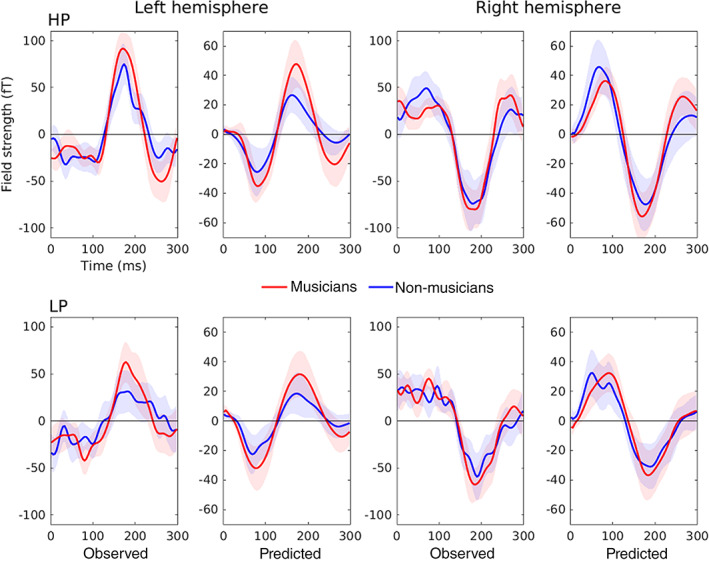
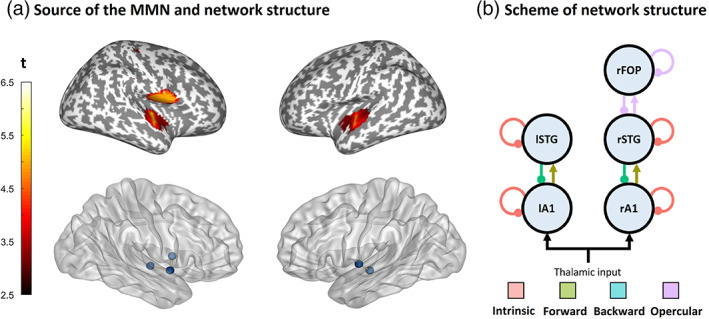
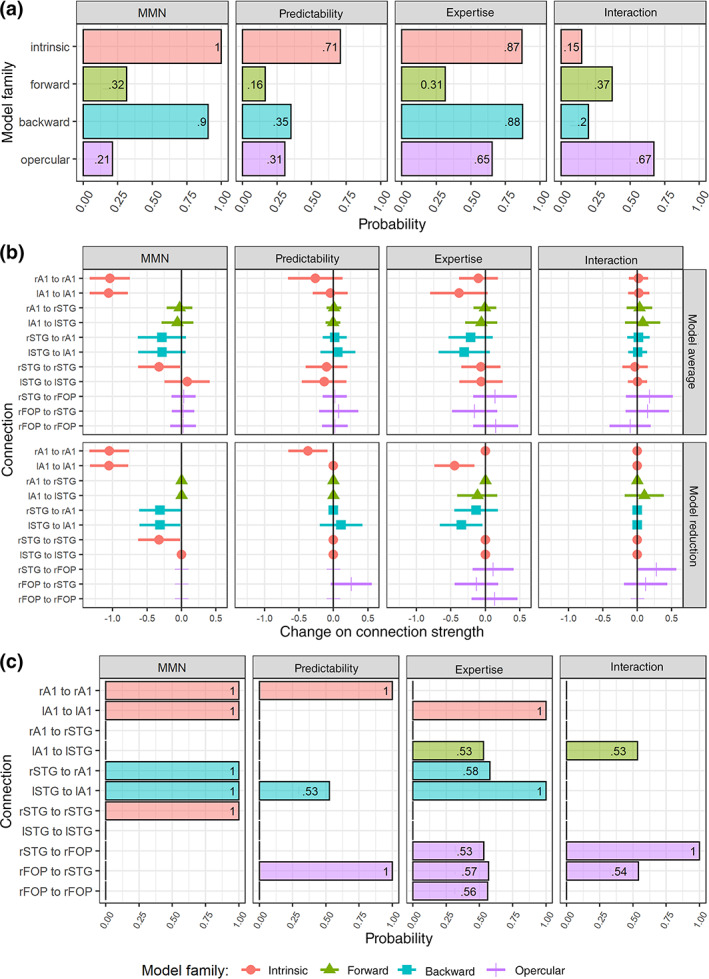
When listening to music, pitch deviations are more salient and elicit stronger prediction error responses when the melodic context is predictable and when the listener is a musician. Yet, the neuronal dynamics and changes in connectivity underlying such effects remain unclear. Here, we employed dynamic causal modeling (DCM) to investigate whether the magnetic mismatch negativity response (MMNm)-and its modulation by context predictability and musical expertise-are associated with enhanced neural gain of auditory areas, as a plausible mechanism for encoding precision-weighted prediction errors. Using Bayesian model comparison, we asked whether models with intrinsic connections within primary auditory cortex (A1) and superior temporal gyrus (STG)-typically related to gain control-or extrinsic connections between A1 and STG-typically related to propagation of prediction and error signals-better explained magnetoencephalography responses. We found that, compared to regular sounds, out-of-tune pitch deviations were associated with lower intrinsic (inhibitory) connectivity in A1 and STG, and lower backward (inhibitory) connectivity from STG to A1, consistent with disinhibition and enhanced neural gain in these auditory areas. More predictable melodies were associated with disinhibition in right A1, while musicianship was associated with disinhibition in left A1 and reduced connectivity from STG to left A1. These results indicate that musicianship and melodic predictability, as well as pitch deviations themselves, enhance neural gain in auditory cortex during deviance detection. Our findings are consistent with predictive processing theories suggesting that precise and informative error signals are selected by the brain for subsequent hierarchical processing.
当聆听音乐时,旋律语境可预测且聆听者为音乐家时,音高偏差更为明显,并引发更强的预测误差响应。然而,支持这些效应的神经动力学和连通性变化仍不清楚。在这里,我们采用动态因果建模(DCM)来研究磁源性失匹配负波(MMNm)及其对语境可预测性和音乐专业知识的调制是否与听觉区域的增强神经增益相关,作为编码精确加权预测误差的合理机制。通过贝叶斯模型比较,我们询问了在初级听觉皮层(A1)和颞上回(STG)内具有内在连接的模型(通常与增益控制有关)-或 A1 和 STG 之间具有外在连接的模型(通常与预测和误差信号的传播有关)-是否更好地解释了脑磁图反应。我们发现,与规则声音相比,音高偏差与 A1 和 STG 中的内在(抑制性)连通性降低以及 STG 到 A1 的反向(抑制性)连通性降低有关,这与这些听觉区域中的去抑制和增强的神经增益一致。更可预测的旋律与右 A1 中的去抑制有关,而音乐技巧与左 A1 中的去抑制以及从 STG 到左 A1 的连通性降低有关。这些结果表明,音乐技巧和旋律可预测性以及音高偏差本身在偏差检测过程中增强了听觉皮层的神经增益。我们的发现与预测加工理论一致,该理论表明大脑会选择精确和信息丰富的误差信号进行后续的分层处理。