El-Maaty Amal M Abo, Mohamed Ragab H, Hozyen Heba F, El-Kattan Adel M, Mahmoud Mona A, Ali Amal H
Department of Animal Reproduction and Artificial Insemination, Veterinary Division, National Research Center, Dokki, Giza, Egypt.
Department of Theriogenology, Faculty of Veterinary Medicine, Aswan University, Egypt.
Vet World. 2019;12(4):542-550. doi: 10.14202/vetworld.2019.542-550. Epub 2019 Apr 17.
Research about the effects of progesterone (P) and the relationship of P to oxidative stress has been achieved in ruminants but not enough in camels.
This study evaluated the effect of exogenous P hormone using CIDR for 7 days on blood concentrations of steroid hormones and oxidative status of dromedary she-camels during peak and low breeding seasons.
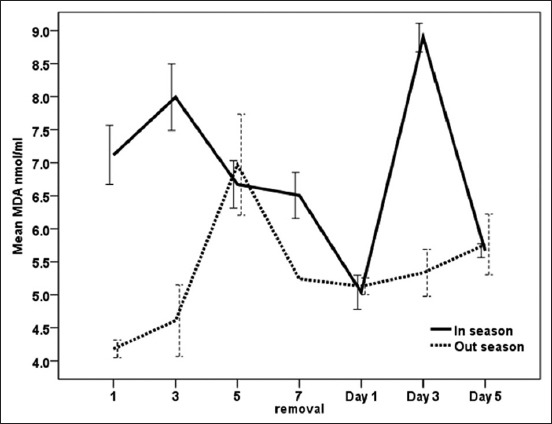
The present work was conducted on ten dark dromedary she-camels which were synchronized using a controlled internal drug release (CIDR) for 7 days as a reproductive management tool during peak breeding (November-April) and low breeding season (May-October). The blood samples were collected each other day from CIDR insertion until the end of experiment 5 days after the removal of CIDR. Camels were examined for P, estradiol (E), and testosterone (T) as well as malondialdehyde (MDA) as indicator of lipid peroxidation and nitric oxide, superoxide dismutase (SOD), and glutathione-S-transferase as antioxidant markers.
Results revealed that P was higher during peak breeding season than low breeding season. While the levels of P increased during CIDR insertion and declined at CIDR removal and thereafter during breeding season, its concentrations declined after CIDR application during the non-breeding season. On the other hand, blood E and testosterone levels decreased after CIDR insertion in both high and low breeding seasons with higher serum E concentrations during the peak than the low breeding season. MDA concentrations and SOD activities were significantly (p<0.05) high on day 3 after CIDR insertion during the breeding and non-breeding seasons. During both the seasons, GSH levels decreased after CIDR removal in camels. However, MDA was lower during non-breeding season than high breeding season with no seasonal effect on SOD activity.
Exogenous P treatment through CIDR in dromedary camels could be more efficient during breeding season than non-breeding season, and effects on circulating oxidant/antioxidant biomarkers and their return to normal levels might refer to the adaptation of camels to CIDR by modulating their oxidant and antioxidant levels.
关于孕酮(P)的作用以及P与氧化应激的关系,在反刍动物中已有研究,但在骆驼中研究不足。
本研究评估了在繁殖高峰期和低繁殖季节,使用孕酮释放装置(CIDR)7天给予外源性P激素对单峰雌性骆驼血液中类固醇激素浓度和氧化状态的影响。
本研究以10峰深色单峰雌性骆驼为对象,在繁殖高峰期(11月至4月)和低繁殖季节(5月至10月),使用可控内部药物释放装置(CIDR)7天作为繁殖管理工具使其发情同步。从插入CIDR开始,每隔一天采集血样,直至移除CIDR后5天实验结束。检测骆驼血液中的P、雌二醇(E)、睾酮(T),以及作为脂质过氧化指标的丙二醛(MDA)和一氧化氮、超氧化物歧化酶(SOD)、谷胱甘肽 - S - 转移酶作为抗氧化标志物。
结果显示,繁殖高峰期的P高于低繁殖季节。在插入CIDR期间P水平升高,在移除CIDR时及之后的繁殖季节下降,而在非繁殖季节应用CIDR后其浓度降低。另一方面,在高繁殖季节和低繁殖季节插入CIDR后,血液中的E和睾酮水平均下降,且繁殖高峰期的血清E浓度高于低繁殖季节。在繁殖季节和非繁殖季节,插入CIDR后第3天MDA浓度和SOD活性显著(p<0.05)升高。在两个季节中,移除CIDR后骆驼的谷胱甘肽(GSH)水平均下降。然而,非繁殖季节的MDA低于繁殖高峰期,且SOD活性无季节性影响。
在单峰骆驼中,通过CIDR进行外源性P处理在繁殖季节可能比非繁殖季节更有效,对循环氧化/抗氧化生物标志物的影响及其恢复到正常水平可能是骆驼通过调节其氧化和抗氧化水平来适应CIDR的表现。