Department of Community Medicine, Nagasaki University Graduate School of Biomedical Sciences, Nagasaki, Japan.
Department of Cardiovascular Disease Prevention, Osaka Center for Cancer and Cardiovascular Disease Prevention, Osaka, Japan.
Clin Interv Aging. 2019 May 8;14:849-857. doi: 10.2147/CIA.S197982. eCollection 2019.
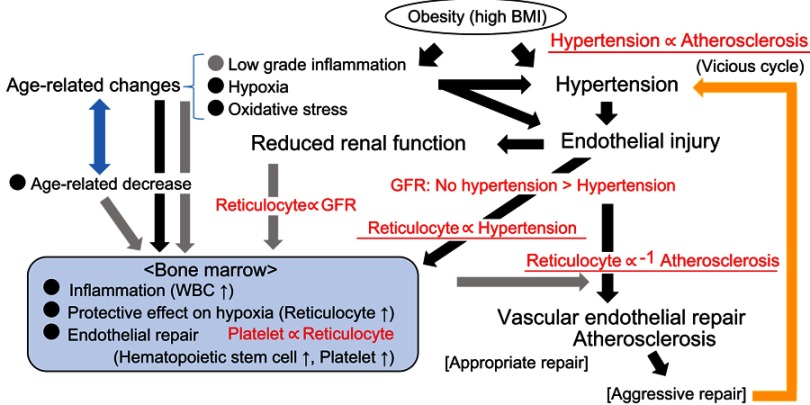
Age-related reduction in bone marrow activity has been shown to cause anemia, and hypertension and endothelial dysfunction (atherosclerosis) are age-related diseases. However, recent studies have revealed a close association between bone marrow activity and endothelial maintenance. This study aimed to determine the association between elevated reticulocyte levels in conjunction with vigorous bone marrow activity and hypertension and atherosclerosis among the elderly. To determine the associations between reticulocyte levels and hypertension and atherosclerosis, we conducted a cross-sectional study of 2,098 elderly Japanese individuals, aged between 60 and 89 years, who had participated in an annual health check-up in 2014. Of the total study population, 1,348 individuals were diagnosed with hypertension (systolic blood pressure ≥140 mmHg and/or diastolic blood pressure ≥90 mmHg and/or having used antihypertensive medication), and 393 were diagnosed with atherosclerosis (carotid intima-media thickness ≥1.1 mm). Reticulocyte levels were found to be significantly positively associated with hypertension and inversely associated with atherosclerosis. Cardiovascular risk factor-adjusted odds ratios and 95% confidence intervals for hypertension and atherosclerosis, when raised incrementally by 1 standard deviation to determine reticulocyte levels (5.5×10 cells/μL for men and 5.0×10 cells/μL for women), were 1.12 (1.01, 1.25) and 0.83 (0.72, 0.94), respectively. Along with established cardiovascular risk factors, reticulocyte levels in elderly Japanese individuals were found to be positively associated with hypertension and inversely associated with atherosclerosis. This finding may help clarify the background mechanisms concerning the association between bone marrow activity and vascular remodeling.
年龄相关的骨髓活性降低已被证明会导致贫血,而高血压和内皮功能障碍(动脉粥样硬化)是与年龄相关的疾病。然而,最近的研究揭示了骨髓活性与内皮维持之间的密切关联。本研究旨在确定老年人群中网织红细胞水平升高与骨髓活性增强与高血压和动脉粥样硬化之间的关系。
为了确定网织红细胞水平与高血压和动脉粥样硬化之间的关系,我们对 2098 名年龄在 60 至 89 岁之间的日本老年人进行了横断面研究,他们在 2014 年参加了年度健康检查。在总研究人群中,1348 人被诊断为高血压(收缩压≥140mmHg 和/或舒张压≥90mmHg 和/或使用抗高血压药物),393 人被诊断为动脉粥样硬化(颈动脉内膜中层厚度≥1.1mm)。结果发现,网织红细胞水平与高血压呈显著正相关,与动脉粥样硬化呈负相关。调整心血管危险因素后,网织红细胞水平每升高 1 个标准差(男性为 5.5×10 个细胞/μL,女性为 5.0×10 个细胞/μL),高血压和动脉粥样硬化的校正比值比和 95%置信区间分别为 1.12(1.01,1.25)和 0.83(0.72,0.94)。
除了已确立的心血管危险因素外,日本老年人的网织红细胞水平与高血压呈正相关,与动脉粥样硬化呈负相关。这一发现可能有助于阐明骨髓活性与血管重塑之间关联的背景机制。