Miller Renfrew Linda, Lord Anna C, McFadyen Angus K, Rafferty Danny, Hunter Rebecca, Bowers Roy, Mattison Paul, Moseley Owen, Paul Lorna
Douglas Grant Rehabilitation Unit, Irvine, UK.
2School of Health and Life Sciences, Glasgow Caledonian University, Glasgow, UK.
J Rehabil Assist Technol Eng. 2018 Feb 2;5:2055668318755071. doi: 10.1177/2055668318755071. eCollection 2018 Jan-Dec.
Foot drop affects walking in people with multiple sclerosis (pwMS). This study compares the initial orthotic effects of two treatments for foot drop: ankle-foot orthoses (AFO) and functional electrical stimulation (FES), on the speed and oxygen cost of walking in MS.
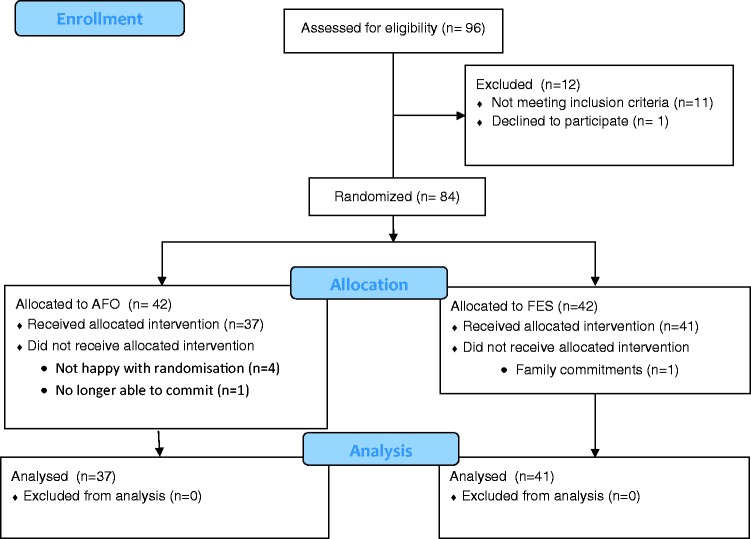
Seventy-eight pwMS were randomised to receive AFO or FES (ODFS PACE (OML, Salisbury, UK)). Participants completed the 25-ft walk test (25ftWT) and 5-min self-selected walk test (5minSSWT), from which oxygen cost was determined, with and without their device. Between-, within- and sub-group analyses (based on baseline walking speed of <0.8 m/s (slow) or ≥0.8 m/s (fast)) were undertaken.
No significant differences between baseline measures were observed. The AFO group walked significantly slower than the FES group (5minSSWT, = 0.037, 0.11 m/s). The AFO group walked significantly slower with than without AFO (25ftWT, = 0.037), particularly in the fast-walking group ( = 0.011). The slow-walking FES group walked significantly faster with FES than without (25ftWT; = 0.029, 5minSSWT; = 0.037). There were no differences in the fast-walking FES group or in the oxygen cost for either device.
AFO reduced walking speed, particularly in fast walkers. FES increased walking speed in slow, but not fast walkers.
足下垂会影响多发性硬化症患者(pwMS)的行走。本研究比较了两种足下垂治疗方法的初始矫形效果:踝足矫形器(AFO)和功能性电刺激(FES),对多发性硬化症患者行走速度和氧气消耗的影响。
78名pwMS患者被随机分配接受AFO或FES(ODFS PACE,英国索尔兹伯里OML公司)。参与者完成25英尺步行测试(25ftWT)和5分钟自选步行测试(5minSSWT),在佩戴和不佩戴其设备的情况下测定氧气消耗。进行了组间、组内和亚组分析(基于基线步行速度<0.8米/秒(慢)或≥0.8米/秒(快))。
未观察到基线测量之间的显著差异。AFO组的行走速度明显慢于FES组(5minSSWT,P = 0.037,0.11米/秒)。AFO组佩戴AFO时的行走速度明显慢于不佩戴时(25ftWT,P = 0.037),特别是在快走组(P = 0.011)。慢走的FES组佩戴FES时的行走速度明显快于不佩戴时(25ftWT;P = 0.029,5minSSWT;P = 0.037)。快走的FES组或两种设备的氧气消耗均无差异。
AFO降低了行走速度,尤其是在快走者中。FES提高了慢走者的行走速度,但对快走者没有效果。