Sandroff Brian M, Klaren Rachel E, Pilutti Lara A, Motl Robert W
Department of Kinesiology and Community Health, University of Illinois at Urbana-Champaign, 233 Freer Hall, 906 South Goodwin Avenue, Urbana, IL 61801, USA.
Mult Scler Int. 2014;2014:162765. doi: 10.1155/2014/162765. Epub 2014 Mar 6.
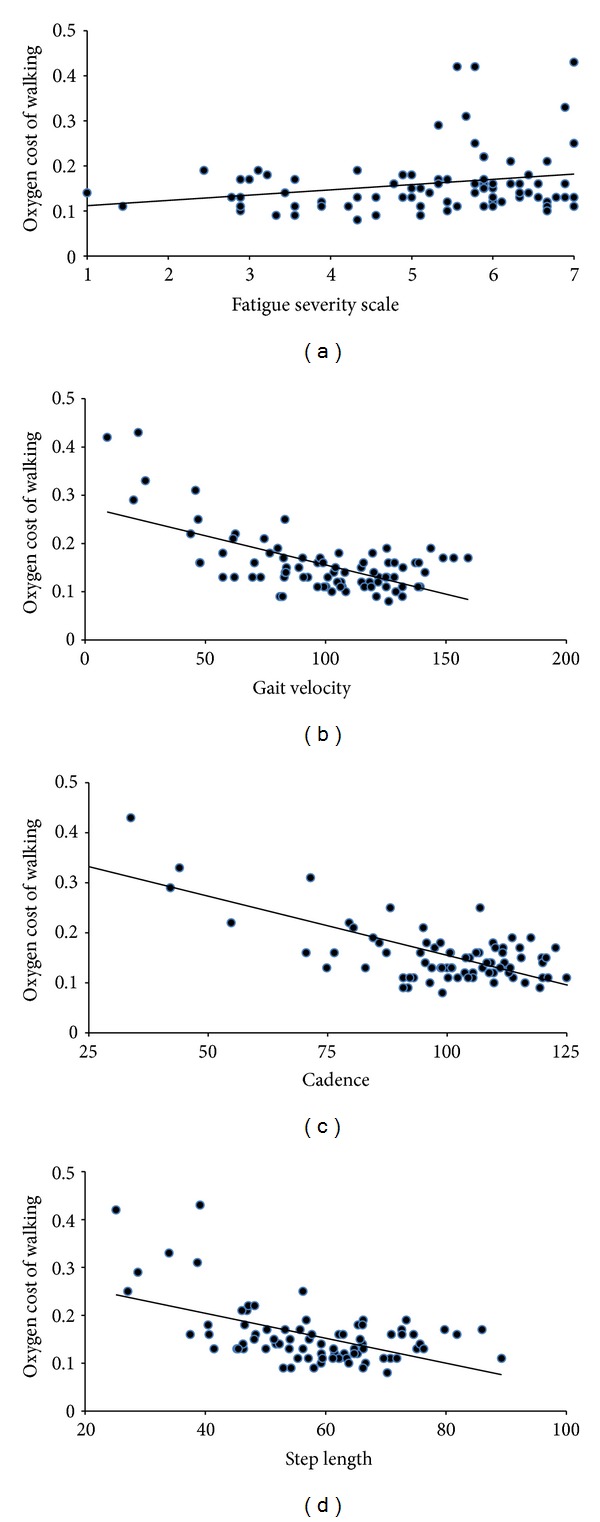
Background. The oxygen cost (O2 cost) of walking is elevated in persons with MS, particularly as a function of increasing disability status. Objective. The current study examined symptomatic (i.e., fatigue, pain, anxiety, and depression) and gait (i.e., velocity, cadence, and step length) variables that might explain why disability status is associated with O2 cost of walking in persons with MS. Materials and Methods. 82 participants completed the Patient-Determined Disease Steps, Fatigue Severity Scale, McGill Pain Questionnaire, and Hospital Anxiety and Depression Scale and undertook 2 trials of walking on a GAITRite electronic walkway. Participants then completed a six-minute walk test with concurrent assessment of expired gases for quantifying oxygen consumption and O2 cost of walking. Results. Disability (r = 0.55) as well as fatigue (r = 0.22), gait velocity (r = -0.62), cadence (r = -0.73), and step length (r = -0.53) were associated with the O2 cost of walking. Cadence (β = -0.67), but not step length (β = -0.14) or fatigue (β = -0.10), explained the association between disability and the O2 cost of walking. Conclusions. These results highlight cadence as a target of rehabilitation for increasing metabolic efficiency during walking among those with MS, particularly as a function of worsening disability.
背景。多发性硬化症患者步行时的氧气消耗(O2消耗)会升高,尤其是随着残疾程度的增加。目的。本研究考察了可能解释为何残疾程度与多发性硬化症患者步行时的O2消耗相关的症状性(即疲劳、疼痛、焦虑和抑郁)和步态(即速度、步频和步长)变量。材料与方法。82名参与者完成了患者自定疾病阶段量表、疲劳严重程度量表、麦吉尔疼痛问卷和医院焦虑抑郁量表,并在GAITRite电子步道上进行了2次步行试验。参与者随后完成了六分钟步行测试,同时评估呼出气体以量化氧气消耗和步行时的O2消耗。结果。残疾程度(r = 0.55)以及疲劳(r = 0.22)、步态速度(r = -0.62)、步频(r = -0.73)和步长(r = -0.53)与步行时的O2消耗相关。步频(β = -0.67),而非步长(β = -0.14)或疲劳(β = -0.10),解释了残疾程度与步行时O2消耗之间的关联。结论。这些结果突出了步频作为康复目标的重要性,以提高多发性硬化症患者步行时的代谢效率,尤其是在残疾程度恶化的情况下。