Ryan Alice S, Xu Huichun, Ivey Frederick M, Macko Richard F, Hafer-Macko Charlene E
VA Maryland Health Care System, Research Service, Department of Medicine, Division of Gerontology and Geriatric Medicine, Department of Neurology, at the University of Maryland School of Medicine, and the Baltimore Geriatric Research, Education and Clinical Center (GRECC), MD.
Neurol Genet. 2019 May 1;5(3):e331. doi: 10.1212/NXG.0000000000000331. eCollection 2019 Jun.
(1) To compare paretic (P) vs nonparetic (NP) skeletal muscle brain-derived neurotrophic factor (BDNF) and the effects of resistive training (RT) on systemic and skeletal muscle BDNF mRNA expression in stroke; and (2) to compare the DNA methylation profile for BDNF and BDNFAS (BDNF antisense RNA) between P and NP muscle and the effects of aerobic exercise training (AEX) on DNA methylation in stroke.
In this longitudinal investigation, participants (50-76 years) with chronic stroke underwent a fasting blood draw, a 12-week (3×/week) RT intervention (n = 16), and repeated bilateral vastus lateralis muscle tissue biopsies (n = 10) with BDNF expression determined by RT-PCR. Five stroke survivors completed 6 months of AEX (3×/week) and had bilateral muscle biopsies. DNA methylation status in gene BDNF and BDNFAS was assessed by Illumina 450k methylation array.
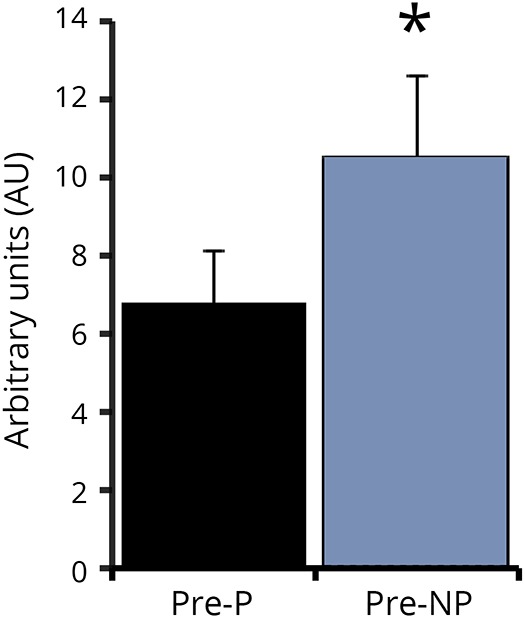
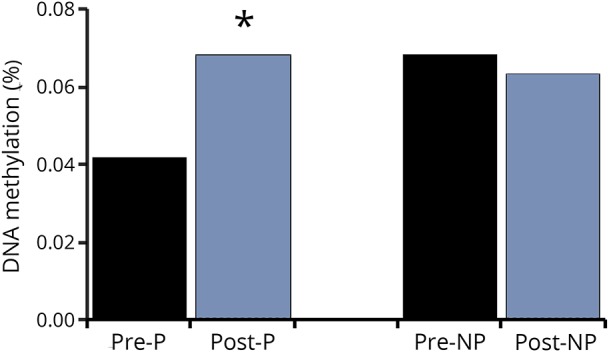
P muscle had ∼45% lower BDNF mRNA expression than NP muscle (6.79 ± 1.30 vs 10.52 ± 2.06 arbitrary units [AU], < 0.05), and P muscle exhibited differential methylation status in the DNA sequences of BDNF (3 CpG [5'-C-phosphate-G-3'] sites, = 0.016-0.044) and BDNFAS (1 CpG site, = 0.016) compared to NP. Plasma BDNF and muscle BDNF messenger RNA (mRNA) expression did not significantly change after RT. BDNFAS DNA methylation increased after AEX in P relative to NP muscle ( = 0.017).
This is the first evidence that stroke hemiparesis reduces BDNF skeletal muscle expression, with our findings identifying methylation alterations on the DNA sequence of BDNF and BDNFAS gene. Preliminary results further indicate that AEX increases methylation in BDNFAS gene, which presumably could regulate the expression of BDNF.
(1)比较中风患者患侧(P)与非患侧(NP)骨骼肌中脑源性神经营养因子(BDNF)的差异,以及抗阻训练(RT)对全身和骨骼肌中BDNF mRNA表达的影响;(2)比较P肌与NP肌中BDNF和BDNFAS(BDNF反义RNA)的DNA甲基化谱,以及有氧运动训练(AEX)对中风患者DNA甲基化的影响。
在这项纵向研究中,患有慢性中风的参与者(50 - 76岁)进行空腹采血、为期12周(每周3次)的RT干预(n = 16),并重复进行双侧股外侧肌组织活检(n = 10),通过逆转录聚合酶链反应(RT-PCR)测定BDNF表达。5名中风幸存者完成了6个月的AEX(每周3次)并进行了双侧肌肉活检。通过Illumina 450k甲基化芯片评估BDNF和BDNFAS基因的DNA甲基化状态。
P肌的BDNF mRNA表达比NP肌低约45%(分别为6.79 ± 1.30与10.52 ± 2.06任意单位[AU],P < 0.05),与NP肌相比,P肌在BDNF的DNA序列(3个CpG[5'-C-磷酸-G-3']位点,P = 0.016 - 0.044)和BDNFAS(1个CpG位点,P = 0.016)中表现出不同的甲基化状态。RT后血浆BDNF和肌肉BDNF信使核糖核酸(mRNA)表达无显著变化。与NP肌相比,AEX后P肌中BDNFAS的DNA甲基化增加(P = 0.017)。
这是首个表明中风偏瘫会降低BDNF骨骼肌表达的证据,我们的研究结果确定了BDNF和BDNFAS基因DNA序列上的甲基化改变。初步结果进一步表明,AEX会增加BDNFAS基因的甲基化,这可能会调节BDNF的表达。