Murphy Sandra, Zweyer Margit, Mundegar Rustam R, Swandulla Dieter, Ohlendieck Kay
Department of Biology, Maynooth University, National University of Ireland, Maynooth, Co. Kildare, Ireland.
Institute of Physiology II, University of Bonn, D53115 Bonn, Germany.
Biochem Biophys Rep. 2018 May 30;18:100541. doi: 10.1016/j.bbrep.2018.05.006. eCollection 2019 Jul.
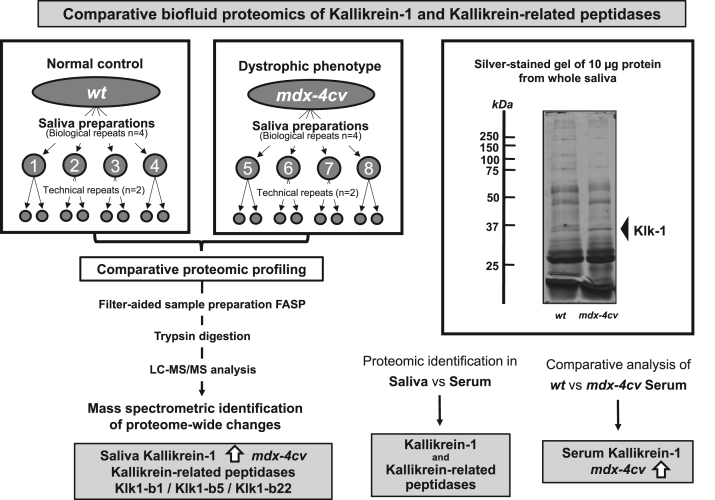
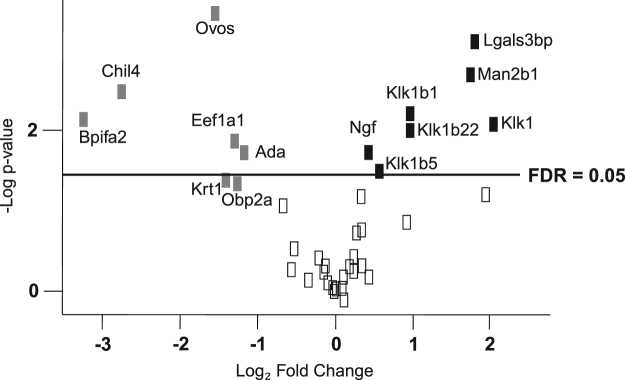
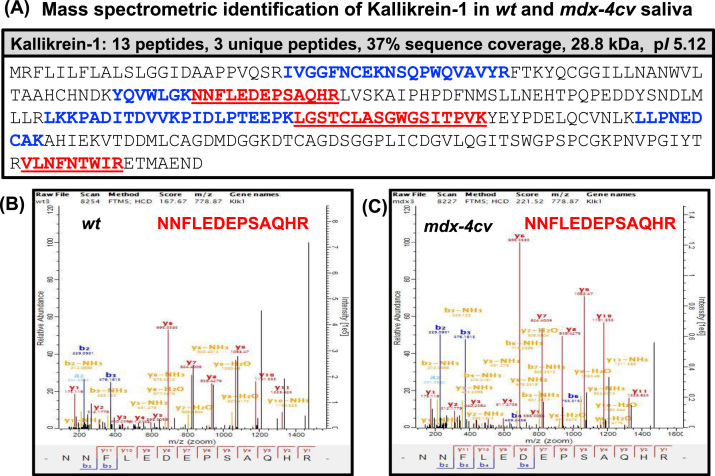
Dystrophinopathies are multi-system disorders that affect the skeletal musculature, the cardio-respiratory system and the central nervous system. The systematic screening of suitable biofluids for released or altered proteins promises new insights into the highly complex pathophysiology of X-linked muscular dystrophy. However, standard detection approaches using antibody-based assays often fail to reproducibly detect low-abundance protein isoforms in dilute biological fluids. In contrast, mass spectrometric screening approaches enable the proteome-wide identification of minor protein changes in biofluids. This report describes the findings from the comparative proteomic analysis of whole saliva samples from wild type versus the established mouse model of highly progressive muscular dystrophy, focusing on the kallikrein protein family. Kallikrein-1 (Klk1) and 13 Klk1-related peptidases were identified in saliva and serum from normal mice. Comparative proteomics revealed elevated saliva levels of the Klk1-related peptidases Klk1-b1, Klk1-b5 and Klk-b22, as well as an increased Klk-1 concentration, which agrees with higher Klk-1 levels in serum from mice. This indicates altered cellular signaling, extracellular matrix remodeling and an altered immune response in the mouse, and establishes liquid biopsy procedures as suitable bioanalytical tools for the systematic survey of complex pathobiochemical changes in animal models of muscular dystrophy.
肌营养不良症是一种多系统疾病,会影响骨骼肌肉组织、心肺系统和中枢神经系统。对释放或改变的蛋白质进行合适生物流体的系统筛查,有望为X连锁肌营养不良症高度复杂的病理生理学带来新的见解。然而,基于抗体检测的标准检测方法往往无法在稀释的生物流体中可重复地检测到低丰度蛋白质异构体。相比之下,质谱筛查方法能够在蛋白质组范围内识别生物流体中微小的蛋白质变化。本报告描述了野生型与已建立的高度进行性肌营养不良小鼠模型的全唾液样本的比较蛋白质组学分析结果,重点关注激肽释放酶蛋白家族。在正常小鼠的唾液和血清中鉴定出了激肽释放酶-1(Klk1)和13种与Klk1相关的肽酶。比较蛋白质组学显示,与Klk1相关的肽酶Klk1-b1、Klk1-b5和Klk-b22的唾液水平升高,以及Klk-1浓度增加,这与小鼠血清中较高的Klk-1水平一致。这表明小鼠体内细胞信号传导、细胞外基质重塑和免疫反应发生了改变,并将液体活检程序确立为用于系统调查肌营养不良动物模型中复杂病理生化变化的合适生物分析工具。