Mbah Emmanuel Ukaobasi, Nwankwo Blessing Chinwoke, Njoku Damian Ndubuisi, Gore Michael A
Department of Agronomy, College of Crop and Soil Sciences, Michael Okpara University of Agriculture, Umudike, Abia State, Nigeria.
Genetic Resources Unit, National Root Crops Research Institute, Umudike, Nigeria.
Heliyon. 2019 Jun 1;5(6):e01855. doi: 10.1016/j.heliyon.2019.e01855. eCollection 2019 Jun.
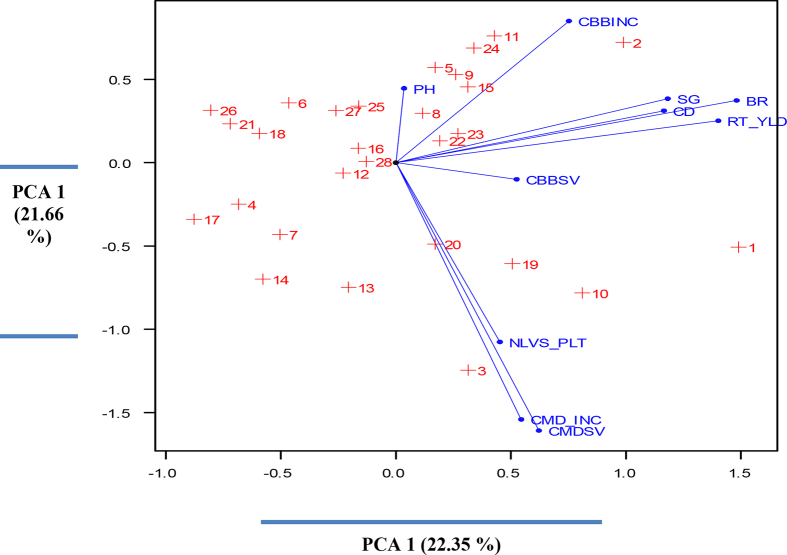
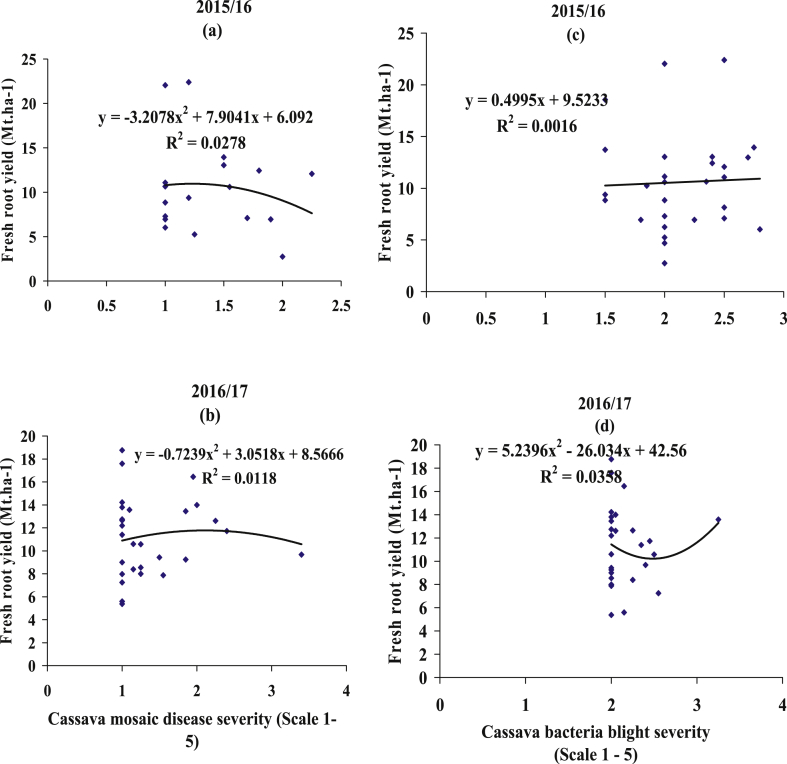
A two-year field experiment was carried out in a randomized complete block design with two replications in 2015/16 and 2016/17 cropping seasons at the National Root Crops Research Institute, Umudike (05° 29'N; 07° 33'E; 122 m above sea level) in Nigeria. The objectives of the study were to assess growth, disease status and yield responses of twenty-eight (28) newly developed high- and low-cyanide cassava genotypes in low-land humid tropics of Umudike, Nigeria. Plant height, stem girth, canopy diameter, number of leaves/plant, cassava mosaic disease (CMD) and cassava bacterial blight (CBB) incidence and severity as well as bulking rate and fresh root yield varied significantly ( < 0.05) amongst the high- and low-cyanide cassava genotypes in both cropping seasons. Also, the results showed that bitter cassava genotypes exhibited greater tolerance to CMD than sweet cassava. However, there was no significant () difference in bulking rate and fresh root yield between the two groups. The Pearson's and Spearman's ranked associations between fresh root yield of the cassava genotypes and other variables analysed across the two cropping seasons were highly significant ( ≤ 0.01) and positive contrary to the other variables. However, they exhibited different degrees of associations amongst themselves, especially CMD incidence that indicated highly significant and positive association with severity. The principal component analysis across the two cropping seasons indicated eigen-values of the four axes > unity with cumulative variance of 68.98 %. Most of the characters that contributed to the 22.35 % observed variability in principal component (PC1) were CMD incidence and severity, and number of leaves/plant while PC2 also exhibited high vector load from plant attributes such as number of leaves/plant, bulking rate ha and canopy diameter. The bi-plot clustering indicated that genotypes (BI-56, NR110439 and B1-29) exhibited strong similarity amongst themselves across the tested variables. The combined fresh root yield sequence of the first ten high yielder genotypes was in the order: NR110439 > TMS010354 > NR110315 > NR 110238 > NR 110228 > NR 060169 > BI-117 > BI-50 > NR110084 > NR 110181. These cassava genotypes were considered to be better endowed genetically, hence their improvement can be encouraged to ensure high and sustainable root yield. A poly-linear and positive regression was recorded between CMD and root yield as well as between CBB and root yield indicating that they affected fresh root yield of high- and low-cyanide cassava genotypes and demands attention also in cassava improvement studies.
2015/16年和2016/17年种植季,在尼日利亚乌姆迪克国家块根作物研究所(北纬05°29′;东经07°33′;海拔122米),采用随机完全区组设计,进行了一项为期两年的田间试验,重复两次。本研究的目的是评估28个新培育的高氰和低氰木薯基因型在尼日利亚乌姆迪克低地湿润热带地区的生长、病害状况和产量反应。在两个种植季中,高氰和低氰木薯基因型之间的株高、茎围、冠幅、单株叶片数、木薯花叶病(CMD)和木薯细菌性枯萎病(CBB)的发病率和病情严重程度以及块根膨大率和鲜根产量均存在显著差异(P<0.05)。此外,结果表明,苦味木薯基因型对CMD的耐受性高于甜味木薯。然而,两组之间的块根膨大率和鲜根产量没有显著差异(P>0.05)。在两个种植季中,木薯基因型的鲜根产量与其他分析变量之间的Pearson和Spearman等级相关性极显著(P≤0.01)且为正相关,这与其他变量相反。然而,它们之间表现出不同程度的相关性,尤其是CMD发病率与病情严重程度呈极显著正相关。两个种植季的主成分分析表明,四个轴的特征值大于1,累积方差为68.98%。对主成分1(PC1)中观察到的22.35%变异有贡献的大多数性状是CMD发病率和病情严重程度以及单株叶片数,而PC2也表现出来自单株叶片数、公顷块根膨大率和冠幅等植株属性的高向量负荷。双标图聚类表明,基因型(BI-56、NR110439和B1-29)在所有测试变量中彼此表现出很强的相似性。前十位高产基因型的综合鲜根产量顺序为:NR110439>TMS010354>NR110315>NR 110238>NR 110228>NR 060169>BI-117>BI-50>NR110084>NR 110181。这些木薯基因型被认为具有更好的遗传禀赋,因此可以鼓励对其进行改良,以确保获得高产和可持续的根产量。CMD与根产量之间以及CBB与根产量之间均记录到多线性正回归,表明它们影响高氰和低氰木薯基因型的鲜根产量,在木薯改良研究中也需要关注。