Parasites and Microbes, Wellcome Sanger Institute, Hinxton, UK.
Parasites and Microbes, Wellcome Sanger Institute, Hinxton, UK.
Lancet Infect Dis. 2019 Jul;19(7):759-769. doi: 10.1016/S1473-3099(19)30297-X. Epub 2019 Jun 10.
Invasive pneumococcal disease remains an important health priority owing to increasing disease incidence caused by pneumococci expressing non-vaccine serotypes. We previously defined 621 Global Pneumococcal Sequence Clusters (GPSCs) by analysing 20 027 pneumococcal isolates collected worldwide and from previously published genomic data. In this study, we aimed to investigate the pneumococcal lineages behind the predominant serotypes, the mechanism of serotype replacement in disease, as well as the major pneumococcal lineages contributing to invasive pneumococcal disease in the post-vaccine era and their antibiotic resistant traits.
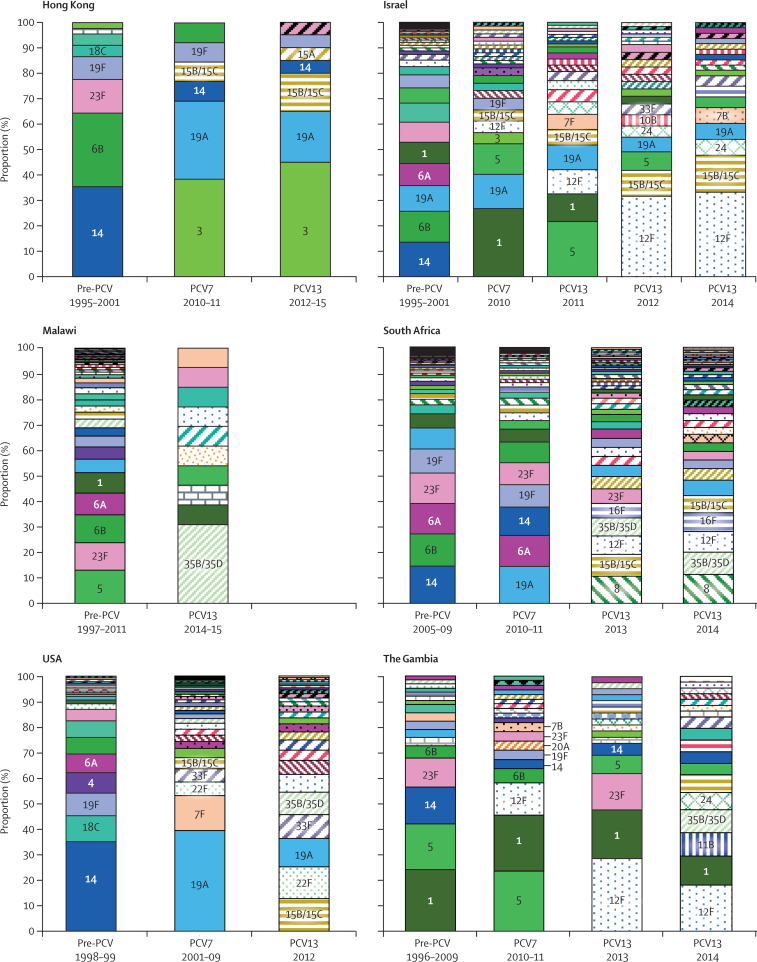
We whole-genome sequenced 3233 invasive pneumococcal disease isolates from laboratory-based surveillance programmes in Hong Kong (n=78), Israel (n=701), Malawi (n=226), South Africa (n=1351), The Gambia (n=203), and the USA (n=674). The genomes represented pneumococci from before and after pneumococcal conjugate vaccine (PCV) introductions and were from children younger than 3 years. We identified predominant serotypes by prevalence and their major contributing lineages in each country, and assessed any serotype replacement by comparing the incidence rate between the pre-PCV and PCV periods for Israel, South Africa, and the USA. We defined the status of a lineage as vaccine-type GPSC (≥50% 13-valent PCV [PCV13] serotypes) or non-vaccine-type GPSC (>50% non-PCV13 serotypes) on the basis of its initial serotype composition detected in the earliest vaccine period to measure their individual contribution toward serotype replacement in each country. Major pneumococcal lineages in the PCV period were identified by pooled incidence rate using a random effects model.
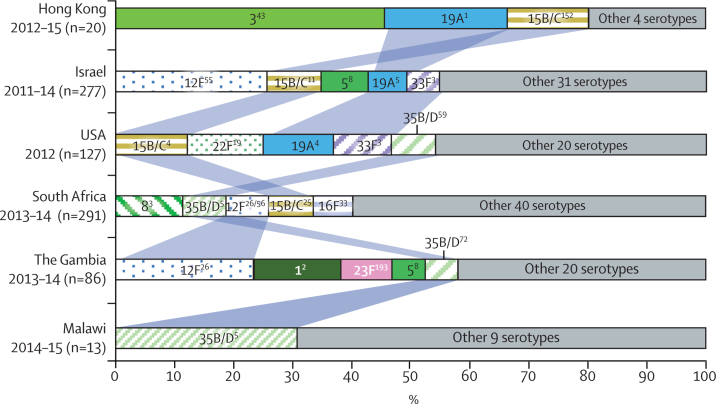
The five most prevalent serotypes in the PCV13 period varied between countries, with only serotypes 5, 12F, 15B/C, 19A, 33F, and 35B/D common to two or more countries. The five most prevalent serotypes in the PCV13 period varied between countries, with only serotypes 5, 12F, 15B/C, 19A, 33F, and 35B/D common to two or more countries. These serotypes were associated with more than one lineage, except for serotype 5 (GPSC8). Serotype replacement was mainly mediated by expansion of non-vaccine serotypes within vaccine-type GPSCs and, to a lesser extent, by increases in non-vaccine-type GPSCs. A globally spreading lineage, GPSC3, expressing invasive serotypes 8 in South Africa and 33F in the USA and Israel, was the most common lineage causing non-vaccine serotype invasive pneumococcal disease in the PCV13 period. We observed that same prevalent non-vaccine serotypes could be associated with distinctive lineages in different countries, which exhibited dissimilar antibiotic resistance profiles. In non-vaccine serotype isolates, we detected significant increases in the prevalence of resistance to penicillin (52 [21%] of 249 vs 169 [29%] of 575, p=0·0016) and erythromycin (three [1%] of 249 vs 65 [11%] of 575, p=0·0031) in the PCV13 period compared with the pre-PCV period.
Globally spreading lineages expressing invasive serotypes have an important role in serotype replacement, and emerging non-vaccine serotypes associated with different pneumococcal lineages in different countries might be explained by local antibiotic-selective pressures. Continued genomic surveillance of the dynamics of the pneumococcal population with increased geographical representation in the post-vaccine period will generate further knowledge for optimising future vaccine design.
Bill & Melinda Gates Foundation, Wellcome Sanger Institute, and the US Centers for Disease Control.
由于表达非疫苗血清型的肺炎球菌导致侵袭性肺炎球菌病发病率不断上升,该疾病仍然是一个重要的健康优先事项。我们之前通过分析来自全球和先前发表的基因组数据的 20027 株肺炎球菌分离株,定义了 621 个全球肺炎球菌序列簇(GPSC)。在这项研究中,我们旨在研究主要血清型背后的肺炎球菌谱系、疾病中血清型替代的机制,以及在疫苗接种后时代导致侵袭性肺炎球菌病的主要肺炎球菌谱系及其抗生素耐药特征。
我们对来自香港(n=78)、以色列(n=701)、马拉维(n=226)、南非(n=1351)、冈比亚(n=203)和美国(n=674)的基于实验室的监测计划的 3233 例侵袭性肺炎球菌病分离株进行了全基因组测序。这些基因组代表了肺炎球菌在引入肺炎球菌结合疫苗(PCV)前后的情况,且来自 3 岁以下的儿童。我们根据每个国家的流行程度确定了主要血清型及其主要贡献谱系,并通过比较以色列、南非和美国在 PCV 前后时期的发病率来评估任何血清型替代情况。我们根据最早的疫苗接种时期检测到的初始血清型组成,将谱系定义为疫苗型 GPSC(≥50% 13 价 PCV [PCV13] 血清型)或非疫苗型 GPSC(>50%非 PCV13 血清型),以衡量它们在每个国家血清型替代中的个体贡献。在 PCV 时期,通过使用随机效应模型对主要的肺炎球菌谱系进行了汇总发病率分析。
在 PCV13 时期,各国之间最常见的 5 种血清型不同,只有血清型 5、12F、15B/C、19A、33F 和 35B/D 与两个或更多国家有关。这些血清型与多个谱系相关,除了血清型 5(GPSC8)之外。血清型替代主要是通过疫苗型 GPSC 内非疫苗血清型的扩展和在较小程度上通过非疫苗型 GPSC 的增加来介导的。一个在全球范围内传播的谱系 GPSC3,在南非表达侵袭性血清型 8,在美国和以色列表达 33F,是导致 PCV13 时期非疫苗血清型侵袭性肺炎球菌病的最常见谱系。我们观察到,在不同国家,相同的流行非疫苗血清型可能与不同的谱系相关,这些谱系表现出不同的抗生素耐药谱。在非疫苗血清型分离株中,我们发现与 PCV 前时期相比,青霉素(249 株中的 52 [21%]与 575 株中的 169 [29%],p=0·0016)和红霉素(249 株中的 3 [1%]与 575 株中的 65 [11%],p=0·0031)的耐药率显著增加。
在全球范围内传播的表达侵袭性血清型的谱系在血清型替代中起着重要作用,而在不同国家与不同肺炎球菌谱系相关的新出现的非疫苗血清型可能可以用当地抗生素选择压力来解释。在疫苗接种后时期,随着地理代表性的增加,对肺炎球菌种群动态的持续基因组监测将为优化未来的疫苗设计提供进一步的知识。
比尔和梅琳达·盖茨基金会、惠康桑格研究所和美国疾病控制与预防中心。