Department of Gastrointestinal Surgery, Union Hospital, Tongji Medical College, Huazhong University of Science and Technology, Wuhan, China.
Cancer Med. 2019 Aug;8(9):4149-4158. doi: 10.1002/cam4.2328. Epub 2019 Jun 13.
Whether gastrointestinal (GI) bleeding indicates gastrointestinal stromal tumor (GIST) rupture and impacts prognosis is unclear. We examined the prognostic value of GI bleeding in GIST.
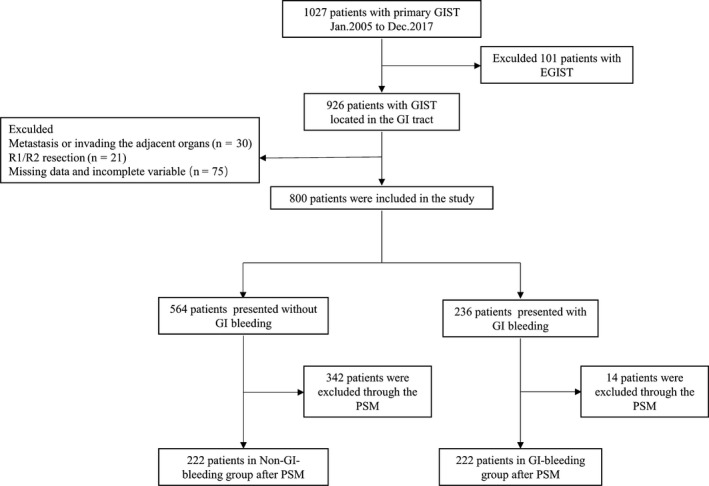
Primary GIST patients with (GB group) or without (NGB group) initial symptoms of GI bleeding were retrospectively studied. Propensity score matching (PSM) was conducted to reduce confounders.
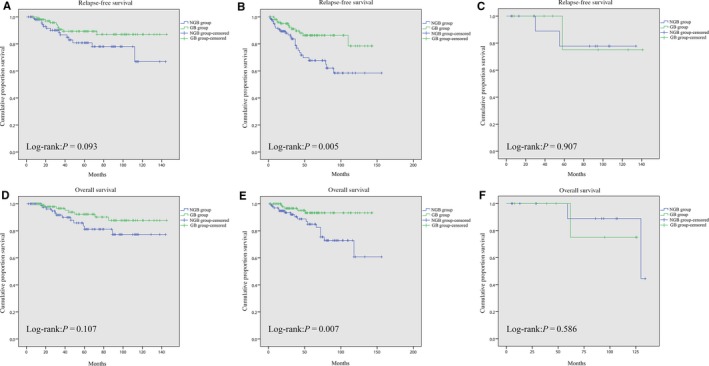
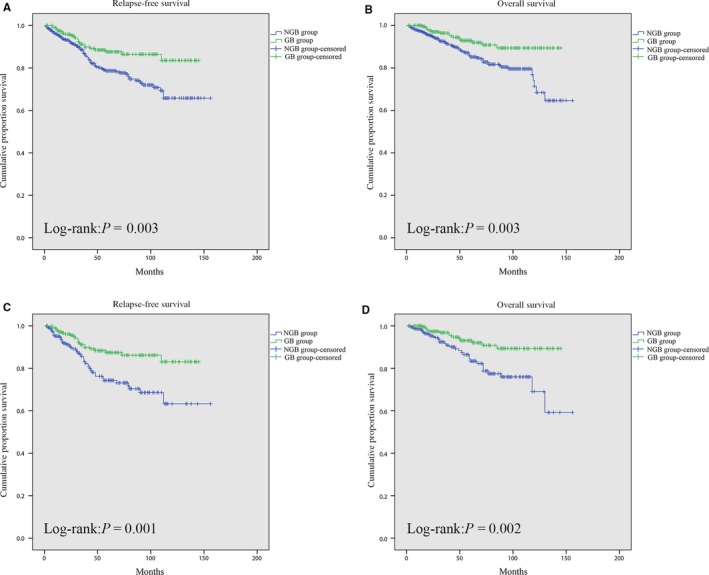
Eight hundred patients were enrolled. Male gender [odds ratio (OR) = 1.517, P = 0.011], tumors in the small intestine (OR = 2.539, P < 0.001), and tumor size 5-10 cm (OR = 2.298, P = 0.004) increased the odds of GI bleeding; age >60 years decreased the odds (OR = 0.683, P = 0.031). After PSM, 444 patients were included (222 in each group). Relapse-free survival (RFS) (P = 0.001) and overall survival (OS) (P = 0.002) were both superior in the GB group. In subgroup analysis, the GB group achieved a superior RFS (P = 0.005) and OS (P = 0.007) in patients with small intestine GIST, but not stomach or colorectal GIST.
GIST patients with age <60, male gender, tumors located in the small intestine, and tumors 5-10 cm in size had a higher risk of GI bleeding. GIST patients with GI bleeding had a superior RFS and OS. This difference was statistically significant only in small intestine GIST.
胃肠道(GI)出血是否提示胃肠道间质瘤(GIST)破裂并影响预后尚不清楚。我们研究了 GI 出血对 GIST 的预后价值。
回顾性研究了初发时有(GB 组)或无(NGB 组)GI 出血症状的原发性 GIST 患者。采用倾向评分匹配(PSM)来减少混杂因素。
共纳入 800 例患者。男性(比值比 [OR] = 1.517,P = 0.011)、小肠肿瘤(OR = 2.539,P < 0.001)和肿瘤大小 5-10 cm(OR = 2.298,P = 0.004)增加了 GI 出血的可能性;年龄 >60 岁降低了可能性(OR = 0.683,P = 0.031)。PSM 后,共纳入 444 例患者(每组 222 例)。GB 组的无复发生存率(RFS)(P = 0.001)和总生存率(OS)(P = 0.002)均更优。亚组分析显示,GB 组在小肠 GIST 患者中 RFS(P = 0.005)和 OS(P = 0.007)更优,但在胃或结直肠 GIST 患者中无差异。
年龄 <60 岁、男性、肿瘤位于小肠且肿瘤大小为 5-10 cm 的 GIST 患者发生 GI 出血的风险更高。发生 GI 出血的 GIST 患者的 RFS 和 OS 更优。这种差异仅在小肠 GIST 中具有统计学意义。