Department of Gastrointestinal Surgery, West China Hospital, Sichuan University, Chengdu, Sichuan, China (mainland).
Med Sci Monit. 2018 Jan 18;24:363-369. doi: 10.12659/msm.908186.
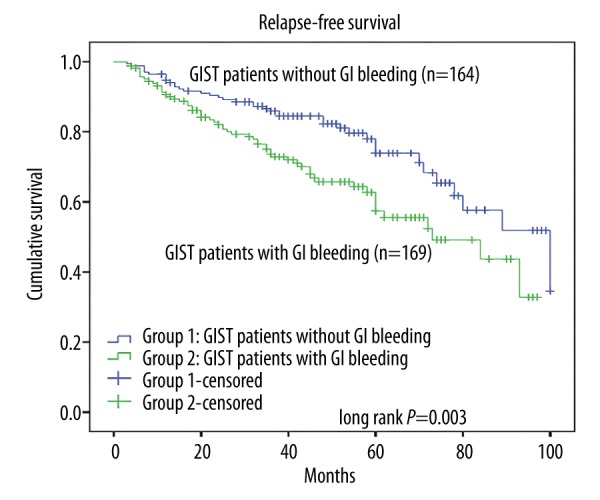
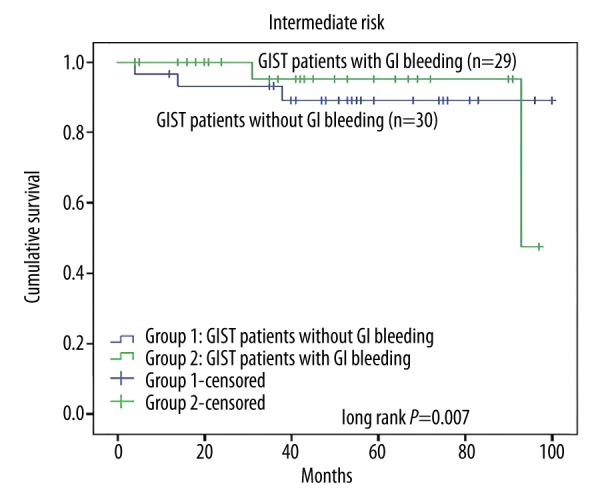
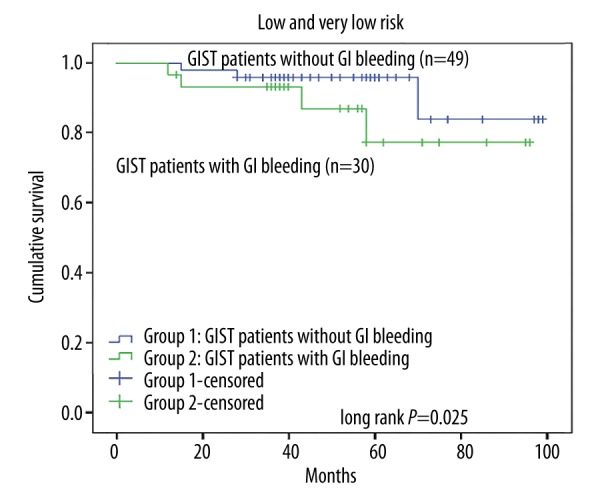
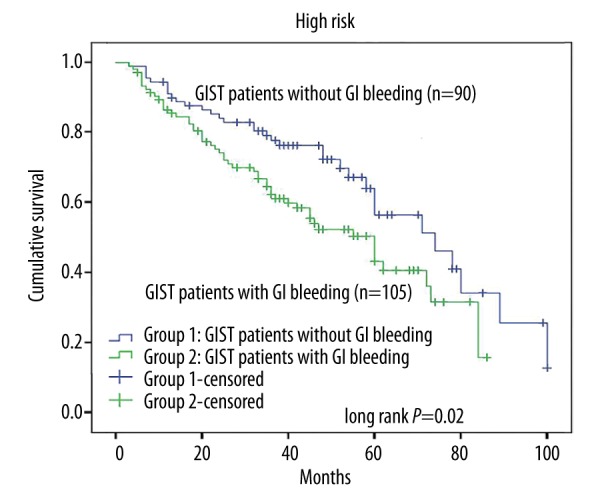
BACKGROUND The contemporary risk classification criteria of gastrointestinal stromal tumors (GISTs) may still have room to improve. The aim of our research was to analyze the impact factors for GIST patients' relapse-free survival (RFS). Furthermore, we explore whether gastrointestinal (1) bleeding will be a valuable indicator to predict GIST patients' prognosis. MATERIAL AND METHODS R0 resection GISTs patients were retrospectively enrolled during an 8-year period at West China Hospital of Sichuan University, and all patients' data were from the WCHSU-GIST database. Of a total of 333 GIST patients, 164 patients had GI bleeding. Univariate analysis and Cox regression analysis were used to calculate the survival and recurrence rates. RESULTS Compared with non-GI-bleeding patients, GI-bleeding patients had a shorter relapse-free survival (RFS, P=0.003), but among the different risk groups, GI bleeding only affected the RFS rate of the high-risk group. A Cox regression analysis illustrated that tumor site (P<0.001), tumor size (P=0.009), mitotic index (P<0.001), tumor rupture (P<0.001), and GI-bleeding (P=0.01) were independent indicators for GIST patients' RFS. CONCLUSIONS Our study demonstrates that the RFS of GIST patients with GI bleeding was significantly shorter than that of non-GI-bleeding patients, and GI bleeding was an independent negative factor predicting RFS, while GI bleeding had more influence among high-risk patients.
胃肠道间质瘤(GIST)的当代风险分类标准可能仍有改进的空间。本研究旨在分析影响 GIST 患者无复发生存(RFS)的因素。此外,我们还探讨了胃肠道(1)出血是否会成为预测 GIST 患者预后的有价值指标。
回顾性纳入在四川大学华西医院接受 R0 切除的 GIST 患者,研究时间为 8 年,所有患者的数据均来自 WCHSU-GIST 数据库。在总共 333 名 GIST 患者中,有 164 名患者有胃肠道出血。采用单因素分析和 Cox 回归分析计算生存率和复发率。
与非胃肠道出血患者相比,胃肠道出血患者的无复发生存(RFS)更短(P=0.003),但在不同风险组中,胃肠道出血仅影响高危组的 RFS 率。Cox 回归分析表明,肿瘤部位(P<0.001)、肿瘤大小(P=0.009)、有丝分裂指数(P<0.001)、肿瘤破裂(P<0.001)和胃肠道出血(P=0.01)是 GIST 患者 RFS 的独立指标。
本研究表明,胃肠道出血的 GIST 患者的 RFS 明显短于非胃肠道出血患者,且胃肠道出血是预测 RFS 的独立负性因素,而胃肠道出血在高危患者中影响更大。