de Laval Philip, Mobarrez Fariborz, Almquist Tora, Vassil Liina, Fellström Bengt, Soveri Inga
Department of Medical Sciences, Uppsala University, Uppsala, Sweden.
Department of Medicine, Karolinska Institutet, Unit of Rheumatology, Karolinska University Hospital, Solna, Sweden.
Clin Kidney J. 2018 Oct 30;12(3):456-462. doi: 10.1093/ckj/sfy109. eCollection 2019 Jun.
Microparticles (MPs) are small cell membrane-derived vesicles regarded as both biomarkers and mediators of biological effects. Elevated levels of MPs have previously been associated with endothelial dysfunction and predict cardiovascular death in patients with end-stage renal disease. The objective of this study was to measure change in MP concentrations in contemporary haemodialysis (HD).
Blood was sampled from 20 consecutive HD patients before and 1 h into the HD session. MPs were measured by flow cytometry and phenotyped based on surface markers.
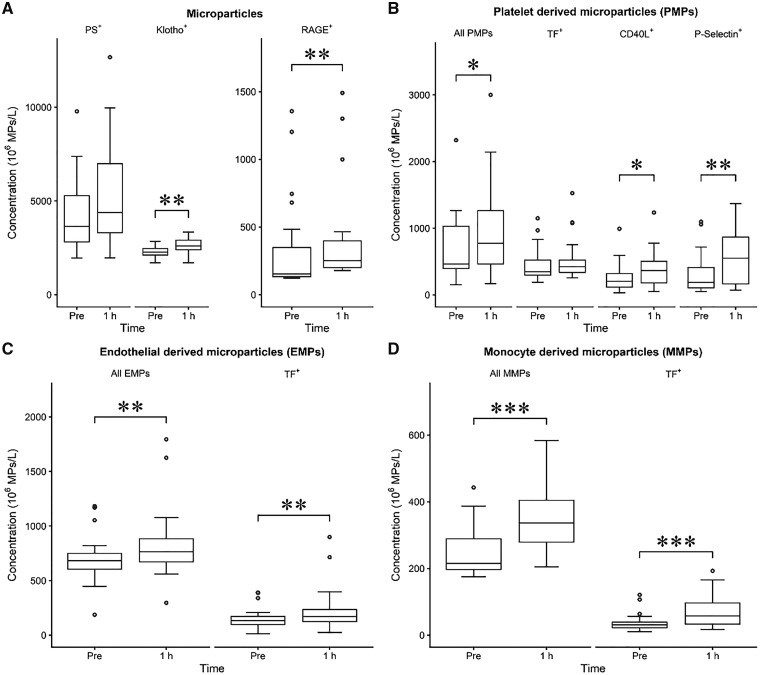
Concentrations of platelet (CD41) (P = 0.039), endothelial (CD62E) (P = 0.004) and monocyte-derived MPs (CD14) (P < 0.001) significantly increased during HD. Similarly, endothelial- (P = 0.007) and monocyte-derived MPs (P = 0.001) expressing tissue factor (TF) significantly increased as well as MPs expressing Klotho (P = 0.003) and receptor for advanced glycation end products (RAGE) (P = 0.009). Furthermore, MPs expressing platelet activation markers P-selectin (P = 0.009) and CD40L (P = 0.045) also significantly increased. The increase of endothelial (P = 0.034), monocyte (P = 0.014) and RAGE MPs (P = 0.032) as well as TF platelet-derived MPs (P = 0.043) was significantly higher in patients treated with low-flux compared with high-flux dialysers.
Dialysis triggers release of MPs of various origins with marked differences between high-flux and low-flux dialysers. The MPs carry surface molecules that could possibly influence coagulation, inflammation, oxidative stress and endothelial dysfunction. The clinical impact of these findings remains to be established in future studies.
微粒(MPs)是源自细胞膜的小囊泡,被视为生物标志物和生物效应的介质。此前,MPs水平升高与内皮功能障碍相关,并可预测终末期肾病患者的心血管死亡。本研究的目的是测量当代血液透析(HD)中MP浓度的变化。
对20例连续HD患者在HD治疗前及治疗1小时后采集血液样本。通过流式细胞术测量MPs,并根据表面标志物进行表型分析。
HD期间,血小板(CD41)(P = 0.039)、内皮细胞(CD62E)(P = 0.004)和单核细胞来源的MPs(CD14)(P < 0.001)浓度显著增加。同样,表达组织因子(TF)的内皮细胞来源的MPs(P = 0.007)和单核细胞来源的MPs(P = 0.001)以及表达Klotho(P = 0.003)和晚期糖基化终产物受体(RAGE)(P = 0.009)的MPs也显著增加。此外,表达血小板活化标志物P-选择素(P = 0.009)和CD40L(P = 0.045)的MPs也显著增加。与高通量透析器相比,低通量透析器治疗的患者中,内皮细胞(P = 0.034)、单核细胞(P = 0.014)和RAGE MPs(P = 0.032)以及TF血小板来源的MPs(P = 0.043)的增加显著更高。
透析引发多种来源的MPs释放,高通量和低通量透析器之间存在显著差异。MPs携带的表面分子可能影响凝血、炎症、氧化应激和内皮功能障碍。这些发现的临床影响有待未来研究确定。