Spady Blake L, Nay Tiffany J, Rummer Jodie L, Munday Philip L, Watson Sue-Ann
Australian Research Council Centre of Excellence for Coral Reef Studies, James Cook University, Townsville, QLD, Australia.
College of Science and Engineering, James Cook University, Townsville, QLD, Australia.
Conserv Physiol. 2019 Jun 7;7(1):coz024. doi: 10.1093/conphys/coz024. eCollection 2019.
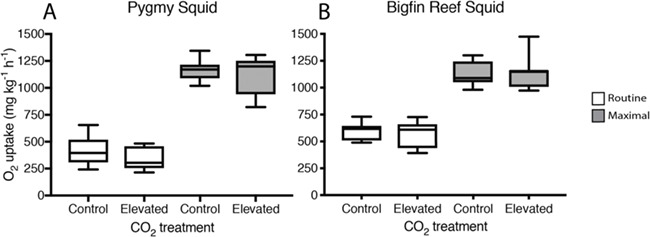
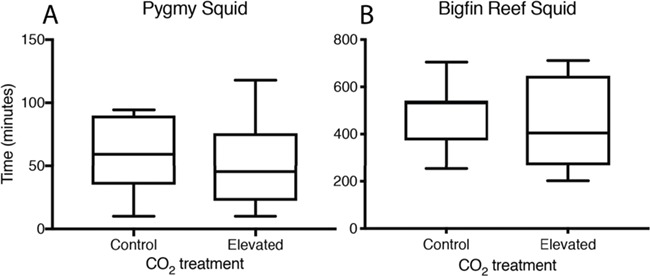
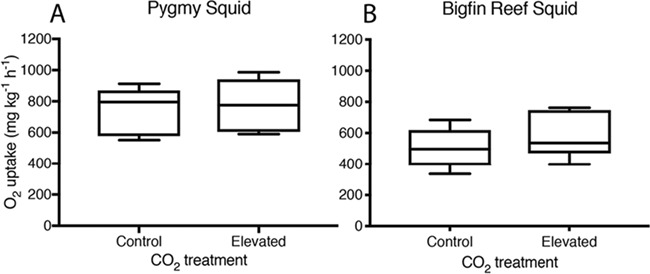
Squid and many other cephalopods live continuously on the threshold of their environmental oxygen limitations. If the abilities of squid to effectively take up oxygen are negatively affected by projected future carbon dioxide (CO) levels in ways similar to those demonstrated in some fish and invertebrates, it could affect the success of squid in future oceans. While there is evidence that acute exposure to elevated CO has adverse effects on cephalopod respiratory performance, no studies have investigated this in an adult cephalopod after relatively prolonged exposure to elevated CO or determined any effects on aerobic scope. Here, we tested the effects of prolonged exposure (≥20% of lifespan) to elevated CO levels (~1000 μatm) on the routine and maximal oxygen uptake rates, aerobic scope and recovery time of two tropical cephalopod species, the two-toned pygmy squid, and the bigfin reef squid, . Neither species exhibited evidence of altered aerobic performance after exposure to elevated CO when compared to individuals held at control conditions. The recovery time of under both control and elevated CO conditions was less than 1 hour, whereas required approximately 8 hours to recover fully following maximal aerobic performance. This difference in recovery time may be due to the more sedentary behaviours of . The ability of these two cephalopod species to cope with prolonged exposure to elevated CO without detriment to their aerobic performance suggests some resilience to an increasingly high CO world.
鱿鱼和许多其他头足类动物一直生活在其环境氧气限制的临界状态。如果鱿鱼有效摄取氧气的能力受到未来预计二氧化碳(CO)水平的负面影响,其方式类似于在一些鱼类和无脊椎动物中所表现出的情况,那么这可能会影响鱿鱼在未来海洋中的生存。虽然有证据表明急性暴露于高浓度CO对头足类动物的呼吸性能有不利影响,但尚无研究在成年头足类动物中调查相对长时间暴露于高浓度CO后的情况,也未确定其对有氧代谢范围的任何影响。在此,我们测试了长时间暴露(≥寿命的20%)于高浓度CO水平(约1000微大气压)对两种热带头足类动物——双斑矮鱿鱼和大鳍礁鱿鱼的常规和最大摄氧率、有氧代谢范围及恢复时间的影响。与处于对照条件下的个体相比,两种物种在暴露于高浓度CO后均未表现出有氧性能改变的迹象。在对照和高浓度CO条件下,双斑矮鱿鱼的恢复时间均少于1小时,而大鳍礁鱿鱼在最大有氧性能后完全恢复大约需要8小时。恢复时间的这种差异可能是由于双斑矮鱿鱼的行为更为 sedentary 。这两种头足类动物应对长时间暴露于高浓度CO而不损害其有氧性能的能力表明它们对日益升高的CO环境具有一定的适应能力。