Interdisciplinary Program in Bioengineering, Seoul National University, Seoul, Republic of Korea.
Institute of Medical & Biological Engineering, Medical Research Center, Seoul National University, Seoul, Republic of Korea.
JMIR Mhealth Uhealth. 2019 Jun 13;7(6):e13327. doi: 10.2196/13327.
Cardiorespiratory fitness (CRF), an important index of physical fitness, is the ability to inhale and provide oxygen to the exercising muscle. However, despite its importance, the current gold standard for measuring CRF is impractical, requiring maximal exercise from the participants.
This study aimed to develop a convenient and practical estimation model for CRF using data collected from daily life with a wristwatch-type device.
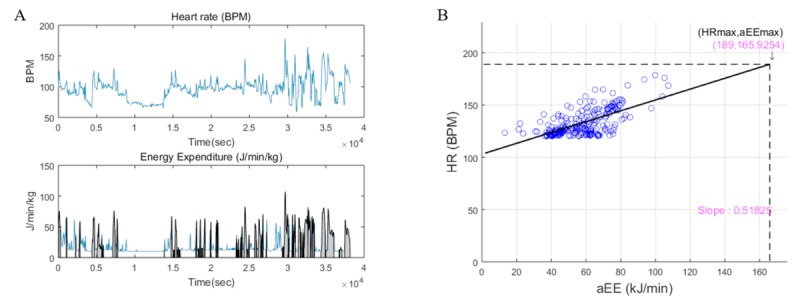
A total of 191 subjects, aged 20 to 65 years, participated in this study. Maximal oxygen uptake (VO max), a standard measure of CRF, was measured with a maximal exercise test. Heart rate (HR) and physical activity data were collected using a commercial wristwatch-type fitness tracker (Fitbit; Fitbit Charge; Fitbit) for 3 consecutive days. Maximal activity energy expenditure (aEEmax) and slope between HR and physical activity were calculated using a linear regression. A VO max estimation model was built using multiple linear regression with data on age, sex, height, percent body fat, aEEmax, and the slope. The result was validated with 2 different cross-validation methods.
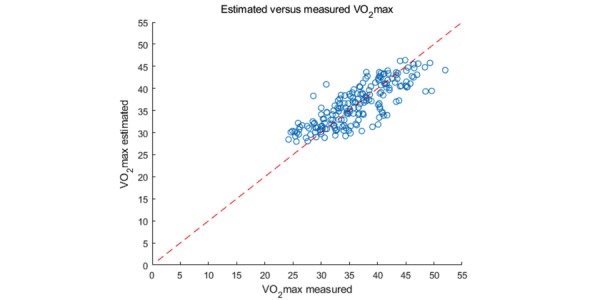
aEEmax showed a moderate correlation with VO max (r=0.50). The correlation coefficient for the multiple linear regression model was 0.81, and the SE of estimate (SEE) was 3.518 mL/kg/min. The regression model was cross-validated through the predicted residual error sum of square (PRESS). The PRESS correlation coefficient was 0.79, and the PRESS SEE was 3.667 mL/kg/min. The model was further validated by dividing it into different subgroups and calculating the constant error (CE) where a low CE showed that the model does not significantly overestimate or underestimate VO max.
This study proposes a CRF estimation method using data collected by a wristwatch-type fitness tracker without any specific protocol for a wide range of the population.
心肺适能(CRF)是身体机能的一个重要指标,是指吸入氧气并为运动肌肉供氧的能力。然而,尽管它很重要,但目前测量 CRF 的金标准不切实际,需要参与者进行最大运动。
本研究旨在使用从佩戴腕戴式设备的日常生活中收集的数据,开发一种方便实用的 CRF 估计模型。
共有 191 名 20 至 65 岁的受试者参加了这项研究。最大摄氧量(VO max),CRF 的标准测量,是通过最大运动测试来测量的。心率(HR)和身体活动数据是使用商用腕戴式健身追踪器(Fitbit;Fitbit Charge;Fitbit)连续 3 天收集的。使用线性回归计算最大活动能量消耗(aEEmax)和 HR 与身体活动之间的斜率。使用多元线性回归,根据年龄、性别、身高、体脂百分比、aEEmax 和斜率建立 VO max 估计模型。使用两种不同的交叉验证方法验证结果。
aEEmax 与 VO max 呈中度相关(r=0.50)。多元线性回归模型的相关系数为 0.81,估计标准误差(SEE)为 3.518 mL/kg/min。通过预测残差平方和(PRESS)对回归模型进行交叉验证。PRESS 相关系数为 0.79,PRESS SEE 为 3.667 mL/kg/min。该模型通过将其分为不同的亚组并计算常量误差(CE)进一步验证,其中低 CE 表明该模型不会显著高估或低估 VO max。
本研究提出了一种使用腕戴式健身追踪器收集的数据来估计 CRF 的方法,无需针对广泛人群制定特定的方案。