Primary Care, VA Boston Healthcare System, 1400 VFW Pkwy, West Roxbury, Boston, MA, 02132, USA.
Usher Institute, Edinburgh Medical School, University of Edinburgh, Edinburgh, UK.
Sci Rep. 2021 Jul 21;11(1):14851. doi: 10.1038/s41598-021-94164-x.
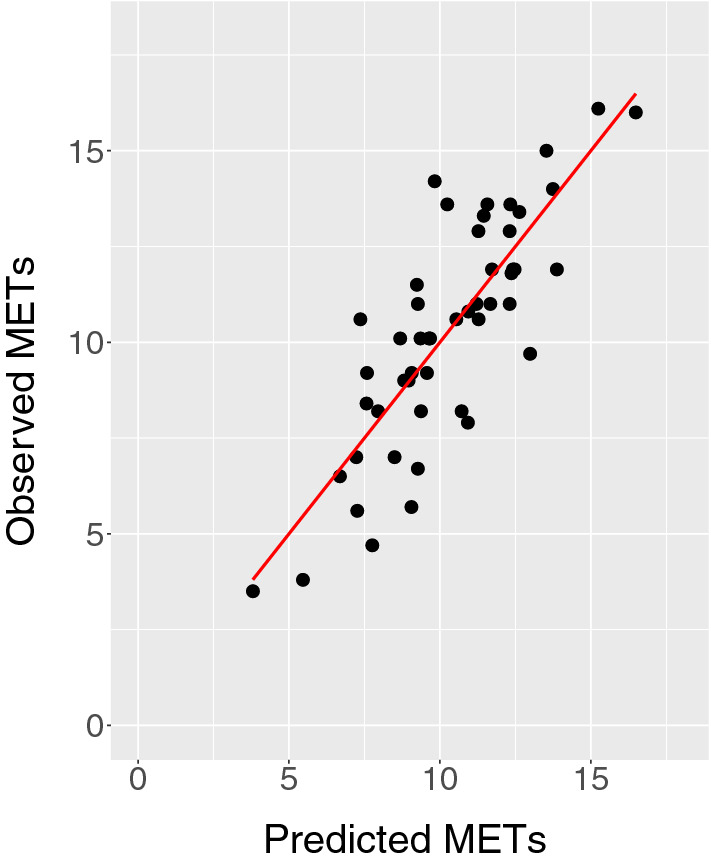
While cardiorespiratory fitness is strongly associated with mortality and diverse outcomes, routine measurement is limited. We used smartphone-derived physical activity data to estimate fitness among 50 older adults. We recruited iPhone owners undergoing cardiac stress testing and collected recent iPhone physical activity data. Cardiorespiratory fitness was measured as peak metabolic equivalents of task (METs) achieved on cardiac stress test. We then estimated peak METs using multivariable regression models incorporating iPhone physical activity data, and validated with bootstrapping. Individual smartphone variables most significantly correlated with peak METs (p-values both < 0.001) included daily peak gait speed averaged over the preceding 30 days (r = 0.63) and root mean square of the successive differences of daily distance averaged over 365 days (r = 0.57). The best-performing multivariable regression model included the latter variable, as well as age and body mass index. This model explained 68% of variability in observed METs (95% CI 46%, 81%), and estimated peak METs with a bootstrapped mean absolute error of 1.28 METs (95% CI 0.98, 1.60). Our model using smartphone physical activity estimated cardiorespiratory fitness with high performance. Our results suggest larger, independent samples might yield estimates accurate and precise for risk stratification and disease prognostication.
虽然心肺适能与死亡率和各种结果密切相关,但常规测量受到限制。我们使用智能手机生成的体力活动数据来估算 50 名老年人的健康状况。我们招募了正在接受心脏压力测试的 iPhone 所有者,并收集了他们最近的 iPhone 体力活动数据。心肺适能通过心脏压力测试中达到的最大代谢当量(METs)来衡量。然后,我们使用包含 iPhone 体力活动数据的多变量回归模型来估计最大 METs,并通过自举法进行验证。与最大 METs 相关性最强的个体智能手机变量(p 值均<0.001)包括过去 30 天内平均每日最高步速(r=0.63)和过去 365 天内平均每日距离的连续差异的均方根(r=0.57)。表现最佳的多变量回归模型包含后者变量,以及年龄和体重指数。该模型解释了观察到的 METs 变化的 68%(95% CI 46%,81%),并通过自举法估计最大 METs 的平均绝对误差为 1.28 METs(95% CI 0.98,1.60)。我们使用智能手机体力活动的模型以高性能估计心肺适能。我们的研究结果表明,更大的独立样本可能会产生用于风险分层和疾病预后预测的准确和精确的估计值。