Caserman Polona, Yum Sungsoo, Göbel Stefan, Reif Andreas, Matura Silke
Serious Games Research Group, Technical University of Darmstadt, Darmstadt, Germany.
Department of Psychiatry, Psychosomatic Medicine and Psychotherapy, Goethe University Frankfurt, University Hospital, Frankfurt am Main, Germany.
JMIR Biomed Eng. 2024 Jul 31;9:e59459. doi: 10.2196/59459.
Determining maximum oxygen uptake (VOmax) is essential for evaluating cardiorespiratory fitness. While laboratory-based testing is considered the gold standard, sports watches or fitness trackers offer a convenient alternative. However, despite the high number of wrist-worn devices, there is a lack of scientific validation for VOmax estimation outside the laboratory setting.
This study aims to compare the Apple Watch Series 7's performance against the gold standard in VOmax estimation and Apple's validation findings.
A total of 19 participants (7 female and 12 male), aged 18 to 63 (mean 28.42, SD 11.43) years were included in the validation study. VOmax for all participants was determined in a controlled laboratory environment using a metabolic gas analyzer. Thereby, they completed a graded exercise test on a cycle ergometer until reaching subjective exhaustion. This value was then compared with the estimated VOmax value from the Apple Watch, which was calculated after wearing the watch for at least 2 consecutive days and measured directly after an outdoor running test.
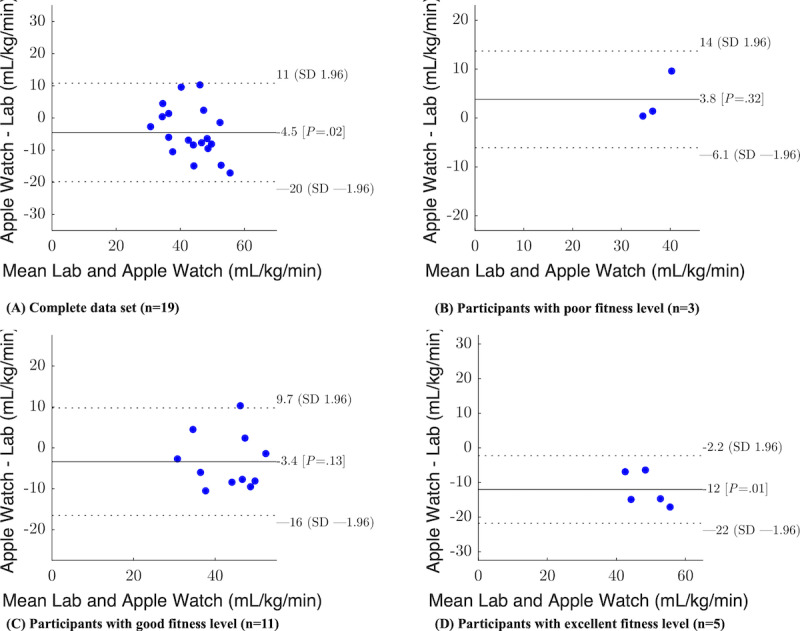
The measured VOmax (mean 45.88, SD 9.42 mL/kg/minute) in the laboratory setting was significantly higher than the predicted VOmax (mean 41.37, SD 6.5 mL/kg/minute) from the Apple Watch (t=2.51; P=.01) with a medium effect size (Hedges g=0.53). The Bland-Altman analysis revealed a good overall agreement between both measurements. However, the intraclass correlation coefficient ICC(2,1)=0.47 (95% CI 0.06-0.75) indicated poor reliability. The mean absolute percentage error between the predicted and the actual VOmax was 15.79%, while the root mean square error was 8.85 mL/kg/minute. The analysis further revealed higher accuracy when focusing on participants with good fitness levels (mean absolute percentage error=14.59%; root-mean-square error=7.22 ml/kg/minute; ICC(2,1)=0.60 95% CI 0.09-0.87).
Similar to other smartwatches, the Apple Watch also overestimates or underestimates the VOmax in individuals with poor or excellent fitness levels, respectively. Assessing the accuracy and reliability of the Apple Watch's VOmax estimation is crucial for determining its suitability as an alternative to laboratory testing. The findings of this study will apprise researchers, physical training professionals, and end users of wearable technology, thereby enhancing the knowledge base and practical application of such devices in assessing cardiorespiratory fitness parameters.
确定最大摄氧量(VOmax)对于评估心肺适能至关重要。虽然基于实验室的测试被认为是金标准,但运动手表或健身追踪器提供了一种便捷的替代方法。然而,尽管腕戴式设备数量众多,但在实验室环境之外对VOmax估计缺乏科学验证。
本研究旨在比较Apple Watch Series 7在VOmax估计方面与金标准的性能以及苹果公司的验证结果。
共有19名参与者(7名女性和12名男性),年龄在18至63岁(平均28.42岁,标准差11.43岁)纳入验证研究。所有参与者的VOmax在受控的实验室环境中使用代谢气体分析仪测定。因此,他们在自行车测力计上完成了递增运动测试,直到主观疲劳。然后将该值与Apple Watch估计的VOmax值进行比较,该值是在连续佩戴手表至少2天后计算得出,并在户外跑步测试后直接测量。
实验室环境中测量的VOmax(平均45.88,标准差9.42 mL/kg/分钟)显著高于Apple Watch预测的VOmax(平均41.37,标准差6.5 mL/kg/分钟)(t = 2.51;P = 0.01),效应量中等(Hedges g = 0.53)。Bland-Altman分析显示两次测量之间总体一致性良好。然而,组内相关系数ICC(2,1)=0.47(95%CI 0.06 - 0.75)表明可靠性较差。预测VOmax与实际VOmax之间的平均绝对百分比误差为15.79%,而均方根误差为8.85 mL/kg/分钟。分析进一步表明,关注健康水平良好的参与者时准确性更高(平均绝对百分比误差 = 14.59%;均方根误差 = 7.22 ml/kg/分钟;ICC(2,1)=0.60 95%CI 0.09 - 0.87)。
与其他智能手表类似,Apple Watch在健康水平较差或较好的个体中也分别高估或低估了VOmax。评估Apple Watch的VOmax估计的准确性和可靠性对于确定其作为实验室测试替代方法的适用性至关重要。本研究结果将告知研究人员、体育训练专业人员和可穿戴技术的最终用户,从而加强此类设备在评估心肺适能参数方面的知识库和实际应用。