M. Aikimbayev's Kazakh Scientific Centre for Quarantine and Zoonotic Diseases, Almaty, Kazakhstan.
Taldyqorgan Anti-Plague Station, Taldyqorgan, Kazakhstan.
PLoS One. 2019 Jun 14;14(6):e0218366. doi: 10.1371/journal.pone.0218366. eCollection 2019.
In Kazakhstan, a live plague vaccine EV 76 NIIEG has been used for plague prophylaxis since the mid-1930s. Vaccination is administered yearly among people living in plague-enzootic areas. Similar practices are used in other former Soviet Union countries. Yet, to this day, the effectiveness period of the vaccine is unknown. It is also not clear how different factors can affect the effectiveness of the vaccine over time.
We surveyed changes in antibody levels specific for F1 antigens of Yersinia pestis among vaccinated people 4, 8, and 12 months post- vaccination. Blood samples were taken from the participants of the study for producing sera, which was later analyzed using indirect hemagglutination reaction with antigenic erythrocyte assay (micromethod) for identifying antibodies to F1 Y.pestis.
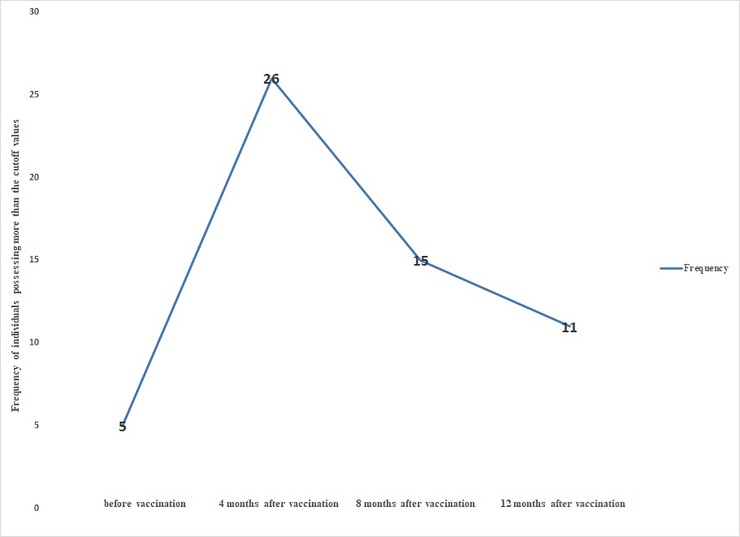
In first-time-receivers of the plague vaccine, antibody titer reached the highest level of antibody that represents a conditionally protective titer after 4 months, dropped drastically after 8 months, and dropped again after 12 months. Similar results were obtained among those who have been vaccinated previously. However, in that group, the percentage of people with a level of antibody that represents a conditionally protective titer remained statistically significant even after 8 and 12 months.
Based on the results of this study, we recommend initiating vaccination campaigns for the medical and veterinary staff, as well as the general population four months prior to the springtime epizootics of plague among wild rodents.
自 20 世纪 30 年代中期以来,哈萨克斯坦一直在使用活鼠疫疫苗 EV 76 NIIEG 进行鼠疫预防接种。居住在鼠疫流行地区的人每年接种一次疫苗。前苏联的其他国家也采用类似的做法。然而,到目前为止,还不知道疫苗的有效期限。也不清楚随着时间的推移,不同因素如何影响疫苗的有效性。
我们调查了接种疫苗后 4、8 和 12 个月,鼠疫耶尔森氏菌 F1 抗原特异性抗体水平的变化。从研究参与者中抽取血液样本用于产生血清,然后使用间接血凝反应和抗原红细胞测定(微方法)分析血清,以鉴定对 F1 Y.pestis 的抗体。
在首次接受鼠疫疫苗接种的人群中,抗体滴度在 4 个月后达到代表条件保护性滴度的最高水平,8 个月后急剧下降,12 个月后再次下降。以前接种过疫苗的人群也得到了类似的结果。然而,在该组中,即使在 8 个月和 12 个月后,代表条件保护性滴度的抗体水平的人群百分比仍然具有统计学意义。
基于这项研究的结果,我们建议在春季野生啮齿动物鼠疫流行前四个月,为医务人员、兽医和普通人群启动疫苗接种运动。