Mackey S L, Glanzman D L, Small S A, Dyke A M, Kandel E R, Hawkins R D
Howard Hughes Medical Institute, Columbia University, College of Physicians and Surgeons, New York, NY.
Proc Natl Acad Sci U S A. 1987 Dec;84(23):8730-4. doi: 10.1073/pnas.84.23.8730.
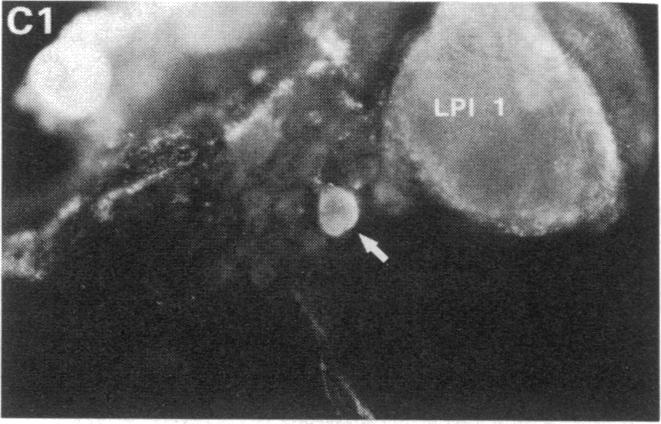
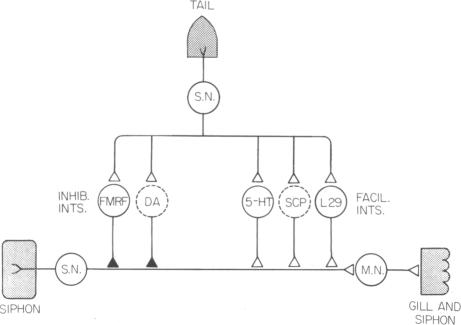
Recent studies have shown that, in addition to being modulated by presynaptic facilitation, the sensory neurons of the gill- and siphon-withdrawal reflex of Aplysia are also capable of being modulated by transient presynaptic inhibition produced by the peptide Phe-Met-Arg-Phe-NH2. These two modulatory effects involve different second-messenger systems: the facilitation is mediated through cAMP-dependent protein phosphorylation, and the inhibition is mediated through the lipoxygenase pathway of arachidonic acid. To explore the behavioral function of this inhibition, we have carried out a parametric analysis of the effect of tail shock on the siphon-withdrawal reflex. In addition to producing sensitization of the withdrawal reflex, tail shock also transiently inhibits the reflex. The inhibition is produced by relatively weak shock, whereas sensitization is more prominent and may mask the inhibition with stronger shock. Furthermore, inhibition is not observed after habituation training. Cellular studies suggest that the behavioral inhibition is mediated, at least in part, by presynaptic inhibition of transmitter release from the siphon sensory neurons. Moreover, we have identified an interneuron within the left pleural ganglion (LPL16) that shows Phe-Met-Arg-Phe-NH2 immunoreactivity, is activated by tail shock, and simulates the presynaptic inhibitory actions produced by tail shock. Therefore, our results suggest that presynaptic inhibition mediated by Phe-Met-Arg-Phe-NH2 and its lipoxygenase second messenger contributes to behavioral inhibition of the siphon-withdrawal reflex.
最近的研究表明,海兔鳃和虹吸管退缩反射的感觉神经元除了受突触前易化调节外,还能被肽Phe-Met-Arg-Phe-NH2产生的短暂突触前抑制所调节。这两种调节作用涉及不同的第二信使系统:易化作用是通过cAMP依赖性蛋白磷酸化介导的,而抑制作用是通过花生四烯酸的脂氧合酶途径介导的。为了探究这种抑制作用的行为功能,我们对尾部电击对虹吸管退缩反射的影响进行了参数分析。尾部电击除了能使退缩反射产生敏感化外,还能短暂抑制该反射。这种抑制作用由相对较弱的电击产生,而敏感化作用更显著,较强的电击可能会掩盖抑制作用。此外,习惯化训练后未观察到抑制作用。细胞研究表明,行为抑制至少部分是由突触前抑制虹吸管感觉神经元释放递质介导的。此外,我们在左胸膜神经节内鉴定出一个中间神经元(LPL16),它显示出Phe-Met-Arg-Phe-NH2免疫反应性,被尾部电击激活,并模拟尾部电击产生的突触前抑制作用。因此,我们的结果表明,由Phe-Met-Arg-Phe-NH2及其脂氧合酶第二信使介导的突触前抑制作用有助于对虹吸管退缩反射的行为抑制。