Laboratorio de Inmunobiología, UIDCC-UMIEZ, FES-Zaragoza, UNAM, Ciudad de México, Mexico.
Laboratorio de Inmunología y Cáncer, Unidad de Investigación Médica en Enfermedades Oncológicas, CMN SXXI, Instituto Mexicano del Seguro Social, Ciudad de México, Mexico.
Mediators Inflamm. 2019 May 7;2019:4651627. doi: 10.1155/2019/4651627. eCollection 2019.
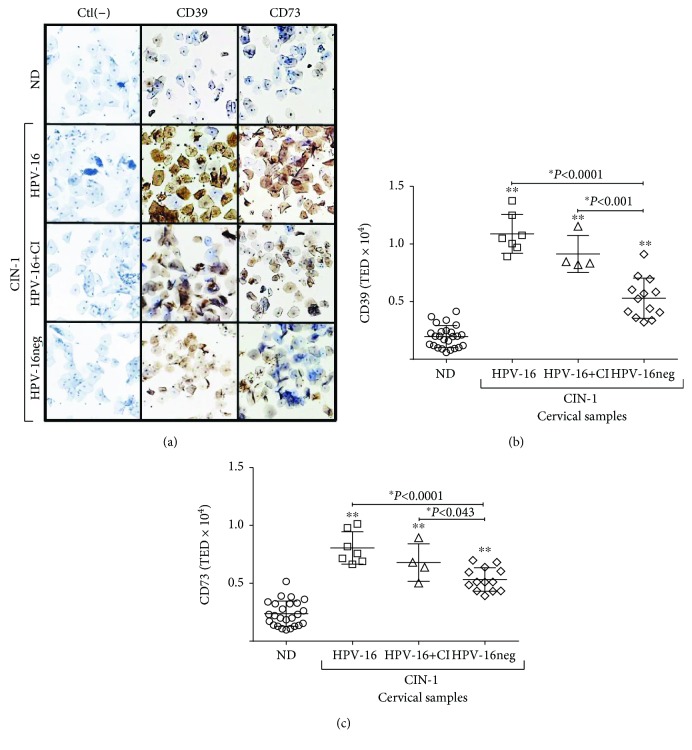
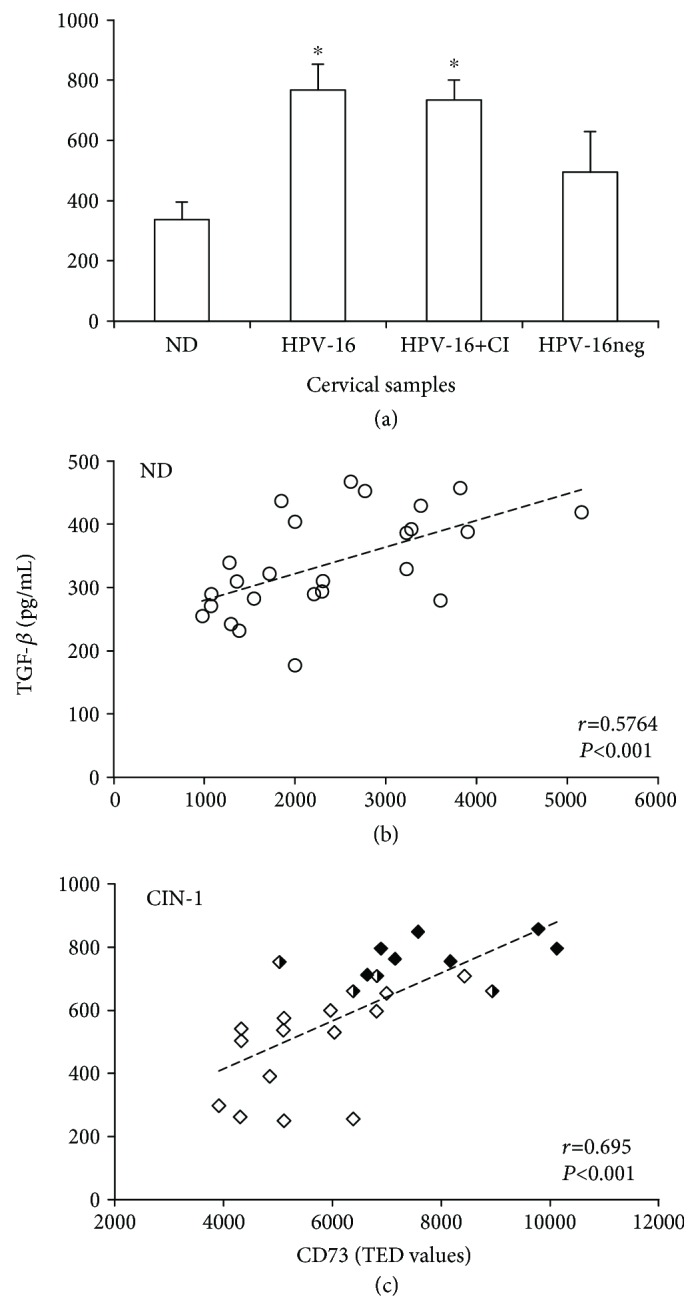
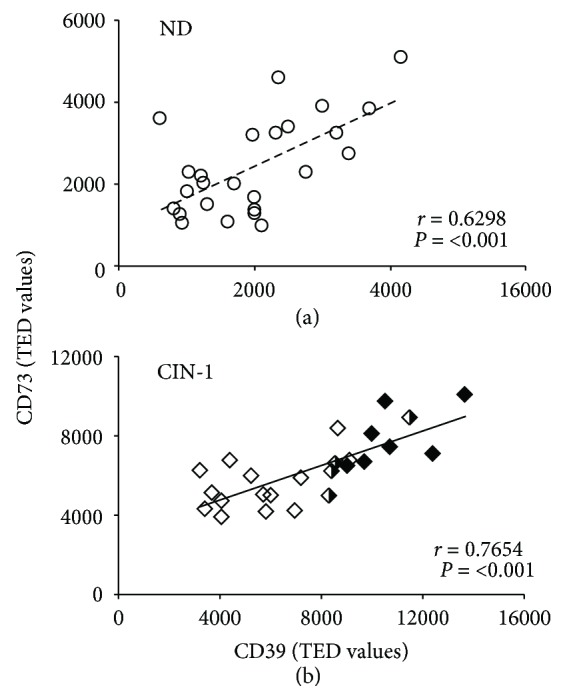
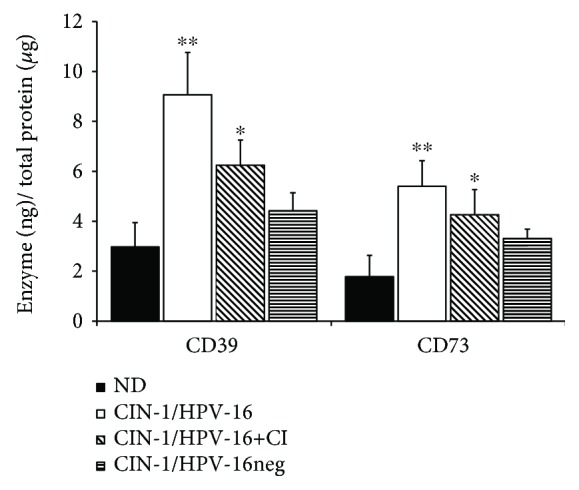
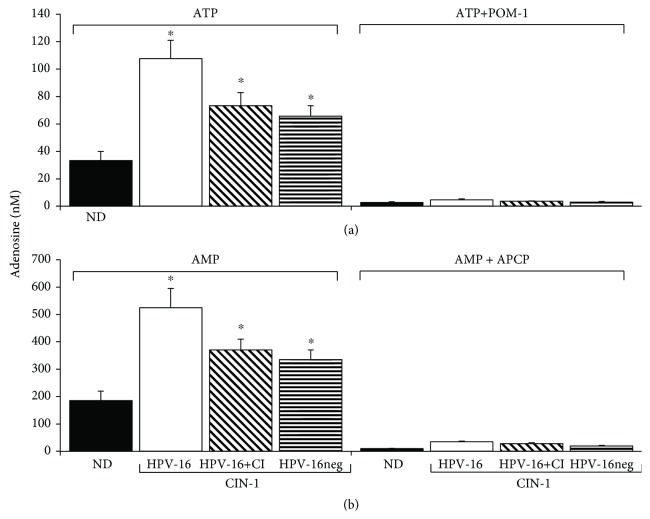
The development of cervical cancer (CeCa) is associated with high-risk human papilloma virus (HR-HPV) infections, mainly HPV-16, which is present in more than 50% of cases. The presence of immunosuppressive factors in the early stages of the disease is also strongly linked to CeCa progression. In this context, it is unknown whether ectonucleotidases CD39 and CD73, which are involved in the production of adenosine (Ado) that suppresses the specific antitumor immune response, are present in precursor lesions of CeCa. In this pilot study, we analyzed the presence of CD39 and CD73 and their capacity to generate Ado in 25 cervical samples from patients with grade 1 cervical intraepithelial neoplasms (CIN-1) and 25 samples from normal donors (NDs) free of HPV infection. Cells obtained from cervical samples of CIN-1 patients positive for HPV-16 showed higher CD39 and CD73 contents compared to samples obtained from CIN-1 patients negative for HPV-16 and NDs. Interestingly, solubilized cervical mucus from these patients also showed higher contents of soluble CD39 and CD73, which were associated with a greater capacity to produce Ado from the hydrolysis of adenosine triphosphate (ATP) and adenosine monophosphate (AMP). In addition, serum samples of these patients showed higher levels of TGF- than those of CIN-1 patients negative for HPV-16 and ND. These results suggest that persistent infection with HR-HPV, mostly HPV-16, in CIN-1 patients may promote the expression of CD39 and CD73 through the production of TGF- in precursor lesions to generate an immunosuppressive microenvironment and allow its progression to CeCa.
宫颈癌(CeCa)的发展与高危型人乳头瘤病毒(HR-HPV)感染有关,主要是 HPV-16,其存在于超过 50%的病例中。疾病早期存在免疫抑制因子也与 CeCa 的进展密切相关。在这种情况下,尚不清楚是否存在参与产生腺苷(Ado)的细胞外核苷酸酶 CD39 和 CD73,Ado 会抑制特异性抗肿瘤免疫反应,而这些酶是否存在于 CeCa 的前体病变中。在这项初步研究中,我们分析了 25 例 HPV 感染阴性的正常供体(ND)和 25 例 1 级宫颈上皮内瘤变(CIN-1)患者宫颈样本中 CD39 和 CD73 的存在及其产生 Ado 的能力。与 HPV-16 阴性的 CIN-1 患者和 NDs 相比,来自 HPV-16 阳性的 CIN-1 患者的细胞中 CD39 和 CD73 的含量更高。有趣的是,这些患者的可溶性宫颈黏液也显示出更高的可溶性 CD39 和 CD73 含量,这与从三磷酸腺苷(ATP)和一磷酸腺苷(AMP)水解产生更多 Ado 的能力有关。此外,这些患者的血清样本中 TGF-的水平高于 HPV-16 阴性的 CIN-1 患者和 ND。这些结果表明,CIN-1 患者持续性感染 HR-HPV,主要是 HPV-16,可能通过在前体病变中产生 TGF-来促进 CD39 和 CD73 的表达,从而产生免疫抑制微环境,并允许其进展为 CeCa。