Sun Jian-Long, Ji Hong-Fang, Shen Liang
Institute of Biomedical Research, Shandong University of Technology, Zibo, Shandong, People's Republic of China.
Zibo Key Laboratory for Neurodegenerative Diseases Drug Development, Shandong Provincial Research Center for Bioinformatic Engineering and Technique, School of Life Sciences, Shandong University of Technology, Zibo, Shandong, People's Republic of China.
Food Nutr Res. 2019 May 31;63. doi: 10.29219/fnr.v63.3451. eCollection 2019.
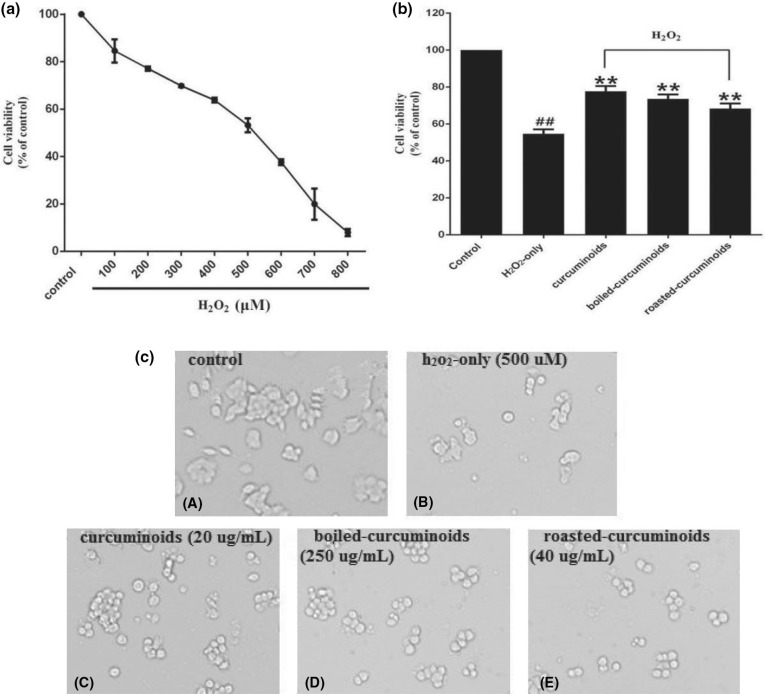
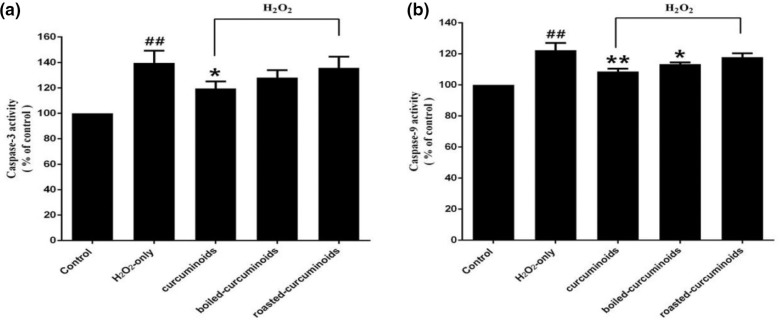
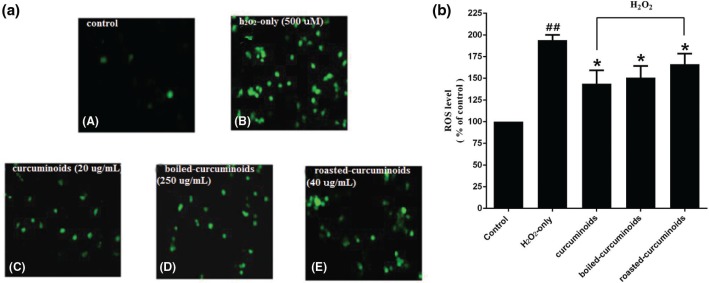
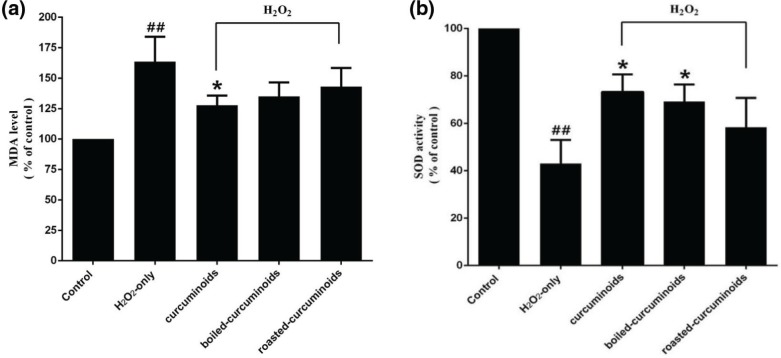
Curcuminoids, as the main ingredient of turmeric, are popularly used in food additives and condiments, and are widely accepted to be beneficial for human health for their antioxidant activity. However, curcuminoids are highly susceptible in terms of thermal-induced degradation, and curry is usually boiled, roasted, or fried in the use of food additives and condiments. Thus, it is interesting to explore the effect of cooking on the antioxidant activity of curcuminoids. In the present study, the total antioxidant capacity (T-AOC) of cooked curcuminoids (boiled curcuminoids, roasted curcuminoids, and fried curcuminoids) processed through three heating conditions, and their protective effects against oxidative damage to rat pheochromocytoma (PC12) cells, a well-established neuronal model, were evaluated. It was found that cooking slightly lowered the T-AOC of curcuminoids, with boiled curcuminoids being relatively stronger than roasted curcuminoids, and fried curcuminoids being the weakest form. Both boiled and roasted curcuminoids could significantly improve cell viability, mitigate intracellular accumulation of reactive oxygen species and reduce malondialdehyde activity, reduce caspase-3 and caspase-9 protein expression, and increase superoxide dismutase activity of PC12 cells compared with the control group. In comparison with parent curcuminoids, the protective effects of cooked curcuminoids got relatively lower overall, with boiled curcuminoids being relatively stronger than roasted curcuminoids. In conclusion, the cooked curcuminoids, including boiled and roasted forms, still have antioxidant and neuroprotective activity.
姜黄素类化合物作为姜黄的主要成分,广泛应用于食品添加剂和调味品中,因其抗氧化活性而被广泛认为对人体健康有益。然而,姜黄素类化合物在热诱导降解方面高度敏感,而咖喱在用作食品添加剂和调味品时通常要经过煮、烤或煎的过程。因此,探究烹饪对姜黄素类化合物抗氧化活性的影响很有意思。在本研究中,评估了通过三种加热条件处理的熟姜黄素类化合物(煮制姜黄素类化合物、烤制姜黄素类化合物和油炸姜黄素类化合物)的总抗氧化能力(T-AOC),以及它们对大鼠嗜铬细胞瘤(PC12)细胞(一种成熟的神经元模型)氧化损伤的保护作用。结果发现,烹饪会略微降低姜黄素类化合物的T-AOC,煮制姜黄素类化合物相对比烤制姜黄素类化合物更强,而油炸姜黄素类化合物是最弱的形式。与对照组相比,煮制和烤制姜黄素类化合物均可显著提高细胞活力,减轻细胞内活性氧的积累并降低丙二醛活性,降低半胱天冬酶-3和半胱天冬酶-9蛋白表达,并提高PC12细胞的超氧化物歧化酶活性。与母体姜黄素类化合物相比,熟姜黄素类化合物的保护作用总体上相对较低,煮制姜黄素类化合物相对比烤制姜黄素类化合物更强。总之,包括煮制和烤制形式在内的熟姜黄素类化合物仍具有抗氧化和神经保护活性。