Sapino Simona, Chirio Daniela, Peira Elena, Abellán Rubio Elena, Brunella Valentina, Jadhav Sushilkumar A, Chindamo Giulia, Gallarate Marina
Department of Drug Science and Technology, University of Turin, 10125 Turin, Italy.
NIS Research Centre, University of Turin, 10125 Turin, Italy.
Nanomaterials (Basel). 2019 Jun 14;9(6):884. doi: 10.3390/nano9060884.
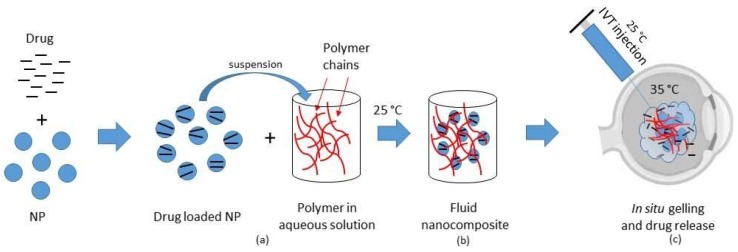
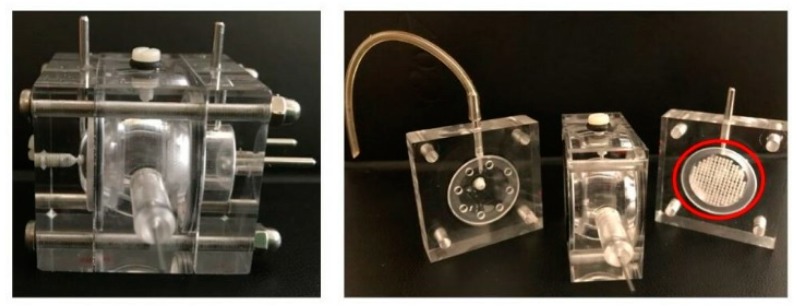
The bioavailability of ophthalmic therapeutics is reduced because of the presence of physiological barriers whose primary function is to hinder the entry of exogenous agents, therefore also decreasing the bioavailability of locally administered drugs. Consequently, repeated ocular administrations are required. Hence, the development of drug delivery systems that ensure suitable drug concentration for prolonged times in different ocular tissues is certainly of great importance. This objective can be partially achieved using thermosensitive drug delivery systems that, owing to their ability of changing their state in response to temperature variations, from room to body temperature, may increase drug bioavailability. In the case of topical instillation, in situ forming gels increase pre-corneal drug residence time as a consequence of their enhanced adhesion to the corneal surface. Otherwise, in the case of intraocular and periocular, i.e., subconjunctival, retrobulbar, peribulbar administration, among others, they have the undoubted advantage of being easily injectable and, owing to their sudden thickening at body temperature, have the ability to form an in situ drug reservoir. As a result, the frequency of administration can be reduced, also favoring the patient's adhesion to therapy. In the main section of this review, we discuss some of the most common treatment options for ocular diseases, with a special focus on posterior segment treatments, and summarize the most recent improvement deriving from thermosensitive drug delivery strategies. Aside from this, an additional section describes the most widespread in vitro models employed to evaluate the functionality of novel ophthalmic drug delivery systems.
由于存在生理屏障,眼用治疗药物的生物利用度会降低,这些生理屏障的主要功能是阻碍外源药物的进入,因此也会降低局部给药药物的生物利用度。因此,需要反复进行眼部给药。因此,开发能够在不同眼组织中长时间确保合适药物浓度的药物递送系统无疑具有重要意义。使用热敏药物递送系统可以部分实现这一目标,由于它们能够响应温度变化(从室温到体温)而改变其状态,可能会提高药物的生物利用度。在局部滴注的情况下,原位形成凝胶由于其对角膜表面的附着力增强而增加了角膜前药物停留时间。否则,在眼内和眼周给药(即结膜下、球后、球周给药等)的情况下,它们具有易于注射的无疑优势,并且由于它们在体温下会突然变稠,具有形成原位药物储库的能力。结果,可以减少给药频率,也有利于患者坚持治疗。在本综述的主要部分,我们讨论了一些最常见的眼部疾病治疗选择,特别关注后段治疗,并总结了热敏药物递送策略带来的最新进展。除此之外,另一部分描述了用于评估新型眼用药物递送系统功能的最广泛使用的体外模型。