Jiangsu Collaborative Innovation Center of Chinese Medicinal Resources Industrialization, State Administration of Traditional Chinese Medicine Key Laboratory of Chinese Medicinal Resources Recycling Utilization, National and Local Collaborative Engineering Center of Chinese Medicinal Resources Industrialization and Formulae Innovative Medicine, Nanjing University of Chinese Medicine, Nanjing 210023, China.
School of Pharmacy, Ningxia Medical University, Yinchuan 750021, China.
Molecules. 2019 Jun 14;24(12):2228. doi: 10.3390/molecules24122228.
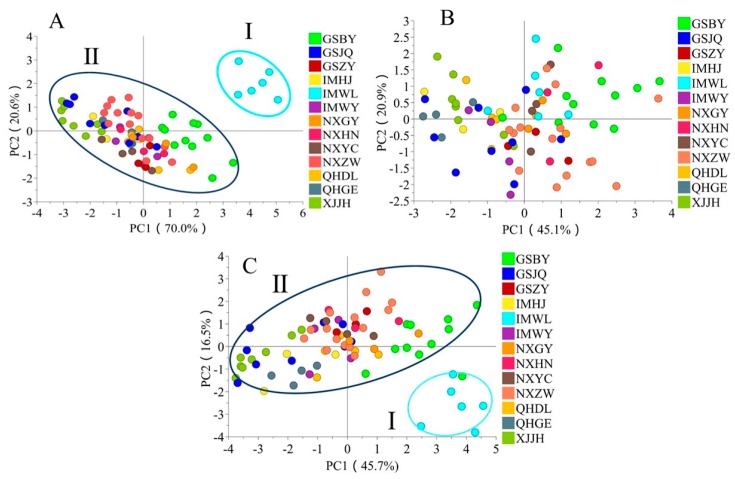
The fruit of L. (FLB) has been used as medicines and functional foods for more than 2000 years in East Asia. In this study, carotenoid, phenolic, flavonoid, and polysaccharide contents as well as the antioxidant activities of FLB from 13 different regions in China from a total of 78 samples were analyzed. The results showed that total carotenoid contents ranged from 12.93 to 25.35 mg β-carotene equivalents/g DW. Zeaxanthin dipalmitate was the predominant carotenoid (4.260-10.07 mg/g DW) in FLB. The total phenolic, total flavonoid, and total polysaccharide contents ranged from 6.899 to 8.253 mg gallic acid equivalents/g DW, 3.177 to 6.144 mg rutin equivalents/g DW, and 23.62 to 42.45 mg/g DW, respectively. Rutin content ranged from 0.1812 to 0.4391 mg/g DW, and ferulic acid content ranged from 0.0994 to 0.1726 mg/g DW. All of these FLB could be divided into two clusters with PCA analysis, and both individual carotenoids and total carotenoid contents could be used as markers for regional characterization. The phenolic components were the main substance for the antioxidant activity of FLB. Considering the functional component and antioxidant activities, FLB produced in Guyuan of Ningxia was the closest to Daodi herbs (Zhongwei of Ningxia), which is commercially available high quality FLB. The results of this study could provide guidance for comprehensive applications of FLB production in different regions.
该果实(FLB)在中国已有 2000 多年的药用和功能性食品应用历史。在这项研究中,分析了来自中国 13 个不同地区的总共 78 个样本的 FLB 中的类胡萝卜素、酚类、类黄酮和多糖含量以及抗氧化活性。结果表明,总类胡萝卜素含量范围为 12.93-25.35mgβ-胡萝卜素当量/gDW。叶黄素二棕榈酸酯是 FLB 中的主要类胡萝卜素(4.260-10.07mg/gDW)。总酚、总黄酮和总多糖含量范围分别为 6.899-8.253mg 没食子酸当量/gDW、3.177-6.144mg 芦丁当量/gDW 和 23.62-42.45mg/gDW。芦丁含量范围为 0.1812-0.4391mg/gDW,阿魏酸含量范围为 0.0994-0.1726mg/gDW。所有这些 FLB 都可以通过 PCA 分析分为两个聚类,并且个体类胡萝卜素和总类胡萝卜素含量都可以作为区域特征的标志物。酚类成分是 FLB 抗氧化活性的主要物质。考虑到功能性成分和抗氧化活性,宁夏固原生产的 FLB 与商业上可获得的高质量 FLB 宁夏中卫道地药材最为接近。本研究结果可为不同地区 FLB 生产的综合应用提供指导。