Yale University Rwanda Human Resources for Health Program, Department of Paediatrics, Centre Hospitalier Universitaire de Kigali (CHUK), PO Box 655, Kigali, Rwanda.
Department of Paediatrics, College of Medicine and Health Sciences, University of Rwanda, Kigali, Rwanda.
BMC Med Educ. 2019 Jun 17;19(1):217. doi: 10.1186/s12909-019-1617-8.
Rwanda is the only African country to use the pediatric International In-Training Examination (I-ITE). The objectives of this study were to use the scores from the I-ITE to outline the baseline level of knowledge of Rwandan residents entering the pediatric residency and the trends in knowledge acquisition from 2012 to 2018, during the Human Resources for Health (HRH) Program, an education partnership between the Rwanda Ministry of Health and a consortium of US universities.
A retrospective descriptive analysis of the I-ITE exam scores, taken by all Rwandan pediatric residents for five of the six academic years of the study period. Individual resident scores were weighted using the non-Rwandan I-ITE sites to minimise confounding from annual variations in exam difficulty. Statistical analysis included descriptives with ANOVA to compare variation in annual mean scores.
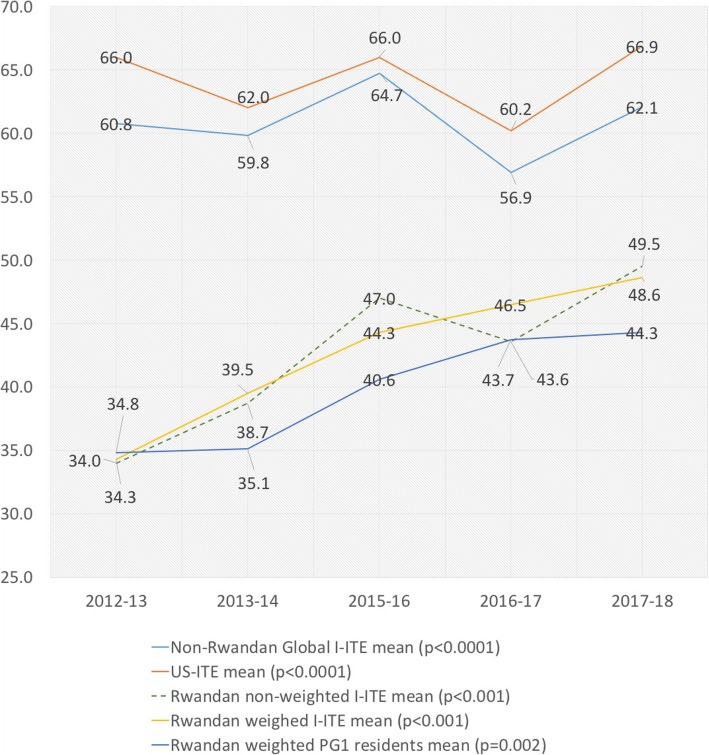
Eighty-four residents took 213 I-ITE exam sittings over the five exam cycles. The mean weighted I-ITE score of all residents increased from 34% in 2013 to 49% (p < 0.001) in 2018. The 32-point gap between the mean US-ITE and Rwandan I-ITE score in 2012-2013 was reduced to a 16-point gap in 2017-2018. First year resident (PG1) scores, which likely reflect the knowledge level of undergraduate medical students entering the residency program, increased from 34.8 to 44.3% (p = 0.002) between 2013 and 2018.
The I-ITE is an independent, robust tool, measuring both learners and the institutional factors supporting residents. This is the first study to demonstrate that the I-ITE can be used to monitor resident knowledge acquisition in resource-limited settings, where assessment of resident knowledge can be a major challenge facing the academic medicine community. The significant increase in I-ITE scores between 2012 and 18 reflects the substantial curricular reorganisation accomplished through collaboration between Rwandan and US embedded faculty and supports the theory that programs such as HRH are highly effective at improving the quality of residency programs and undergraduate medical education.
卢旺达是唯一使用儿科国际培训考试(I-ITE)的非洲国家。本研究的目的是利用 I-ITE 的分数,概述 2012 年至 2018 年期间,在卫生人力资源(HRH)计划期间,卢旺达卫生部与美国大学联盟之间的教育伙伴关系下,进入儿科住院医师培训的卢旺达住院医师的知识基础水平,以及知识获取的趋势。
对研究期间六个学年中的五个学年的所有卢旺达儿科住院医师参加的 I-ITE 考试成绩进行回顾性描述性分析。使用非卢旺达 I-ITE 地点对个别住院医师的分数进行加权,以最大限度地减少考试难度年度变化造成的混杂。统计分析包括描述性分析和方差分析,以比较年度平均分数的变化。
84 名住院医师参加了五个考试周期的 213 次 I-ITE 考试。所有住院医师的加权 I-ITE 平均分数从 2013 年的 34%增加到 2018 年的 49%(p<0.001)。2012-2013 年,卢旺达 I-ITE 与美国 I-ITE 平均分数之间的 32 分差距缩小到 2017-2018 年的 16 分差距。第一年住院医师(PG1)的分数,可能反映了进入住院医师培训计划的本科生医学生的知识水平,从 2013 年的 34.8%增加到 2018 年的 44.3%(p=0.002)。
I-ITE 是一种独立的、强大的工具,可以衡量学习者和支持住院医师的机构因素。这是第一项研究表明,I-ITE 可用于监测资源有限环境中的住院医师知识获取情况,在这种情况下,评估住院医师的知识可能是学术医学社区面临的主要挑战。2012 年至 18 年间 I-ITE 分数的显著增加反映了卢旺达和美国嵌入式教师之间的合作所完成的大量课程重组,并支持这样一种理论,即 HRH 等计划在提高住院医师培训计划和本科医学教育质量方面非常有效。