Department of Biological Sciences, University of Memphis, Memphis, TN 38152;
Data Science Lab, Office of the Chief Information Officer, Smithsonian Institution, Washington, DC 20024.
Proc Natl Acad Sci U S A. 2019 Jul 9;116(28):14083-14088. doi: 10.1073/pnas.1903871116. Epub 2019 Jun 17.
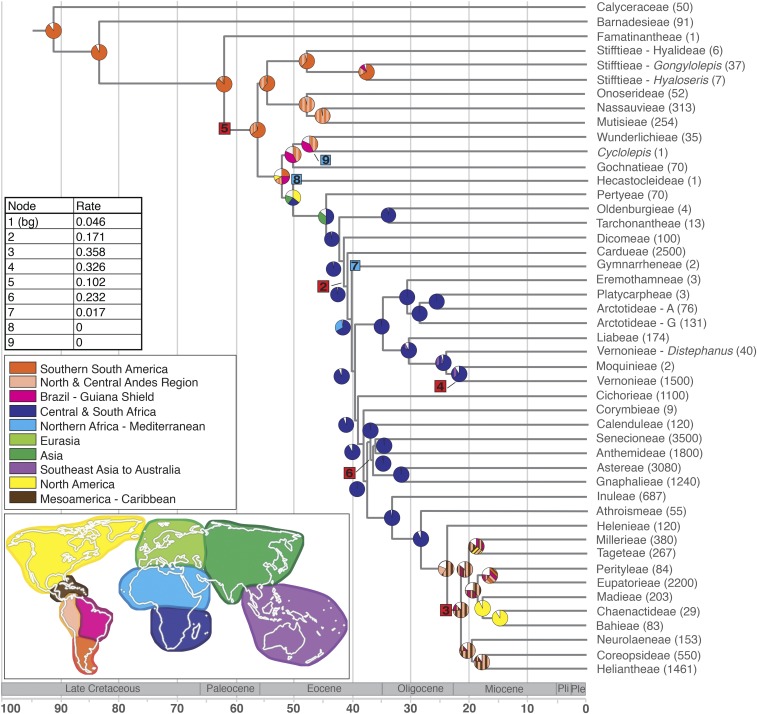
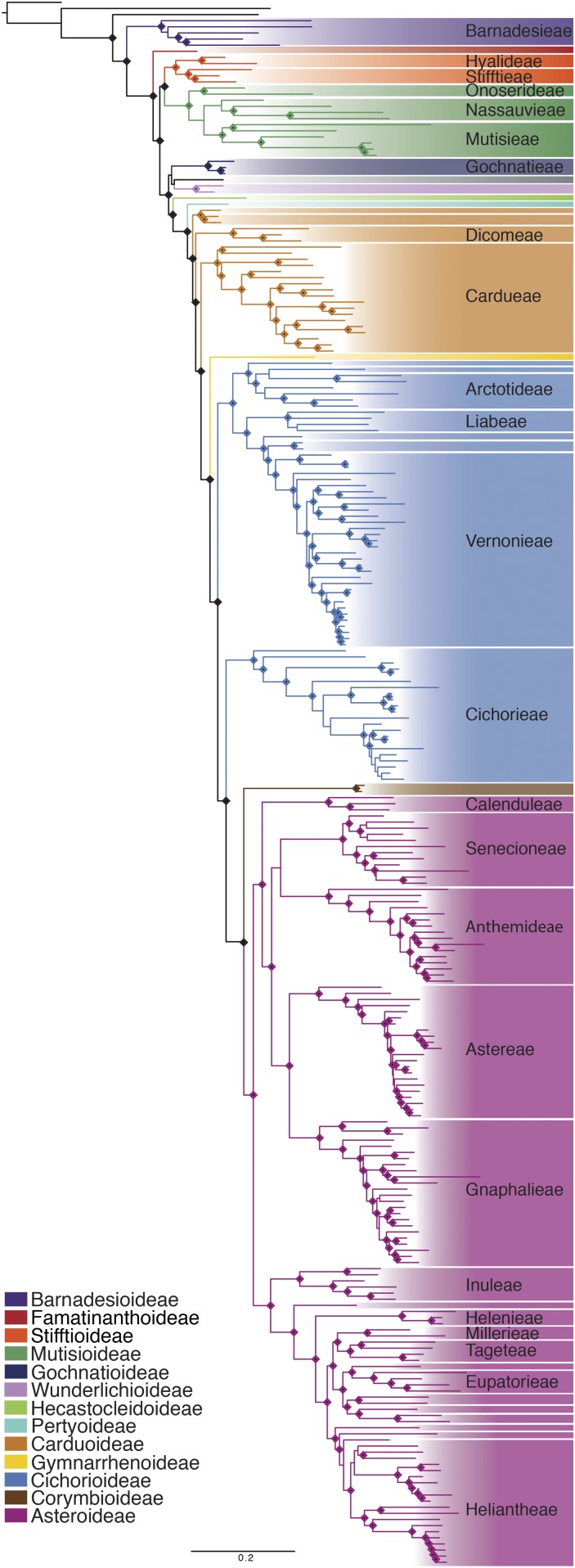
The sunflower family, Asteraceae, comprises 10% of all flowering plant species and displays an incredible diversity of form. Asteraceae are clearly monophyletic, yet resolving phylogenetic relationships within the family has proven difficult, hindering our ability to understand its origin and diversification. Recent molecular clock dating has suggested a Cretaceous origin, but the lack of deep sampling of many genes and representative taxa from across the family has impeded the resolution of migration routes and diversifications that led to its global distribution and tremendous diversity. Here we use genomic data from 256 terminals to estimate evolutionary relationships, timing of diversification(s), and biogeographic patterns. Our study places the origin of Asteraceae at ∼83 MYA in the late Cretaceous and reveals that the family underwent a series of explosive radiations during the Eocene which were accompanied by accelerations in diversification rates. The lineages that gave rise to nearly 95% of extant species originated and began diversifying during the middle Eocene, coincident with the ensuing marked cooling during this period. Phylogenetic and biogeographic analyses support a South American origin of the family with subsequent dispersals into North America and then to Asia and Africa, later followed by multiple worldwide dispersals in many directions. The rapid mid-Eocene diversification is aligned with the biogeographic range shift to Africa where many of the modern-day tribes appear to have originated. Our robust phylogeny provides a framework for future studies aimed at understanding the role of the macroevolutionary patterns and processes that generated the enormous species diversity of Asteraceae.
向日葵科(Asteraceae)包含了所有开花植物种类的 10%,呈现出令人难以置信的形态多样性。向日葵科显然是单系的,但要确定其内部的系统发育关系却很困难,这阻碍了我们理解其起源和多样化的能力。最近的分子钟定年法表明向日葵科起源于白垩纪,但由于缺乏对许多基因和来自家族各部分的代表性分类群的深入采样,阻碍了导致其全球分布和巨大多样性的迁移路线和多样化的解析。在这里,我们使用来自 256 个终端的基因组数据来估计进化关系、多样化的时间和生物地理模式。我们的研究将向日葵科的起源定在白垩纪晚期的约 8300 万年前,揭示了该科在始新世经历了一系列爆炸性辐射,同时伴随着多样化速度的加速。导致近 95%现存物种的谱系起源并在始新世中期开始多样化,与这一时期随之而来的明显降温同时发生。系统发育和生物地理分析支持该科起源于南美洲,随后扩散到北美洲,然后再扩散到亚洲和非洲,随后在许多方向上进行了多次全球扩散。快速的始新世多样化与生物地理范围转移到非洲相吻合,许多现代部落似乎起源于那里。我们强大的系统发育为未来的研究提供了一个框架,旨在理解产生向日葵科巨大物种多样性的宏观进化模式和过程的作用。