Department of Rheumatology, Erasmus University Medical Centre, Rotterdam, The Netherlands.
Department of Rheumatology, Albert Schweitzer Hospital, Dordrecht, The Netherlands.
Rheumatology (Oxford). 2019 Dec 1;58(12):2251-2259. doi: 10.1093/rheumatology/kez215.
To compare responsiveness and longitudinal validity of Disease Activity Score 28 (DAS28), Disease Activity index for PSoriatic Arthritis (DAPSA), Composite Psoriatic Disease Activity Index (CPDAI), Psoriatic ArthritiS Disease Activity Score (PASDAS), GRAppa Composite scorE (GRACE) and Minimal Disease Activity (MDA) in usual care PsA patients, within 1 year after diagnosis.
Data collected in the Dutch southwest early PsA cohort (DEPAR) were used. Responsiveness was assessed using effect size (ES), standardized response mean (SRM), and discrimination between different general health states. Longitudinal validity was tested using mixed models with outcomes health-related quality of life (HRQOL), productivity and disability.
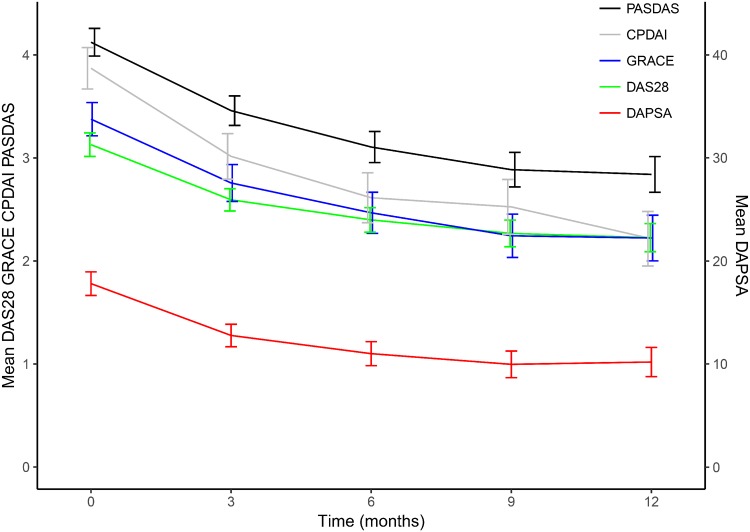
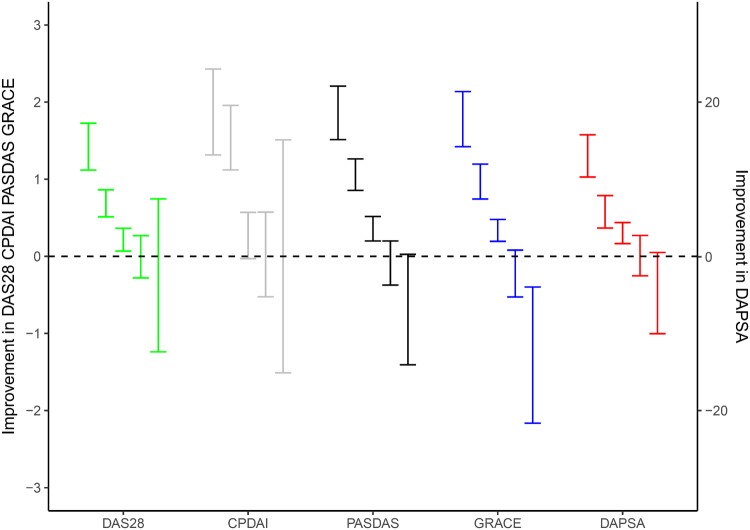
Responsiveness was highest for PASDAS, with ES 1.00 and SRM 0.95, lowest for DAPSA, with ES 0.73 and SRM 0.71, and in between for DAS28, CPDAI and GRACE. Differences in general health were best discriminated with PASDAS and GRACE. Patients reporting stable or worsening general health could not be distinguished by DAS28 or CPDAI. Discrimination was better using DAPSA, but worse than when using PASDAS and GRACE. Longitudinal evolvement of HRQOL and productivity had the highest association with low disease activity according to GRACE, followed by PASDAS, MDA, DAPSA, DAS28, with the lowest association for CPDAI.
PASDAS and GRACE were superior with respect to responsiveness, and together with MDA best related to longitudinal evolvement of HRQOL, productivity and disability. Responsiveness and longitudinal validity of most outcomes were inferior for DAS28, DAPSA and CPDAI. As alternatives to the continuous measure DAPSA, use of PASDAS or GRACE should be considered.
比较疾病活动评分 28 项(DAS28)、银屑病关节炎疾病活动指数(DAPSA)、复合银屑病疾病活动指数(CPDAI)、银屑病关节炎疾病活动评分(PASDAS)、GRAppa 综合评分(GRACE)和最小疾病活动(MDA)在诊断后 1 年内对常规护理中银屑病关节炎患者的反应性和纵向有效性。
使用荷兰西南部早期银屑病关节炎队列(DEPAR)收集的数据。使用效应量(ES)、标准化反应均值(SRM)和不同总体健康状态之间的区分来评估反应性。使用混合模型测试纵向有效性,结果为健康相关生活质量(HRQOL)、生产力和残疾。
PASDAS 的反应性最高,ES 为 1.00,SRM 为 0.95,DAPSA 的反应性最低,ES 为 0.73,SRM 为 0.71,DAS28、CPDAI 和 GRACE 介于两者之间。PASDAS 和 GRACE 可最好地区分总体健康状况的差异。不能用 DAS28 或 CPDAI 来区分报告总体健康状况稳定或恶化的患者。使用 DAPSA 时的区分效果更好,但不如使用 PASDAS 和 GRACE 时好。根据 GRACE,HRQOL 和生产力的纵向演变与低疾病活动的关联度最高,其次是 PASDAS、MDA、DAPSA、DAS28,CPDAI 的关联度最低。
PASDAS 和 GRACE 在反应性方面具有优势,与 MDA 一起与 HRQOL、生产力和残疾的纵向演变关系最密切。DAS28、DAPSA 和 CPDAI 的反应性和纵向有效性较低。作为 DAPSA 连续测量的替代方法,应考虑使用 PASDAS 或 GRACE。