Krajczewski Jan, Kudelski Andrzej
Faculty of Chemistry, University of Warsaw, Warsaw, Poland.
Front Chem. 2019 Jun 4;7:410. doi: 10.3389/fchem.2019.00410. eCollection 2019.
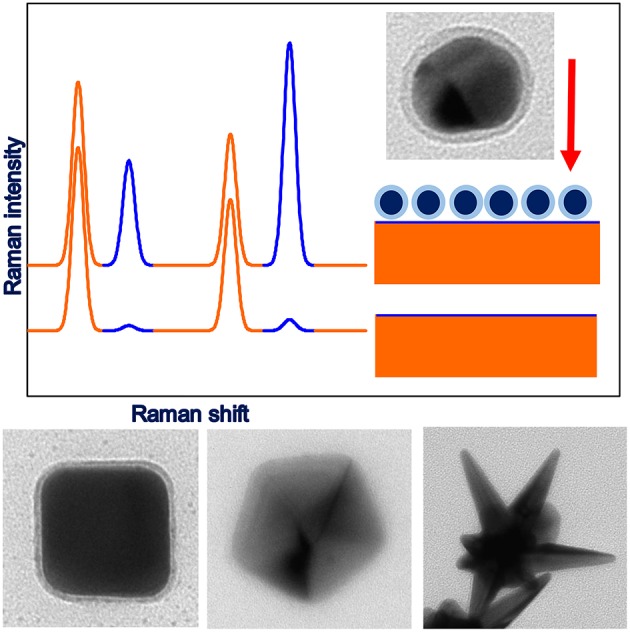
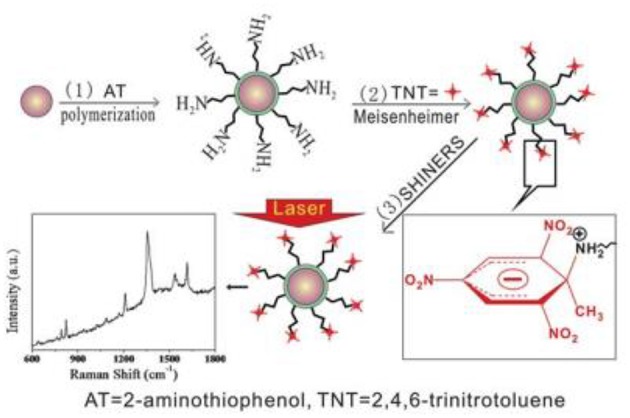
In 2010, Tian et al. reported the development of a new, relatively sensitive method of the chemical analysis of various surfaces, including buried interfaces (for example the surfaces of solid samples in a high-pressure gas or a liquid), which makes it possible to analyze various biological samples . They called their method shell-isolated nanoparticle-enhanced Raman spectroscopy (SHINERS). SHINERS spectroscopy is a type of surface-enhanced Raman spectroscopy (SERS) in which an increase in the efficiency of the Raman scattering is induced by plasmonic nanoparticles acting as electromagnetic resonators that locally significantly enhance the electric field of the incident electromagnetic radiation. In the case of SHINERS measurements, the plasmonic nanoparticles are covered by a very thin transparent protective layer (formed, for example, from various oxides such as SiO, MnO, TiO, or organic polymers) that does not significantly damp surface electromagnetic enhancement, but does separate the nanoparticles from direct contact with the probed material and keeps them from agglomerating. Preventing direct contact between the metal plasmonic structures and the analyzed samples is especially important when biological samples are investigated, because direct interaction between the metal nanoparticles and various biological molecules (e.g., peptides) may lead to a change in the structure of those biomolecules. In this mini-review, the state of the art of SHINERS spectroscopy is briefly described.
2010年,田等人报道了一种新的、相对灵敏的化学分析各种表面的方法,包括埋藏界面(例如高压气体或液体中固体样品的表面),这使得分析各种生物样品成为可能。他们将自己的方法称为壳层隔离纳米粒子增强拉曼光谱法(SHINERS)。SHINERS光谱法是表面增强拉曼光谱法(SERS)的一种,其中拉曼散射效率的提高是由作为电磁谐振器的等离子体纳米粒子引起的,这些纳米粒子在局部显著增强入射电磁辐射的电场。在进行SHINERS测量时,等离子体纳米粒子被一层非常薄的透明保护层覆盖(例如由SiO、MnO、TiO等各种氧化物或有机聚合物形成),该保护层不会显著削弱表面电磁增强作用,但能使纳米粒子与被探测材料不直接接触,并防止它们团聚。在研究生物样品时,防止金属等离子体结构与分析样品直接接触尤为重要,因为金属纳米粒子与各种生物分子(例如肽)之间的直接相互作用可能导致这些生物分子结构的改变。在这篇小型综述中,简要描述了SHINERS光谱法的技术现状。