Development Research Group, World Bank, Washington, DC, United States of America.
Erasmus School of Health Policy and Management and Erasmus School of Economics, Erasmus University Rotterdam, Rotterdam, The Netherlands.
PLoS One. 2019 Jun 20;14(6):e0218527. doi: 10.1371/journal.pone.0218527. eCollection 2019.
TB persists despite being relatively easy to detect and cure because the journey from the onset of symptoms to cure involves a series of steps, with patients being lost to follow-up at each stage and delays occurring among patients not lost to follow-up. One cause of drop-off and delay occurs when patients delay or avoid returning to clinic to get their test results and start treatment.
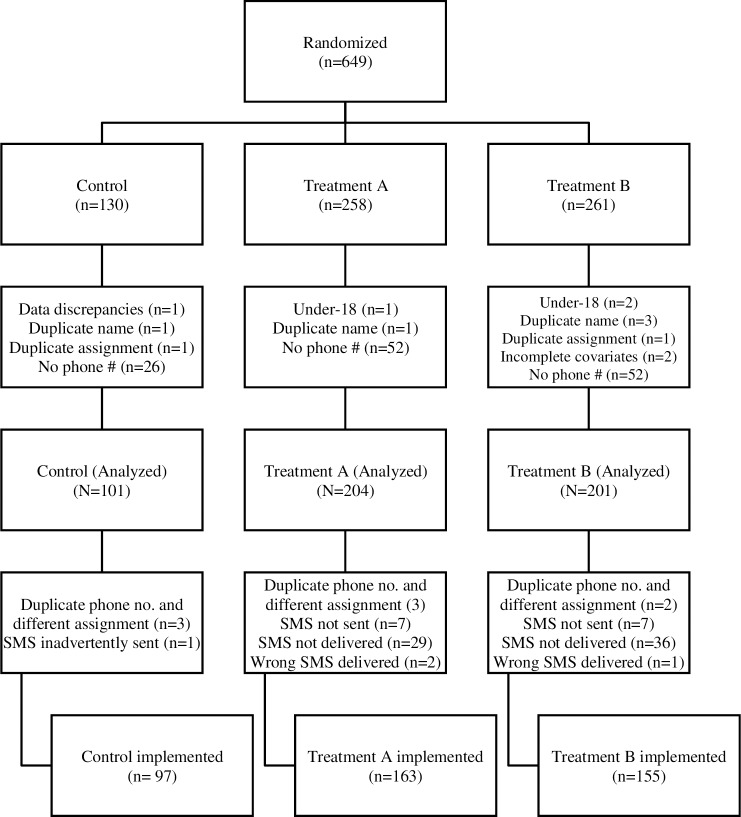
We fielded two SMS interventions in three Cape Town clinics to see their effects on whether people returned to clinic, and how quickly. One was a simple reminder; the other aimed to overcome "optimism bias" by reminding people TB is curable and many millions die unnecessarily from it. Recruits were randomly assigned at the clinic level to a control group or one of the two SMS groups (1:2:2). In addition to estimating effects on the full sample, we also estimated effects on HIV-positive patients.
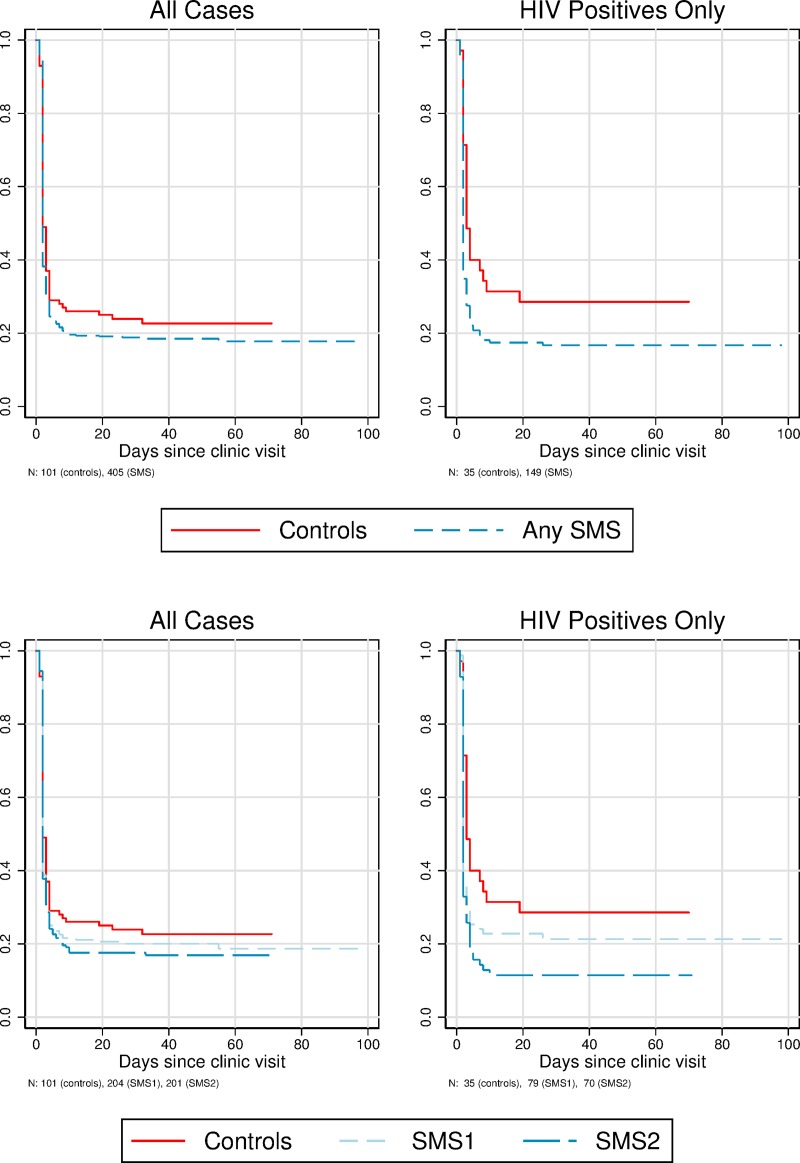
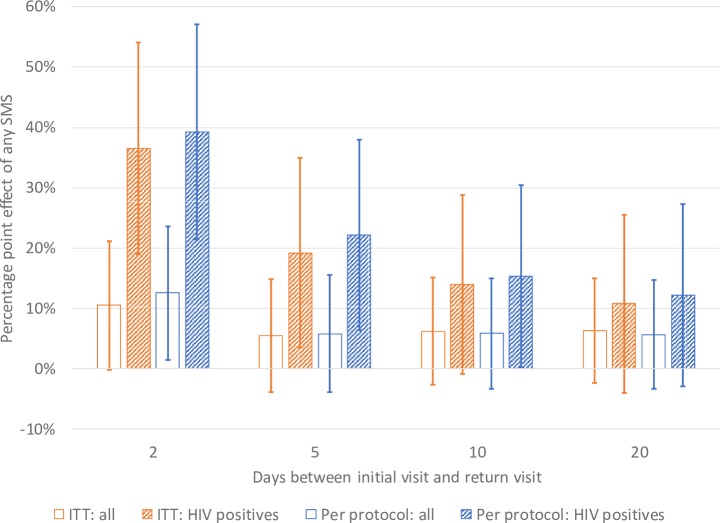
SMS recipients were more likely to return to clinic in the requested two days than the control group. The effect was smaller in the intent-to-treat analysis (52/101 or 51.5% vs. 251/405 or 62.0%, p = 0.05) than in the per-protocol analysis (50/97 or 51.5% vs. 204/318 or 64.2%, p = 0.03). The effect was larger among HIV-positives (10/35 or 28.6% vs. 97/149 or 65.1%, p<0.01). The effects of SMS messages diminished as the interval increased: significant effects at the 5% level were found at five and 10 days only among HIV-positives. The second SMS message had larger effects, albeit not significantly larger, likely due in part to lack of statistical power.
At 2 U.S. cents per message, SMS reminders are an inexpensive option to encourage TB testers to return to clinic, especially when worded to counter optimism bias.
尽管结核病相对容易发现和治疗,但仍持续存在,因为从出现症状到治愈的过程涉及一系列步骤,患者在每个阶段都可能失去随访,而未失去随访的患者也会出现延误。导致脱落和延误的一个原因是,患者延迟或避免返回诊所获取检测结果并开始治疗。
我们在开普敦的三个诊所进行了两项短信干预,以观察它们对人们是否返回诊所以及返回速度的影响。一项是简单的提醒;另一项旨在通过提醒人们结核病是可治愈的,并且有数百万人因此不必要地死亡,从而克服“乐观偏见”。在诊所层面,招募的人员被随机分配到对照组或两个短信组之一(1:2:2)。除了估计对全样本的影响外,我们还估计了对 HIV 阳性患者的影响。
短信接收者比对照组更有可能在要求的两天内返回诊所。意向治疗分析中的效果较小(52/101 或 51.5% 与 251/405 或 62.0%,p=0.05),而在方案分析中的效果较大(50/97 或 51.5% 与 204/318 或 64.2%,p=0.03)。在 HIV 阳性患者中效果更大(10/35 或 28.6% 与 97/149 或 65.1%,p<0.01)。短信消息的效果随着时间间隔的增加而减弱:仅在 HIV 阳性患者中,在 5 天和 10 天时才发现有统计学意义的效果。第二条短信消息的效果更大,但没有显著更大,可能部分原因是缺乏统计能力。
每条短信 2 美分的成本,短信提醒是一种鼓励结核病检测者返回诊所的廉价选择,尤其是在措辞上可以克服乐观偏见时。