
一种口腔、喉部、食管和肺部鳞状细胞癌的亚型,具有高水平的 TrkB-T1 神经营养因子受体 mRNA。
A subtype of oral, laryngeal, esophageal, and lung, squamous cell carcinoma with high levels of TrkB-T1 neurotrophin receptor mRNA.
机构信息
Department of Oral Medicine & Diagnostic Sciences, Center for Molecular Biology of Oral Diseases, College of Dentistry, University of Illinois at Chicago, 801 South Paulina Street, Chicago, IL, 60612, USA.
Department of Computer Science and Carl R. Woese Institute of Genomic Biology, University of Illinois at Urbana-Champaign, 2122 Siebel Center, 201N. Goodwin Ave, Urbana, IL, USA.
出版信息
BMC Cancer. 2019 Jun 20;19(1):607. doi: 10.1186/s12885-019-5789-8.
BACKGROUND
The NTRK2 genetic locus encodes neurotrophin membrane receptors that play an important role in normal neural tissue plasticity, growth, and survival. One NTRK2-encoded protein is TrkB-FL, which can regulate multiple pathways relevant to cancer. A second NTRK2 gene mRNA isoform encodes TrkB-T1, a receptor that has a different cytoplasmic domain encoded in a mRNA with a unique 3' terminal exon.
METHOD
Tumors from The Cancer Genome Atlas (TCGA) and other studies were classified according to the expression of a single form of NTRK2 mRNA, TrkB-T1, identified by its unique 3' terminal exon. Analysis of differentially expressed genes in TrkB-T1 high expressers was done to determine if tumors enriched for TrkB-T1 mRNA were a uniform group independent of anatomic site.
RESULTS
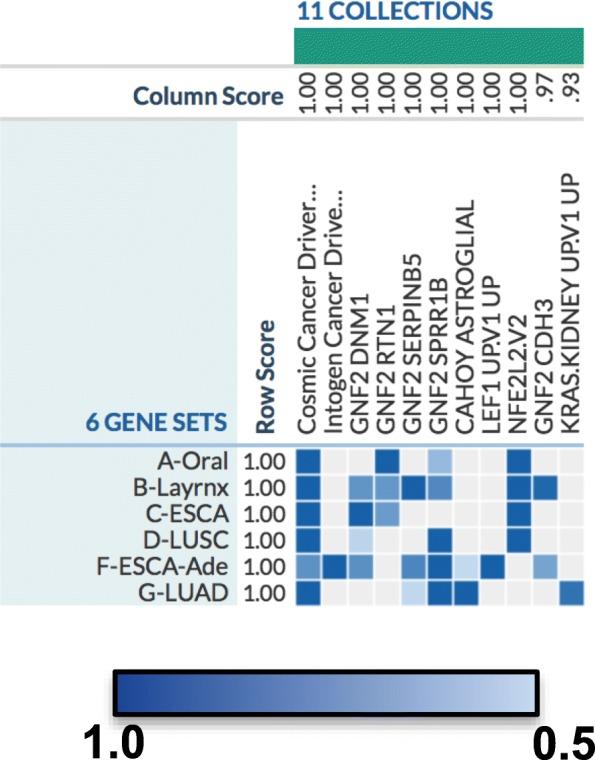
The mRNA for TrkB-T1 is the most abundant NTRK2 gene mRNA in all squamous cell carcinomas (SCCs) in the TCGA database. Comparison of larynx SCC high TrkB-T1 RNA expressers to low expressers (n = 96) revealed gene expression differences consistent with the high TrkB-T1 tumors being more neural-like. The upregulated genes in the TrkB-T1 RNA high expressers also showed enrichment of pathways involved in retinol metabolism, hedgehog signaling, and the Nfe2l2 response, among other pathways. An examination of oral, esophagus, and lung SCCs (n = 284, 97, 501) showed induction of the same pathways among tumors that expressed high levels of TrkB-T1 mRNA. Proteins associated with regulation of the sonic hedgehog pathway, and the Nfe2l2 response, Tp63, and Keap1 and p62/SQSTM1 proteins, showed differential expression in larynx, oral and lung high TrkB1-T1 expresser SCCs. Unexpectantly, the relationship of high level TrkB-T1 expression to patient outcomes was SCC anatomic site specific. High TrkB-T1 mRNA levels in laryngeal SCC correlated with poor survival, but the opposite was true for lung SCC. This may be because pathways enriched in the TrkB high expressers, like those involving oncogenes NFE2L2, PIK3CA, and SOX2, are known to have SCC anatomic site-specific effects on progression.
CONCLUSIONS
High level TrkB-T1 mRNA is a marker of a distinct SCC subtype enriched for at least 3 pathways relevant to tumor progression: Nfe2l2 response, retinol metabolism, and hedgehog signaling.
背景
NTRK2 基因座编码神经营养因子膜受体,在正常神经组织可塑性、生长和存活中发挥重要作用。NTRK2 编码的一种蛋白质是 TrkB-FL,它可以调节与癌症相关的多种途径。第二个 NTRK2 基因 mRNA 异构体编码 TrkB-T1,这是一种受体,其细胞质结构域编码在具有独特 3'末端外显子的 mRNA 中。
方法
根据通过其独特的 3'末端外显子识别的单个 NTRK2 mRNA 形式 TrkB-T1 的表达,对来自癌症基因组图谱 (TCGA) 和其他研究的肿瘤进行分类。对 TrkB-T1 高表达者中差异表达基因的分析,以确定是否富集 TrkB-T1 mRNA 的肿瘤是独立于解剖部位的均质组。
结果
在 TCGA 数据库中的所有鳞状细胞癌 (SCC) 中,TrkB-T1 的 mRNA 是最丰富的 NTRK2 基因 mRNA。与低表达者(n=96)相比,喉 SCC 高 TrkB-T1 RNA 表达者的基因表达差异表明,高 TrkB-T1 肿瘤更具神经样性。在 TrkB-T1 RNA 高表达者中上调的基因也显示出与视黄醇代谢、 hedgehog 信号传导和 Nfe2l2 反应等途径相关的途径富集。对口腔、食管和肺 SCC(n=284、97、501)的检查显示,在表达高水平 TrkB-T1 mRNA 的肿瘤中诱导了相同的途径。与 sonic hedgehog 途径、Nfe2l2 反应、Tp63 和 Keap1 和 p62/SQSTM1 蛋白的调节相关的蛋白在喉、口腔和肺高 TrkB1-T1 表达者 SCC 中显示出差异表达。出乎意料的是,高水平 TrkB-T1 表达与患者结局的关系因 SCC 解剖部位而异。喉 SCC 中高水平 TrkB-T1 表达与生存率降低相关,但肺 SCC 则相反。这可能是因为在 TrkB 高表达者中富集的途径,如涉及癌基因 NFE2L2、PIK3CA 和 SOX2 的途径,对进展具有与 SCC 解剖部位相关的特定作用。
结论
高水平 TrkB-T1 mRNA 是一种独特的 SCC 亚型标志物,至少富集了 3 条与肿瘤进展相关的途径:Nfe2l2 反应、视黄醇代谢和 hedgehog 信号传导。




 Zotero 插件