Computational Imaging Group for MR diagnostic & therapy, Center for Image Sciences, University Medical Center Utrecht, Heidelberglaan 100, Utrecht, 3584 CX, The Netherlands.
Department of Radiotherapy, Division of Imaging & Oncology, University Medical Center Utrecht, Heidelberglaan 100, Utrecht, 3584 CX, The Netherlands.
Sci Rep. 2019 Jun 20;9(1):8895. doi: 10.1038/s41598-019-45382-x.
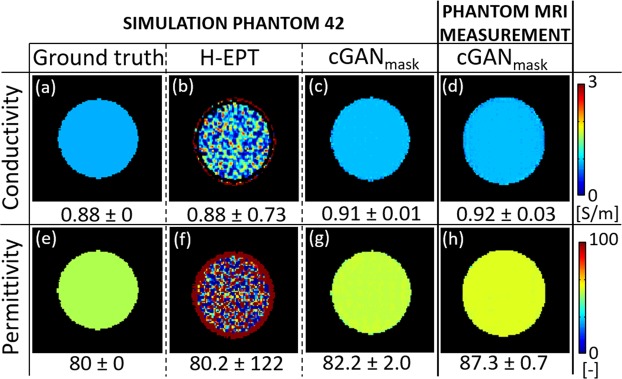
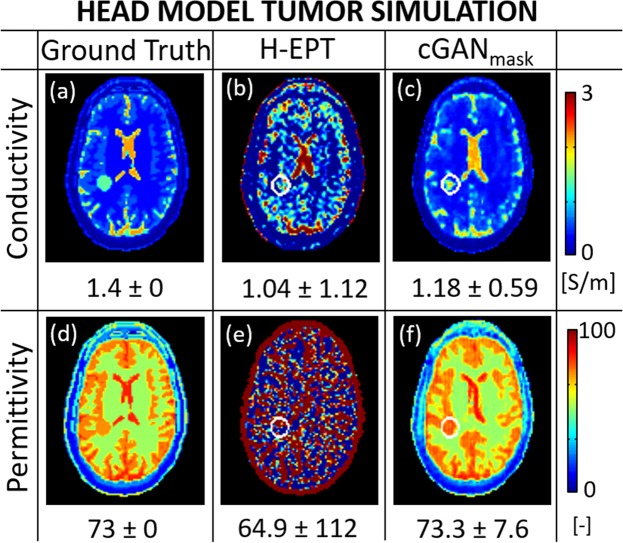
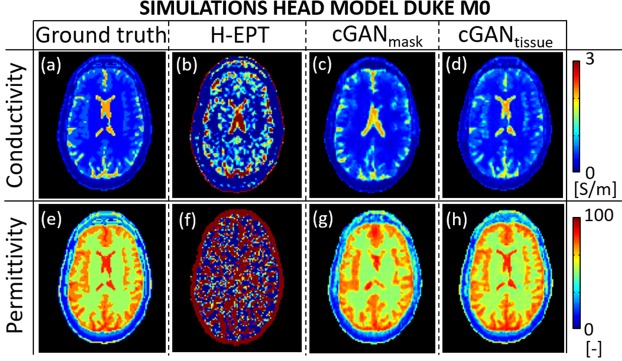
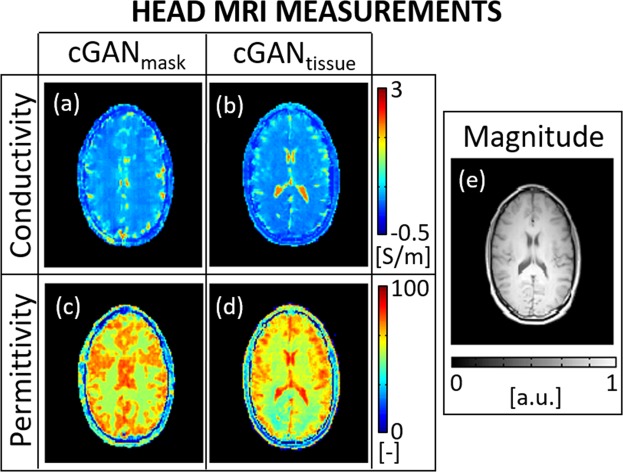
In the radiofrequency (RF) range, the electrical properties of tissues (EPs: conductivity and permittivity) are modulated by the ionic and water content, which change for pathological conditions. Information on tissues EPs can be used e.g. in oncology as a biomarker. The inability of MR-Electrical Properties Tomography techniques (MR-EPT) to accurately reconstruct tissue EPs by relating MR measurements of the transmit RF field to the EPs limits their clinical applicability. Instead of employing electromagnetic models posing strict requirements on the measured MRI quantities, we propose a data driven approach where the electrical properties reconstruction problem can be casted as a supervised deep learning task (DL-EPT). DL-EPT reconstructions for simulations and MR measurements at 3 Tesla on phantoms and human brains using a conditional generative adversarial network demonstrate high quality EPs reconstructions and greatly improved precision compared to conventional MR-EPT. The supervised learning approach leverages the strength of electromagnetic simulations, allowing circumvention of inaccessible MR electromagnetic quantities. Since DL-EPT is more noise-robust than MR-EPT, the requirements for MR acquisitions can be relaxed. This could be a major step forward to turn electrical properties tomography into a reliable biomarker where pathological conditions can be revealed and characterized by abnormalities in tissue electrical properties.
在射频 (RF) 范围内,组织的电特性(电导率和介电常数)会受到离子和含水量的调制,而这些参数会随着病理状况的变化而变化。组织电特性的信息可用于肿瘤学等领域作为生物标志物。磁共振电特性层析成像技术 (MR-EPT) 无法通过将 RF 场的磁共振测量值与电特性相关联来准确重建组织电特性,这限制了其临床应用。我们提出了一种数据驱动的方法,而不是采用对测量的 MRI 量有严格要求的电磁模型,该方法将电特性重建问题可以表述为一个有监督的深度学习任务 (DL-EPT)。使用条件生成对抗网络对模拟和 3T 磁共振测量数据进行的 DL-EPT 重建,在对体模和人脑的重建中,与传统的 MR-EPT 相比,该方法可以实现高质量的电特性重建和极大提高精度。有监督的学习方法利用了电磁模拟的优势,从而可以避开无法测量的磁共振电磁学量。由于 DL-EPT 比 MR-EPT 更能抵抗噪声,因此可以放宽对磁共振采集的要求。这可能是将电特性层析成像转化为可靠的生物标志物的重要一步,通过该生物标志物可以揭示和表征组织电特性的异常,从而反映病理状况。