Li Ze-Hua, Cui Dong, Qiu Cheng-Jie, Song Xue-Jun
Department of Biology, SUSTech Center for Pain Medicine, and Medical School, Southern University of Science and Technology, Shenzhen, Guangdong 518055, China.
Department of Anesthesiology and Key Laboratory of Carcinogenesis and Translational Research (Ministry of Education of China), Peking University School of Oncology, Beijing Cancer Hospital & Institute, Beijing 100142, China.
Neurobiol Pain. 2019 Mar 8;6:100028. doi: 10.1016/j.ynpai.2019.100028. eCollection 2019 Aug-Dec.
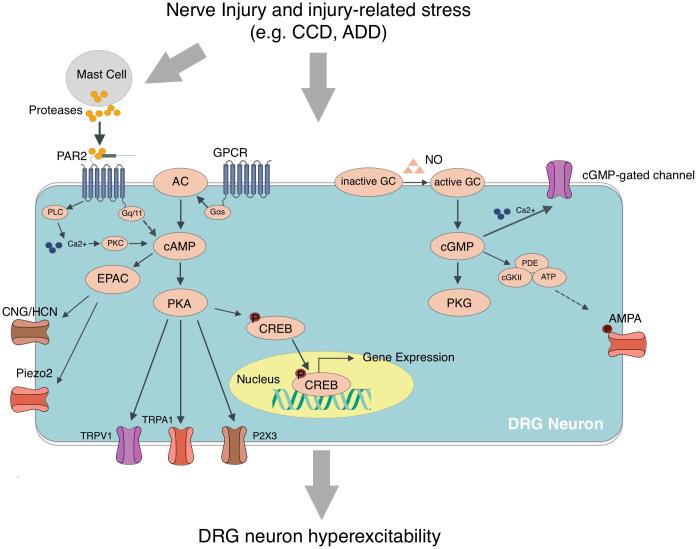
The cyclic nucleotide signaling, including cAMP-PKA and cGMP-PKG pathways, has been well known to play critical roles in regulating cellular growth, metabolism and many other intracellular processes. In recent years, more and more studies have uncovered the roles of cAMP and cGMP in the nervous system. The cAMP and cGMP signaling mediates chronic pain induced by different forms of injury and stress. Here we summarize the roles of cAMP-PKA and cGMP-PKG signaling pathways in the pathogenesis of chronic pain after nerve injury. In addition, acute dissociation and chronic compression of the dorsal root ganglion (DRG) neurons, respectively, leads to neural hyperexcitability possibly through PAR2 activation-dependent activation of cAMP-PKA pathway. Clinically, radiotherapy can effectively alleviate bone cancer pain at least partly through inhibiting the cancer cell-induced activation of cAMP-PKA pathway. Roles of cyclic nucleotide signaling in neuropathic and inflammatory pain are also seen in many other animal models and are involved in many pro-nociceptive mechanisms including the activation of hyperpolarization-activated cyclic nucleotide (HCN)-modulated ion channels and the exchange proteins directly activated by cAMP (EPAC). Further understanding the roles of cAMP and cGMP signaling in the pathogenesis of chronic pain is theoretically significant and clinically valuable for treatment of chronic pain.
环核苷酸信号传导,包括cAMP-PKA和cGMP-PKG途径,在调节细胞生长、代谢及许多其他细胞内过程中发挥关键作用,这一点已广为人知。近年来,越来越多的研究揭示了cAMP和cGMP在神经系统中的作用。cAMP和cGMP信号传导介导由不同形式的损伤和应激诱导的慢性疼痛。在此,我们总结cAMP-PKA和cGMP-PKG信号通路在神经损伤后慢性疼痛发病机制中的作用。此外,背根神经节(DRG)神经元的急性解离和慢性压迫分别可能通过PAR2激活依赖性的cAMP-PKA途径激活导致神经兴奋性增高。临床上,放射治疗至少部分地通过抑制癌细胞诱导的cAMP-PKA途径激活来有效减轻骨癌疼痛。环核苷酸信号传导在神经性和炎性疼痛中的作用在许多其他动物模型中也有体现,并且涉及许多促痛机制,包括超极化激活的环核苷酸(HCN)调制离子通道的激活以及由cAMP直接激活的交换蛋白(EPAC)。进一步了解cAMP和cGMP信号传导在慢性疼痛发病机制中的作用对于慢性疼痛的治疗在理论上具有重要意义且在临床上具有重要价值。