Department of Experimental Therapeutics, National Cancer Center Hospital East, 6-5-1 Kashiwanoha, Kashiwa-shi, Chiba-ken, 277-8577, Japan.
Department of Experimental Therapeutics, National Cancer Center Hospital, Tokyo, Japan.
Cancer Chemother Pharmacol. 2019 Aug;84(2):393-404. doi: 10.1007/s00280-019-03882-7. Epub 2019 Jun 21.
Ipatasertib is a selective inhibitor of Akt, a frequently activated protein kinase in human cancers. The current study assessed the safety, tolerability, and pharmacokinetics of ipatasertib in Japanese patients with solid tumors.
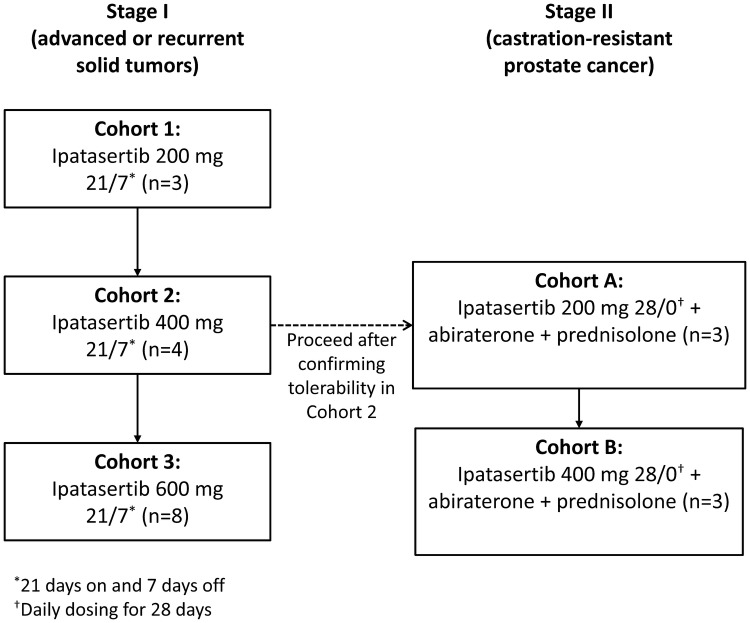
This was a phase I, open-label, 3 + 3 dose-escalation study conducted in two stages. In stage I, Japanese patients with solid tumors were administered ipatasertib 200, 400, or 600 mg/day for 21 days of a 28-day cycle. In stage II, Japanese patients with castration-resistant prostate cancer were administered ipatasertib 200 or 400 mg/day in combination with abiraterone and prednisolone in 28-day cycles. Dose-limiting toxicity (DLT) was assessed at each dose before enrolling patients at a higher dose; DLT was used to determine the maximum tolerated dose (MTD) and maximum administered dose (MAD). Pharmacokinetic parameters were assessed after a single dose and at steady state.
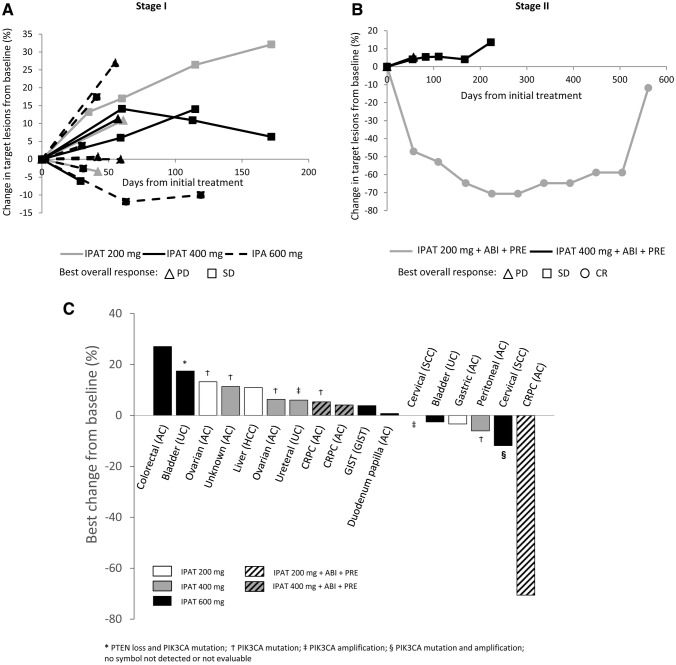
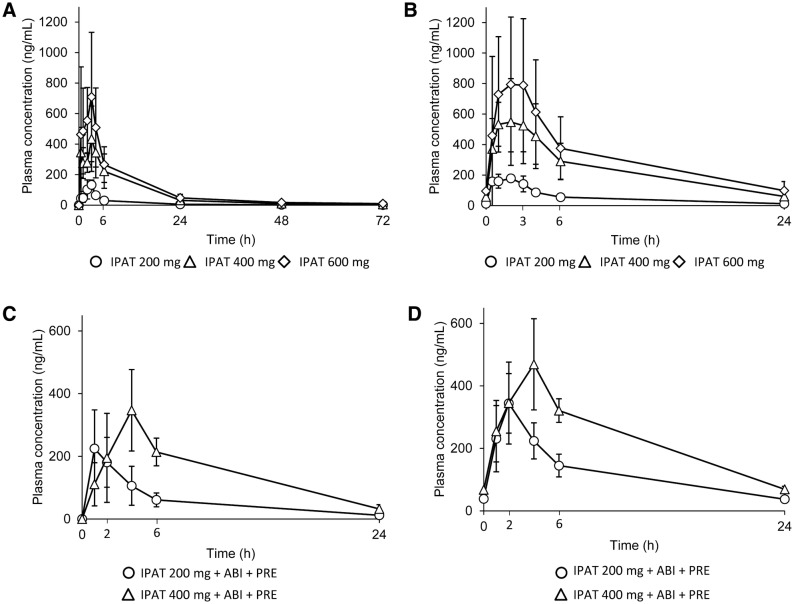
Fifteen patients were enrolled in Stage I and six in Stage II. The ipatasertib MTD was 600 mg as monotherapy and MAD was 400 mg in combination with abiraterone and prednisolone. Ipatasertib plasma exposure was dose proportional across the dose range, and was not markedly affected by concurrent administration of abiraterone plus prednisolone. Stable disease (SD) was observed in eight patients treated with ipatasertib monotherapy (53.3%); four patients had SD and one had complete response with ipatasertib plus abiraterone and prednisolone.
Ipatasertib, at the monotherapy MTD of 600 mg/day and MAD of 400 mg/day in combination with abiraterone and prednisolone, was safe and tolerable in Japanese patients with solid tumors.
依帕司他是一种 Akt 的选择性抑制剂,Akt 是人类癌症中经常被激活的蛋白激酶。本研究评估了依帕司他在日本实体瘤患者中的安全性、耐受性和药代动力学。
这是一项在两个阶段进行的、开放标签的、3+3 剂量递增的 I 期研究。在 I 期阶段,日本实体瘤患者接受依帕司他 200、400 或 600mg/天,每 21 天为一个 28 天的周期。在 II 期阶段,日本去势抵抗性前列腺癌患者接受依帕司他 200 或 400mg/天与阿比特龙和泼尼松龙联合使用,每 28 天为一个周期。在每个剂量水平下,通过评估剂量限制性毒性(DLT)来决定是否招募更高剂量水平的患者;通过 DLT 来确定最大耐受剂量(MTD)和最大给药剂量(MAD)。在单次给药和稳态时评估药代动力学参数。
15 名患者入组 I 期,6 名患者入组 II 期。依帕司他单药治疗的 MTD 为 600mg,MAD 为与阿比特龙和泼尼松龙联合使用时的 400mg。依帕司他的血浆暴露量在剂量范围内呈剂量比例关系,并且不受阿比特龙加泼尼松龙同时给药的显著影响。8 名接受依帕司他单药治疗的患者观察到疾病稳定(SD)(53.3%);4 名患者 SD,1 名患者与阿比特龙和泼尼松龙联合使用时出现完全缓解。
依帕司他在日本实体瘤患者中的单药治疗 MTD 为 600mg/天,与阿比特龙和泼尼松龙联合使用的 MAD 为 400mg/天,安全且耐受良好。