Michaud Kaleb, Pope Janet E, Emery Paul, Zhu Baojin, Gaich Carol L, DeLozier Amy M, Zhang Xiang, Dickson Christina L, Smolen Josef S
University of Nebraska Medical Center, Omaha, NE, USA.
FORWARD, The National Databank for Rheumatic Diseases, Wichita, KS, USA.
Rheumatol Ther. 2019 Sep;6(3):409-419. doi: 10.1007/s40744-019-0164-4. Epub 2019 Jun 21.
To explore the relationship of pain and fatigue with daily activity and work productivity in rheumatoid arthritis (RA) patients from the baricitinib clinical trial, RA-BEAM.
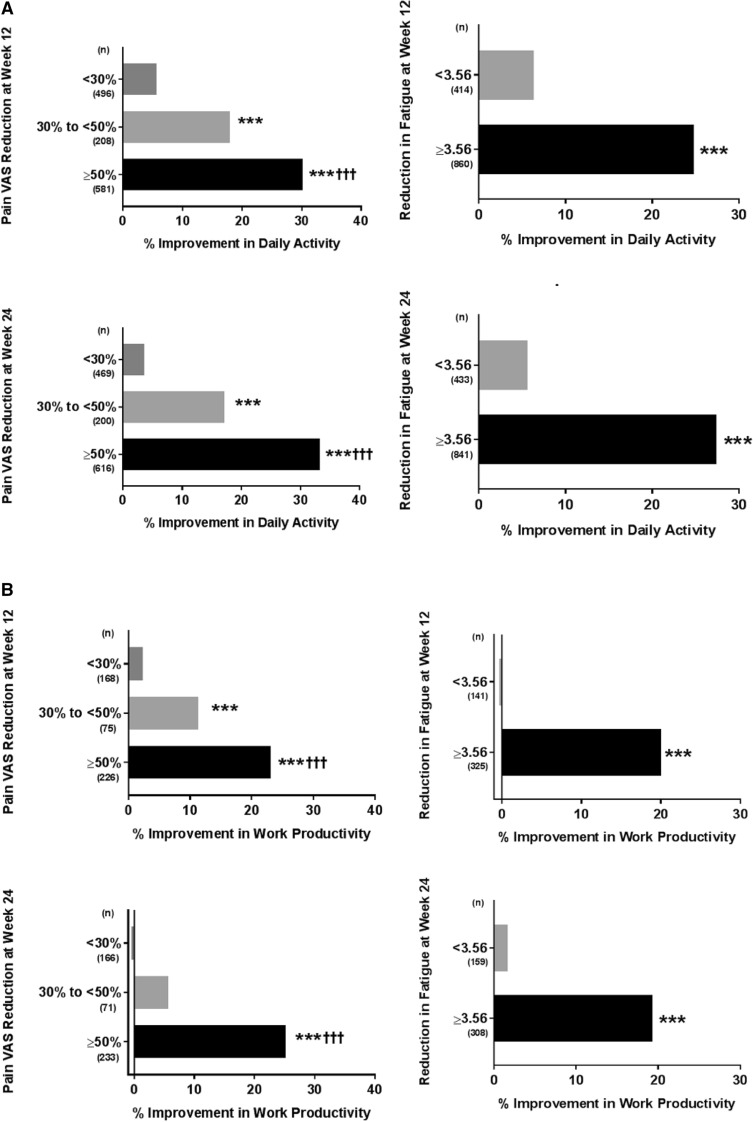
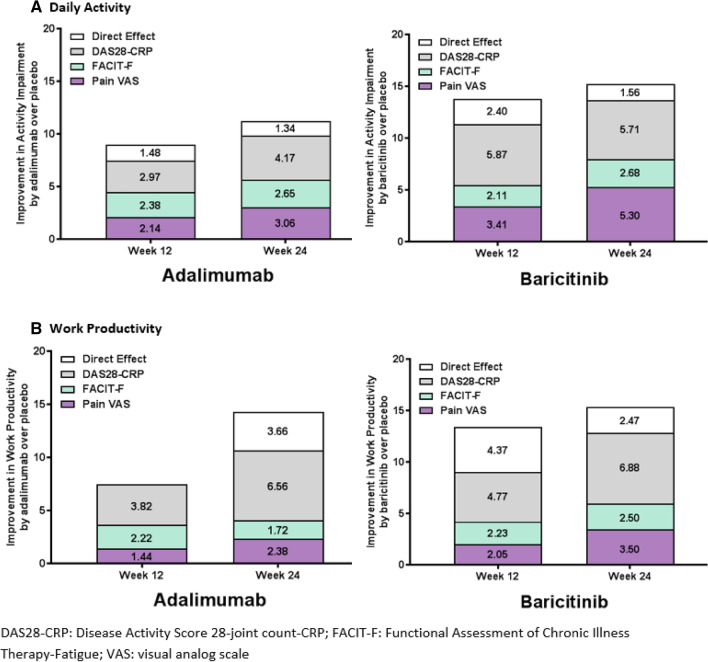
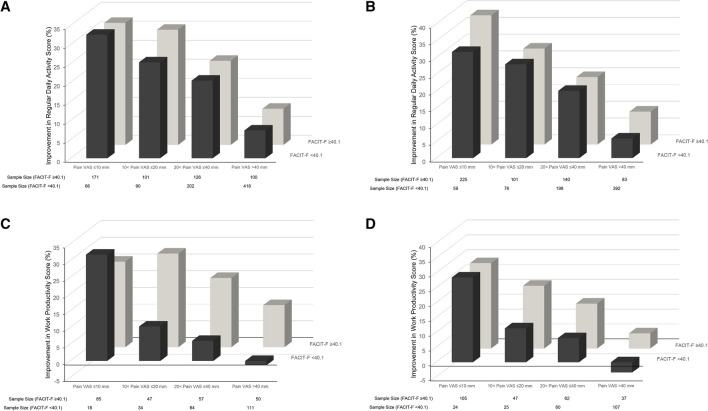
In RA-BEAM, a double-blind phase 3 study, patients were randomized 3:3:2 to placebo (n = 488), baricitinib 4 mg once daily (n = 487), or adalimumab 40 mg biweekly (n = 330) with background methotrexate. The Functional Assessment of Chronic Illness Therapy-Fatigue (FACIT-F) measured fatigue and the pain visual analog scale (0-100 mm) assessed pain. Work Productivity and Activity Impairment Questionnaire-RA measured daily activity and work productivity. At weeks 12 and 24, pain was assessed using pain reduction (< 30%, 30% to < 50%, ≥ 50%) and overall pain score; clinically relevant FACIT-F changes were assessed by values < 3.56 and ≥ 3.56 and the FACIT-F normative value score (< 40.1, ≥ 40.1). Pairwise comparisons between pain/fatigue reduction groups were assessed using ANCOVA with pooled data on daily activity and work productivity. A mediator analysis with pain, fatigue, and disease activity measured their contribution to daily activity and work productivity. Data were pooled from all patients for most analyses, and baricitinib-treated patients were assessed as a sensitivity analysis.
Reductions in pain (≥ 50%) and fatigue (≥ 3.56) had significant (p ≤ 0.001) effects on daily activity and work productivity improvement at weeks 12 and 24. Reductions in pain, fatigue, and disease activity accounted for most of the improvements in daily activity and work productivity. At the lowest levels of remaining pain (≤ 10 mm) at weeks 12 and 24, however, fatigue did not appear to impact work productivity. Similar trends were observed with baricitinib-treated patients.
Reductions in pain and fatigue were associated with improved daily activity and work productivity for all RA patients and for baricitinib-treated patients in RA-BEAM.
ClinicalTrials.gov identifier, NCT01710358.
Incyte Corporation and Eli Lilly and Company.
在巴瑞替尼的临床试验RA-BEAM中,探讨类风湿关节炎(RA)患者疼痛和疲劳与日常活动及工作效率之间的关系。
在RA-BEAM这一3期双盲研究中,患者按3:3:2随机分为接受安慰剂(n = 488)、每日一次4 mg巴瑞替尼(n = 487)或每两周一次40 mg阿达木单抗(n = 330)治疗,并联合使用背景甲氨蝶呤。慢性疾病治疗功能评估-疲劳量表(FACIT-F)用于测量疲劳,疼痛视觉模拟量表(0-100 mm)用于评估疼痛。工作效率和活动障碍问卷-RA用于测量日常活动和工作效率。在第12周和第24周,使用疼痛减轻程度(<30%、30%至<50%、≥50%)和总体疼痛评分评估疼痛;通过<3.56和≥3.56以及FACIT-F标准值评分(<40.1、≥40.1)评估具有临床意义的FACIT-F变化。使用协方差分析对疼痛/疲劳减轻组之间进行两两比较,并汇总日常活动和工作效率的数据。进行一项以疼痛、疲劳和疾病活动为中介因素的分析,以衡量它们对日常活动和工作效率的影响。大多数分析的数据来自所有患者,并对接受巴瑞替尼治疗的患者进行敏感性分析。
在第12周和第24周,疼痛减轻(≥50%)和疲劳减轻(≥3.56)对日常活动和工作效率的改善具有显著(p≤0.001)影响。疼痛、疲劳和疾病活动度的降低是日常活动和工作效率改善的主要原因。然而,在第12周和第24周剩余疼痛水平最低(≤10 mm)时,疲劳似乎并未影响工作效率。在接受巴瑞替尼治疗的患者中也观察到了类似趋势。
在RA-BEAM中,对于所有RA患者以及接受巴瑞替尼治疗的患者,疼痛和疲劳的减轻与日常活动和工作效率的提高相关。
ClinicalTrials.gov标识符,NCT01710358。
因赛特公司和礼来公司。