Smolen Josef S, Kremer Joel M, Gaich Carol L, DeLozier Amy M, Schlichting Douglas E, Xie Li, Stoykov Ivaylo, Rooney Terence, Bird Paul, Sánchez Bursón Juan Miguel, Genovese Mark C, Combe Bernard
Medical University of Vienna and Hietzing Hospital, Vienna, Austria.
Albany Medical College, Albany, New York, USA.
Ann Rheum Dis. 2017 Apr;76(4):694-700. doi: 10.1136/annrheumdis-2016-209821. Epub 2016 Oct 31.
To assess baricitinib on patient-reported outcomes (PROs) in patients with moderately to severely active rheumatoid arthritis, who had insufficient response or intolerance to ≥1 tumour necrosis factor inhibitors (TNFis) or other biological disease-modifying antirheumatic drugs (bDMARDs).
In this double-blind phase III study, patients were randomised to once-daily placebo or baricitinib 2 or 4 mg for 24 weeks. PROs included the Short Form-36, EuroQol 5-D, Functional Assessment of Chronic Illness Therapy-Fatigue (FACIT-F), Health Assessment Questionnaire-Disability Index (HAQ-DI), Patient's Global Assessment of Disease Activity (PtGA), patient's assessment of pain, duration of morning joint stiffness (MJS) and Work Productivity and Activity Impairment Questionnaire-Rheumatoid Arthritis. Treatment comparisons were performed with logistic regression for categorical measures or analysis of covariance for continuous variables.
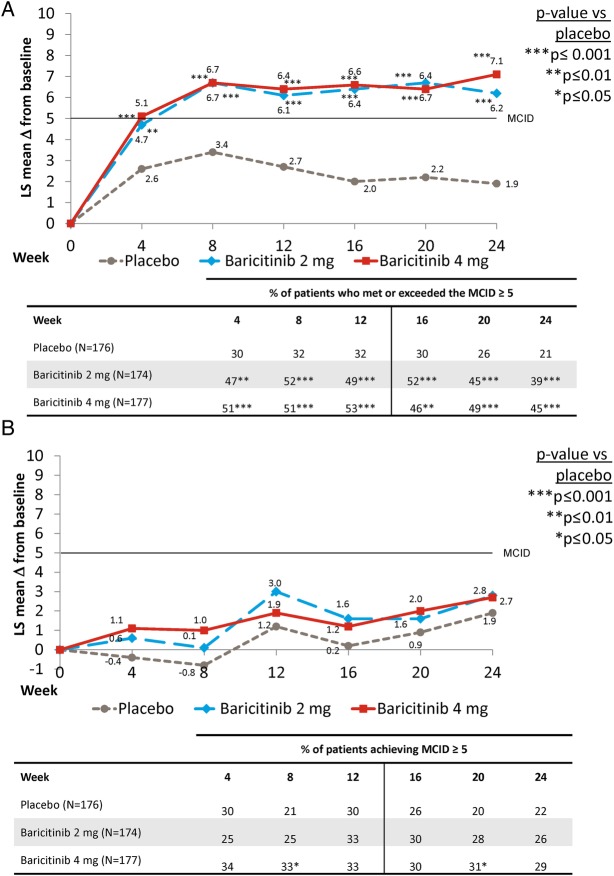
527 patients were randomised (placebo, 176; baricitinib 2 mg, 174; baricitinib 4 mg, 177). Both baricitinib-treated groups showed statistically significant improvements versus placebo in most PROs. Improvements were generally more rapid and of greater magnitude for patients receiving baricitinib 4 mg than 2 mg and were maintained to week 24. At week 24, more baricitinib-treated patients versus placebo-treated patients reported normal physical functioning (HAQ-DI <0.5; p≤0.001), reductions in fatigue (FACIT-F ≥3.56; p≤0.05), improvements in PtGA (p≤0.001) and pain (p≤0.001) and reductions in duration of MJS (p<0.01).
Baricitinib improved most PROs through 24 weeks compared with placebo in this study of treatment-refractory patients with previously inadequate responses to bDMARDs, including at least one TNFi. PRO results aligned with clinical efficacy data for baricitinib.
NCT01721044; Results.
评估巴瑞替尼对中度至重度活动性类风湿关节炎患者的患者报告结局(PROs)的影响,这些患者对≥1种肿瘤坏死因子抑制剂(TNFis)或其他生物改善病情抗风湿药(bDMARDs)反应不足或不耐受。
在这项双盲III期研究中,患者被随机分为每日一次服用安慰剂或2mg或4mg巴瑞替尼,为期24周。PROs包括简短健康调查问卷-36、欧洲五维健康量表、慢性病治疗功能评估-疲劳量表(FACIT-F)、健康评估问卷-残疾指数(HAQ-DI)、患者对疾病活动的整体评估(PtGA)、患者对疼痛的评估、晨僵持续时间(MJS)以及工作效率和活动障碍问卷-类风湿关节炎。对于分类指标,采用逻辑回归进行治疗组间比较;对于连续变量,采用协方差分析。
527例患者被随机分组(安慰剂组176例;巴瑞替尼2mg组174例;巴瑞替尼4mg组177例)。与安慰剂相比,两个巴瑞替尼治疗组在大多数PROs方面均显示出具有统计学意义的改善。接受4mg巴瑞替尼的患者的改善通常比2mg组更快、幅度更大,且持续到第24周。在第24周时,与安慰剂治疗组相比,更多接受巴瑞替尼治疗的患者报告身体功能正常(HAQ-DI<0.5;p≤0.001)、疲劳减轻(FACIT-F≥3.56;p≤0.05)、PtGA改善(p≤0.001)和疼痛改善(p≤0.001)以及MJS持续时间缩短(p<0.01)。
在这项针对先前对bDMARDs(包括至少一种TNFi)反应不足的难治性患者的研究中,与安慰剂相比,巴瑞替尼在24周内改善了大多数PROs。PRO结果与巴瑞替尼的临床疗效数据一致。
NCT01721044;结果