College of Medical, Veterinary and Life Sciences, Institute of Biodiversity, Animal Health and Comparative Medicine, University of Glasgow, Glasgow G61 1QH, UK.
College of Medical, Veterinary and Life Sciences, School of Veterinary Medicine, University of Glasgow, Glasgow G61 1QH, UK.
Psychoneuroendocrinology. 2019 Oct;108:70-77. doi: 10.1016/j.psyneuen.2019.06.008. Epub 2019 Jun 13.
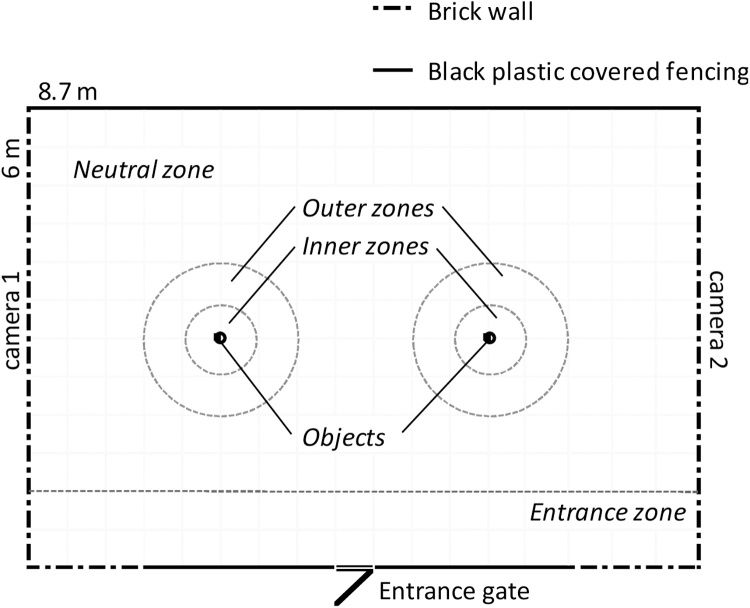
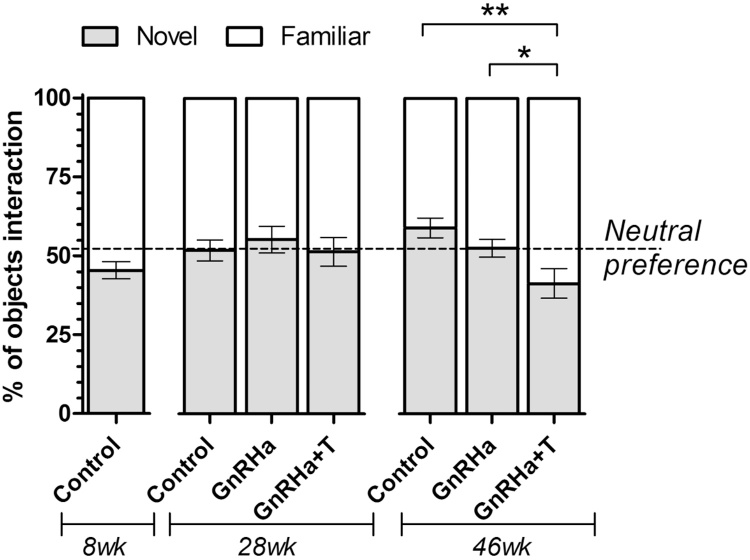
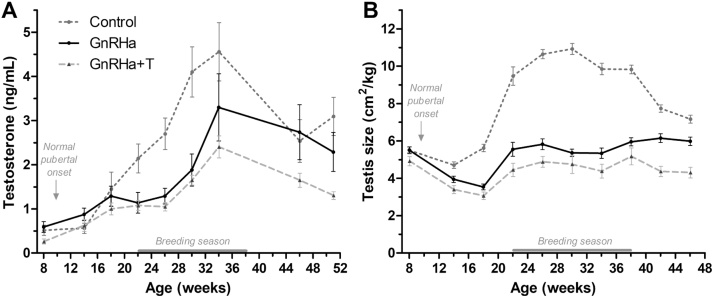
Chronic gonadotropin-releasing hormone agonist (GnRHa) treatment is effective for the medical suppression of the hypothalamic-pituitary-gonadal axis in situations like central precocious puberty and gender dysphoria. However, its administration during the peripubertal period could influence normal brain development and function because GnRH receptors are expressed in brain regions that regulate emotions, cognition, motivation and memory. This study used an ovine model to determine whether chronic peripubertal GnRHa-treatment affected the developmental shift from preference of familiarity to novelty. Experimental groups included Controls and GnRHa-treated rams. To differentiate between effects of altered GnRH signaling and those associated with the loss of sex steroids, a group was also included that received testosterone replacement as well as GnRHa (GnRHa + T). Preference for a novel versus familiar object was assessed during 5-min social isolation at 8, 28 and 46 weeks of age. Approach behavior was measured as interactions with and time spent near the objects, whereas avoidance behavior was measured by time spent in the entrance zone and attempts to escape the arena via the entry point. Emotional reactivity was measured by the number of vocalizations, escape attempts and urinations. As Control and GnRHa-treated rams aged, their approach behaviors showed a shift from preference for familiarity (8 weeks) to novelty (46 weeks). In contrast, relative to the Controls the GnRHa + T rams exhibited more approach behaviors towards both objects, at 28 and 46 weeks of age and preferred familiarity at 46 weeks of age. Vocalisation rate was increased in GnRHa treated rams in late puberty (28 weeks) compared to both Control and GnRHa + T rams but this effect was not seen in young adulthood (46 weeks). These results suggest that the specific suppression of testosterone during a developmental window in late puberty may reduce emotional reactivity and hamper learning a flexible adjustment to environmental change. The results also suggest that disruption of either endogenous testosterone signalling or a synergistic action between GnRH and testosterone signalling, may delay maturation of cognitive processes (e.g. information processing) that affects the motivation of rams to approach and avoid objects.
慢性促性腺激素释放激素激动剂(GnRHa)治疗可有效抑制中枢性性早熟和性别焦虑等情况下的下丘脑-垂体-性腺轴的医学抑制。然而,在青春期期间给予 GnRH 可能会影响正常的大脑发育和功能,因为 GnRH 受体在调节情绪、认知、动机和记忆的大脑区域中表达。本研究使用绵羊模型来确定慢性青春期 GnRHa 治疗是否会影响从熟悉到新奇的偏好的发育转变。实验组包括对照组和 GnRHa 处理的公羊。为了区分改变 GnRH 信号和与失去性类固醇相关的影响,还包括一组接受睾酮替代治疗和 GnRHa(GnRHa+T)的公羊。在 8、28 和 46 周龄时,通过 5 分钟的社交隔离来评估对新颖与熟悉物体的偏好。接近行为作为与物体的相互作用和花费在物体附近的时间来衡量,而回避行为则通过花费在入口区的时间和通过入口点逃脱竞技场的尝试来衡量。情绪反应通过发声次数、逃跑尝试和排尿次数来衡量。随着对照组和 GnRHa 处理的公羊年龄的增长,它们的接近行为从对熟悉的偏好(8 周)转变为对新奇的偏好(46 周)。相比之下,GnRHa+T 公羊与对照组相比,在 28 和 46 周龄时对两种物体表现出更多的接近行为,并在 46 周龄时更喜欢熟悉的物体。与对照组和 GnRHa+T 公羊相比,GnRHa 处理的公羊在青春期后期(28 周)发声率增加,但在成年早期(46 周)没有出现这种情况。这些结果表明,在青春期后期的发育窗口期内,特定的睾酮抑制可能会降低情绪反应,并阻碍灵活适应环境变化的学习。结果还表明,内源性睾酮信号的中断或 GnRH 和睾酮信号之间的协同作用可能会延迟影响公羊接近和回避物体的动机的认知过程(例如信息处理)的成熟。