State Key Laboratory for Infectious Disease Prevention and Control, National Institute for Communicable Disease Control and Prevention, Chinese Center for Disease Control and Prevention, Beijing, People' Republic of China.
Collaborative Innovation Center for Diagnosis and Treatment of Infectious Diseases, Hangzhou, People's Republic of China.
PLoS Negl Trop Dis. 2019 Jun 24;13(6):e0007513. doi: 10.1371/journal.pntd.0007513. eCollection 2019 Jun.
Leptospirosis is one of the most important neglected tropical bacterial diseases worldwide. However, there is limited information on the genetic diversity and host selectivity of pathogenic Leptospira in wild small mammal populations.
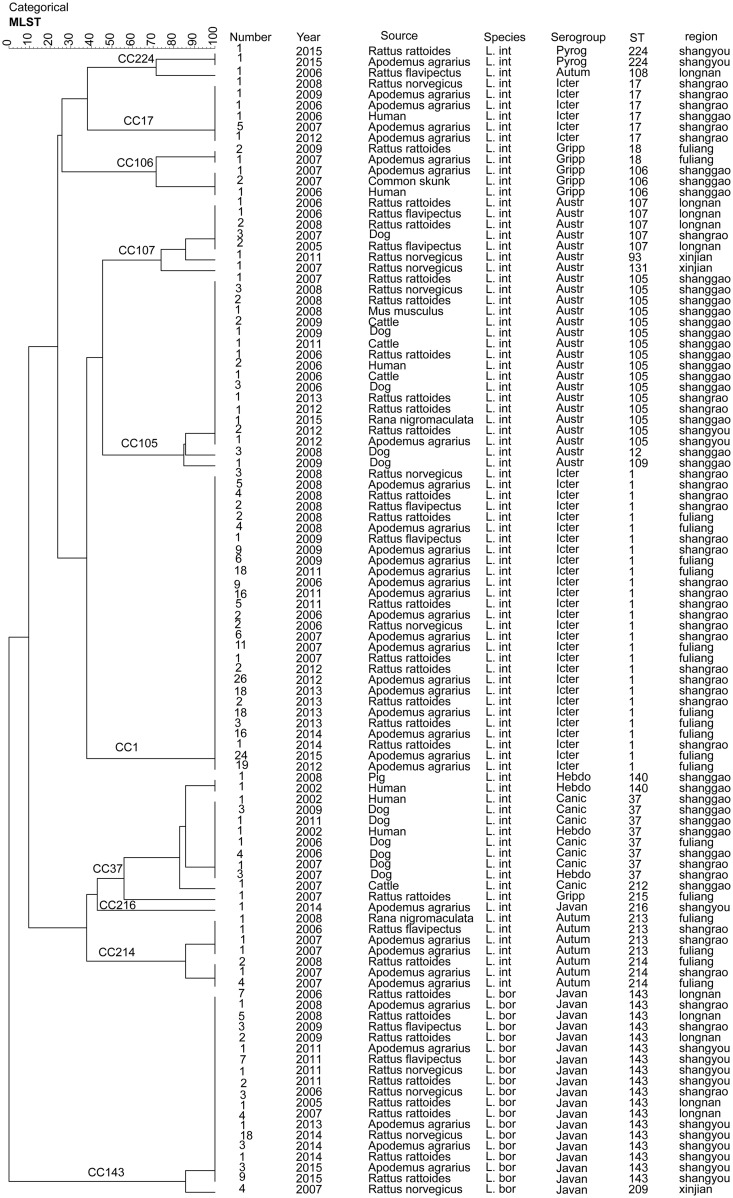
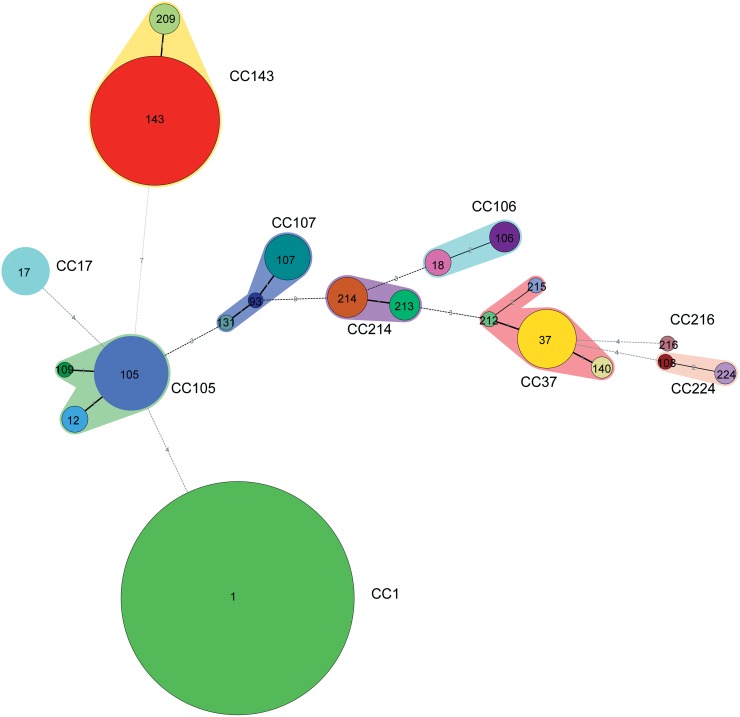
METHODOLOGY/PRINCIPAL FINDINGS: Jiangxi Province, located in southern China, is a region highly endemic for leptospirosis. In this study, among a total of 3,531 trapped rodents dominated by Apodemus agrarius (59.7%), 330 Leptospira strains were successfully isolated from six different sites in Jiangxi between 2002 and 2015. Adding 71 local strains from humans, various kinds of livestock and wild animals in Jiangxi, a total of 401 epidemic strains were characterized using 16S rRNA gene senquencing, multilocus sequence typing (MLST) and the microscopic agglutination test (MAT). Among them, the most prevalent serogroup was Icterohaemorrhagiae (61.10%), followed by Javanica (19.20%) and Australis (9.73%); the remaining five serogroups, Canicola, Autumnalis, Grippotyphosa, Hebdomadis and Pomona, accounted for 9.97%. Species identification revealed that 325 were L. interrogans and 76 were L. borgpetersenii. Moreover, L. interrogans was the only pathogenic species in Fuliang and Shanggao and was predominant in Shangrao (95.0%); L. borgpetersenii was the most common in the remaining three sites. Twenty-one sequence types (STs) were identified. Similarly, ST1 and serogroup Icterohaemorrhagiae were most prevalent in Shangrao (86.0% and 86.4%) and Fuliang (90.4% and 90.4%), ST143 and serogroup Javanica in Shangyou (88.5% and 90.4%) and Longnan (73.1% and 73.1%), and ST105 and serogroup Australis in Shanggao (46.3% and 56.1%). Serogroup Icterohaemorhagiae primarily linked to A. agrarius (86.9%), serogroup Canicola to dogs (83.3%). There were significant differences in the distribution of leptospiral species/serogroups/STs prevalence across host species/collected locations among the 394 animal-associated strains (Fisher's exact test, p<0.001).
CONCLUSIONS/SIGNIFICANCE: Our study demonstrated high genetic diversity of pathogenic Leptospira strains from wild small animals in Jiangxi from 2002 to 2015. A. agrarius was the most abundantly trapped animal reservoir, and serogroup Icterohaemorrhagiae and ST1 were the most dominant in Jiangxi. Significant geographic variation and host diversity in the distribution of dominant species, STs and serogroups were observed. Moreover, rat-to-human transmission might play a crucial role in the circulation of Leptospirosis in Jiangxi. Details of the serological and molecular characteristics circulating in this region will be essential in implementing prevention and intervention measures to reduce the risk of disease transmission in China. However, phylogenetic analysis of more Leptospira isolates should explore the impact of ecological change on leptospirosis transmission dynamics and investigate how such new knowledge might better impact environmental monitoring for disease control and prevention at a public health level.
钩端螺旋体病是全球最重要的被忽视热带细菌病之一。然而,关于野生小型哺乳动物群体中致病性钩端螺旋体的遗传多样性和宿主选择性的信息有限。
方法/主要发现:江西省位于中国南部,是钩端螺旋体病高度流行的地区。在这项研究中,在 2002 年至 2015 年间,总共从 6 个不同地点捕获的以小家鼠(占 59.7%)为主的 3531 只啮齿动物中,成功分离了 330 株钩端螺旋体菌株。加上江西省本地从人类、各种家畜和野生动物中分离的 71 株菌株,使用 16S rRNA 基因测序、多位点序列分型(MLST)和显微镜凝集试验(MAT)共对 401 株流行株进行了特征分析。其中最流行的血清群是伊氏血巴尔通体(61.10%),其次是爪哇型(19.20%)和澳洲型(9.73%);其余五个血清群,即犬型、秋田型、波摩那型、七日热型和黄疸出血型,占 9.97%。物种鉴定显示,325 株为问号钩端螺旋体,76 株为伯氏钩端螺旋体。此外,在富良和上饶,钩端螺旋体是唯一的致病性物种,在上饶占主导地位(95.0%);在其余三个地点,伯氏钩端螺旋体最为常见。共鉴定出 21 种序列型(STs)。同样,ST1 和伊氏血巴尔通体血清群在上饶最为流行(分别为 86.0%和 86.4%)和富良(分别为 90.4%和 90.4%),ST143 和爪哇型血清群在上饶(分别为 88.5%和 90.4%)和龙南(分别为 73.1%和 73.1%)最为常见,ST105 和澳洲型血清群在上饶(分别为 46.3%和 56.1%)最为常见。伊氏血巴尔通体血清群主要与小家鼠(86.9%)相关,犬型血清群与狗(83.3%)相关。394 株动物相关菌株在宿主种类/采集地点的分布中,钩端螺旋体的种/血清群/STs 流行率存在显著差异(Fisher 精确检验,p<0.001)。
结论/意义:本研究表明,2002 年至 2015 年,从江西野生小型动物中分离到的致病性钩端螺旋体菌株具有很高的遗传多样性。小家鼠是最丰富的捕获动物储存库,伊氏血巴尔通体血清群和 ST1 在上饶最为优势。观察到优势种、STs 和血清群的分布存在显著的地理变异和宿主多样性。此外,鼠传人类在江西钩端螺旋体病的传播中可能发挥了重要作用。该地区循环的血清学和分子特征的详细信息对于实施预防和干预措施以降低疾病传播风险至关重要。然而,更多钩端螺旋体分离株的系统发育分析应该探讨生态变化对钩端螺旋体病传播动力学的影响,并研究如何利用这些新知识更好地影响公共卫生层面的疾病控制和预防的环境监测。