Ortiz Rebekka M, Scheperjans Filip, Pekkonen Eero
Department of Neurology, Helsinki University Hospital, Haartmaninkatu 4, 00029 HUS, Helsinki, Finland.
Department of Clinical Neurosciences (Neurology), University of Helsinki, Helsinki, Finland.
BMC Neurol. 2019 Jun 24;19(1):137. doi: 10.1186/s12883-019-1370-y.
Dystonia is a movement disorder substantially affecting the quality of life and the ability to work. A proportion of patients does not respond to first line pharmacotherapy. Deep brain stimulation (DBS) is established as a primary operative treatment option for severe drug resistant dystonia. We studied dystonia patients treated with DBS in Finland between the years 2007-2016 to evaluate the use and outcomes of DBS treatment.
We analysed the hospital records of dystonia patients, who underwent DBS operation during 2007-2016 in Finland. The clinical and technical parameters were recorded as well as preoperative assessments and treatments. The response to DBS was evaluated retrospectively using the Global Dystonia Rating Scale (GDS).
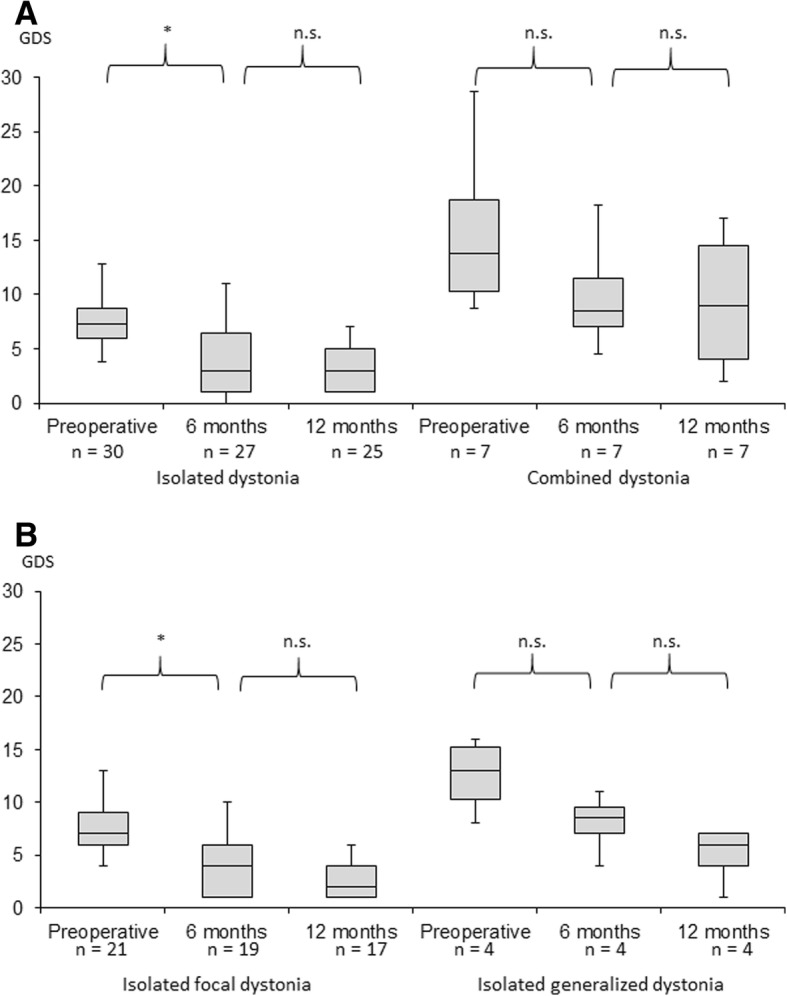
Out of 585 dB implantations during the study period, 37 were done for dystonia. The clinical response improved significantly with time in the isolated focal dystonia group, and at 12 months, 22 of 32 patients had over 50% alleviation of the GDS score. There was only one subclinical intracerebral haemorrhage, and four infections leading to revision. Speech impairment and limb coordination problems were common stimulation- related adverse events and were mostly resolved or relieved with the adjustment of stimulation parameters.
DBS seems to be beneficial in dystonia. Although DBS is indicated for dystonia in Finland, the number of operations did not increase at the same rate as DBS operations in general. DBS appears to be a safe and effective treatment for focal as well as generalized dystonia.
肌张力障碍是一种严重影响生活质量和工作能力的运动障碍。一部分患者对一线药物治疗无反应。深部脑刺激(DBS)已被确立为严重药物抵抗性肌张力障碍的主要手术治疗选择。我们研究了2007年至2016年间在芬兰接受DBS治疗的肌张力障碍患者,以评估DBS治疗的使用情况和疗效。
我们分析了2007年至2016年间在芬兰接受DBS手术的肌张力障碍患者的医院记录。记录了临床和技术参数以及术前评估和治疗情况。使用全球肌张力障碍评分量表(GDS)对DBS的反应进行回顾性评估。
在研究期间的585次DBS植入手术中,有37次是针对肌张力障碍进行的。在孤立性局灶性肌张力障碍组中,临床反应随时间显著改善,在12个月时,32例患者中有22例的GDS评分减轻超过50%。仅发生1例亚临床脑内出血,4例感染导致翻修。言语障碍和肢体协调问题是常见的与刺激相关的不良事件,大多通过调整刺激参数得到解决或缓解。
DBS似乎对肌张力障碍有益。尽管在芬兰DBS被用于治疗肌张力障碍,但手术数量的增长速度与总体DBS手术的增长速度不同。DBS似乎是治疗局灶性和全身性肌张力障碍的一种安全有效的方法。