Moro E, LeReun C, Krauss J K, Albanese A, Lin J-P, Walleser Autiero S, Brionne T C, Vidailhet M
Division of Neurology, CHU de Grenoble, Université Grenoble Alpes, INSERM U1416, Grenoble, France.
Independent biostatistician, Sainte-Anne, Guadeloupe.
Eur J Neurol. 2017 Apr;24(4):552-560. doi: 10.1111/ene.13255. Epub 2017 Feb 10.
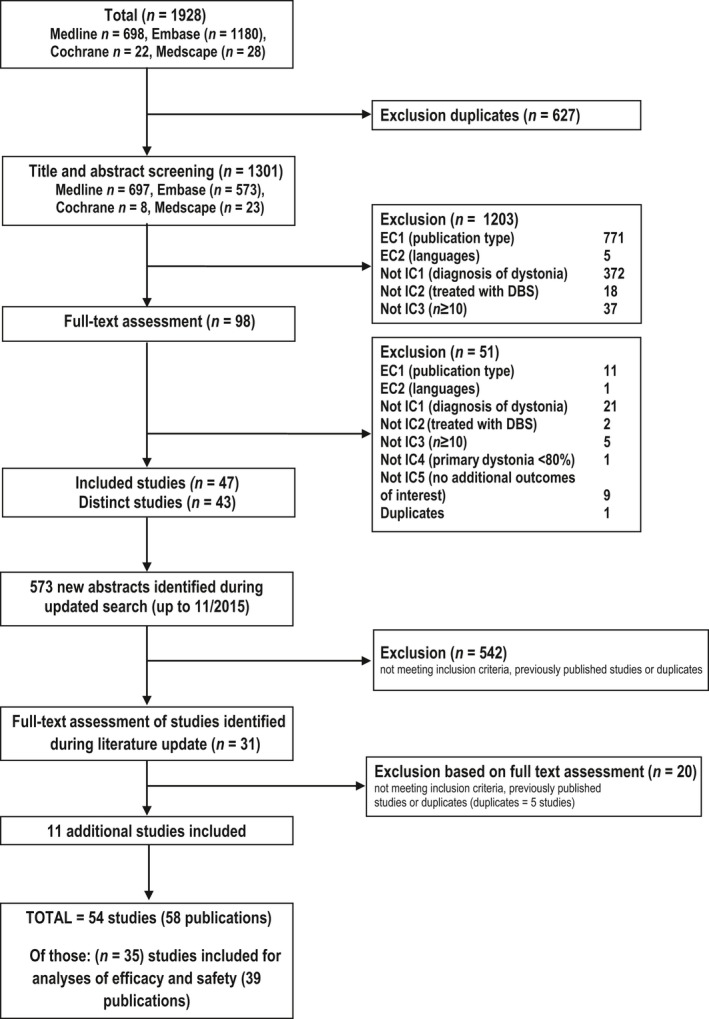
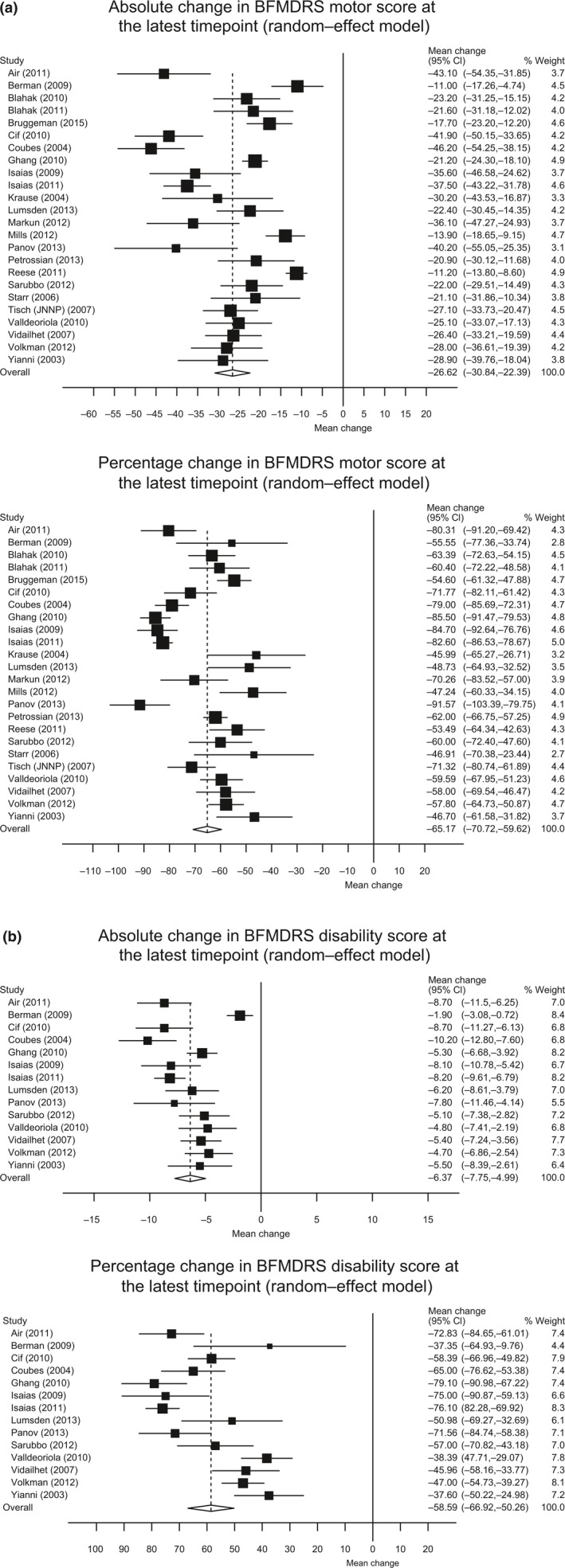
The aim of this review was to provide strong clinical evidence of the efficacy of deep brain stimulation (DBS) of the globus pallidus internus (GPi) in isolated inherited or idiopathic dystonia. Eligible studies were identified after a systematic literature review of the effects of bilateral GPi-DBS in isolated dystonia. Absolute and percentage changes from baseline in the Burke-Fahn-Marsden Dystonia Rating Scale (BFMDRS) motor and disability scores were pooled, and associations between treatment effect and patient characteristics were explored using meta-regression. In total, 24 studies were included in the meta-analysis, comprising 523 patients. The mean absolute and percentage improvements in BFMDRS motor score at the last follow-up (mean 32.5 months; 24 studies) were 26.6 points [95% confidence interval (CI), 22.4-30.8] and 65.2% (95% CI, 59.6-70.7), respectively. The corresponding changes in disability score at the last follow-up (mean 32.9 months; 14 studies) were 6.4 points (95% CI, 5.0-7.8) and 58.6% (95% CI, 50.3-66.9). Multivariate meta-regression of absolute scores indicated that higher BFMDRS motor and disability scores before surgery, together with younger age at time of surgery, were the main factors associated with significantly better DBS outcomes at the latest follow-up. Reporting of safety data was frequently inconsistent and could not be included in the meta-analysis. In conclusion, patients with isolated inherited or idiopathic dystonia significantly improved after GPi-DBS. Better outcomes were associated with greater dystonia severity at baseline. These findings should be taken into consideration for improving patient selection for DBS.
本综述的目的是提供有力的临床证据,证明内侧苍白球(GPi)的深部脑刺激(DBS)对孤立性遗传性或特发性肌张力障碍的疗效。在对双侧GPi-DBS治疗孤立性肌张力障碍的效果进行系统文献综述后,确定了符合条件的研究。汇总了Burke-Fahn-Marsden肌张力障碍评定量表(BFMDRS)运动和残疾评分相对于基线的绝对变化和百分比变化,并使用meta回归探讨了治疗效果与患者特征之间的关联。meta分析共纳入24项研究,涉及523例患者。末次随访时(平均32.5个月;24项研究)BFMDRS运动评分的平均绝对改善和百分比改善分别为26.6分[95%置信区间(CI),22.4 - 30.8]和65.2%(95%CI,59.6 - 70.7)。末次随访时(平均32.9个月;14项研究)残疾评分的相应变化为6.4分(95%CI,5.0 - 7.8)和58.6%(95%CI,50.3 - 66.9)。绝对评分的多变量meta回归表明,术前较高的BFMDRS运动和残疾评分,以及手术时较年轻的年龄,是与末次随访时DBS效果显著更好相关的主要因素。安全性数据的报告经常不一致,无法纳入meta分析。总之,孤立性遗传性或特发性肌张力障碍患者在接受GPi-DBS治疗后有显著改善。更好的治疗效果与基线时更严重的肌张力障碍相关。在改善DBS患者选择时应考虑这些发现。